
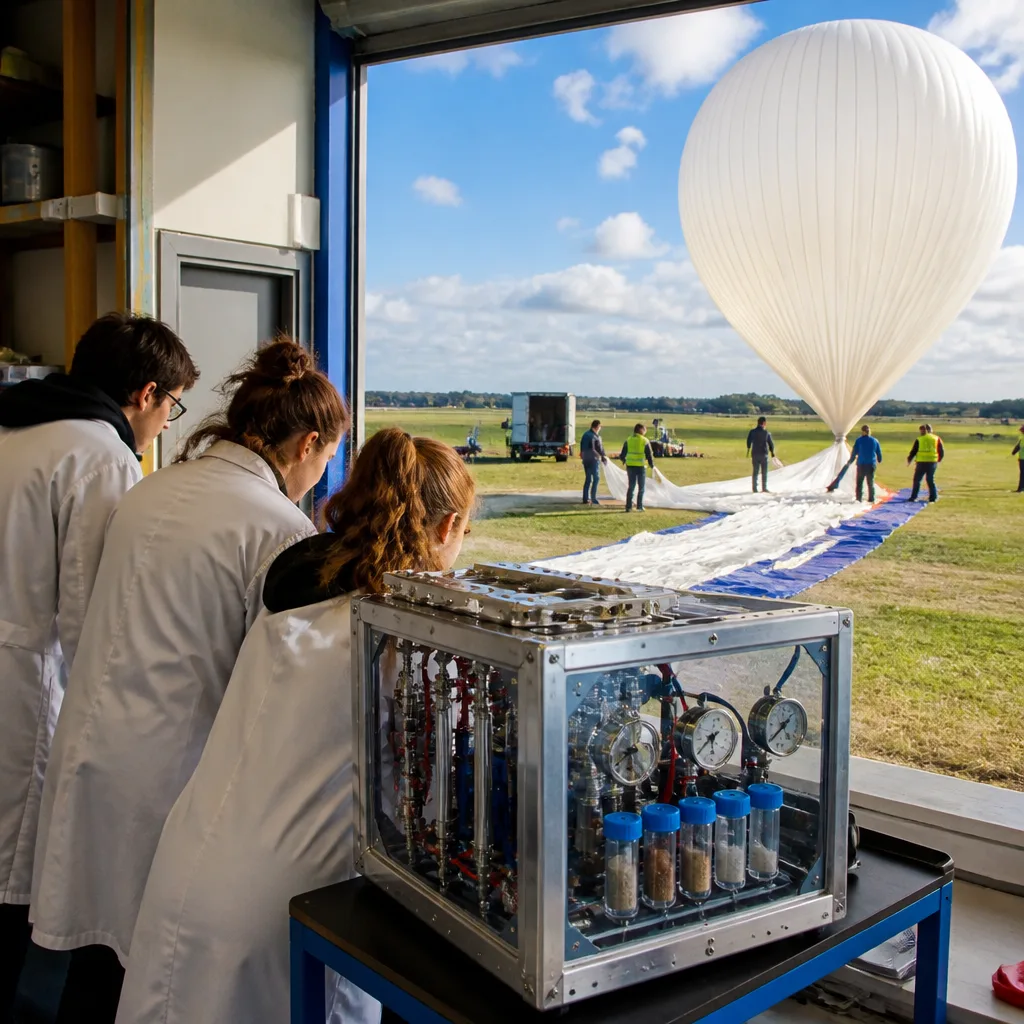
Students from the University of Nottingham have built a compact laboratory that will be carried to the upper stratosphere on a high‑altitude balloon to investigate how space‑like radiation affects human cells. The project, known as HELIA, is the only UK experiment selected for the upcoming flight under the European BEXUS programme.
What the experiment will do
The mini laboratory has been designed to hold human cells in a controlled environment during ascent to as high as the stratosphere so that scientists can isolate the effects of radiation. By stabilising pressure, temperature, humidity and gas composition the students aim to ensure that any cellular changes observed during and after flight can be attributed primarily to ionising radiation rather than to other environmental stressors.
The team will monitor cellular responses in real time using optical readouts that report markers associated with early DNA damage and inflammation. Cells will then be preserved mid‑flight so that a fuller laboratory analysis can be performed after recovery of the payload.
Context: BEXUS and the flight profile
BEXUS (Balloon‑borne Experiments for University Students) is a hands‑on educational programme run jointly by the German Aerospace Center (DLR) and the Swedish National Space Agency (SNSA), in collaboration with the European Space Agency (ESA). It offers student teams the opportunity to fly experiments to the edge of space on stratospheric balloons.
| Parameter | Value |
|---|---|
| Balloon volume | 12,000 m³ |
| Maximum altitude | up to 30 km |
| Typical experiment mass | 40–100 kg |
| Flight duration | 2–5 hours |
Educational and scientific value
Project HELIA brings together students from Engineering, Science and Medicine within the university’s Space Society. Participation required a rigorous design and review process to secure a place on the balloon, indicating the experiment met both technical and scientific standards set by the BEXUS selection panels.
The approach — isolating radiation by holding other variables steady — is a pragmatic way to reproduce a single aspect of the space environment without the cost and complexity of orbital flight. In effect, the payload creates a tiny, mobile tissue culture incubator that briefly visits an environment with substantially increased cosmic and solar radiation compared with ground level.
There are limits: a stratospheric balloon does not replicate microgravity, and the flight window of a few hours constrains the duration over which radiation can act. Nevertheless, by focusing on early biomarkers of damage and inflammation, the experiment targets effects that can appear rapidly after exposure and that provide mechanistic insight into radiation biology.
Implications and next steps
Results from HELIA will help researchers understand initial cellular responses to radiation encountered above most of the atmosphere — data that are relevant for long‑duration human spaceflight and for improving biological models of radiation risk. Post‑flight, the preserved samples will be analysed in laboratory conditions to quantify any molecular or cellular changes detected by the in‑flight optical monitoring.
- Hands‑on training: student engineers and scientists gain systems design, integration and operations experience.
- Scientific return: targeted measurement of early DNA damage and inflammatory signals in human cells exposed to stratospheric radiation.
- Cost‑effective platform: balloon flights allow space‑relevant experiments without the expense and lead time of orbital missions.
Being the only UK team selected for this BEXUS flight underlines the competitive nature of the programme and the maturity of the students’ design. The flight, due to launch from Sweden in October, will place the mini laboratory in an environment that is simultaneously familiar and foreign: like taking a hospital incubator on a day trip to the top of a mountain where the air is thin and the radiation is stiffer.
Careful interpretation will be required after recovery: while balloon flights provide real‑world exposure, they are short and lack microgravity, so conclusions must be framed within those constraints. Nonetheless, this is a clear example of how student‑led projects can contribute usable data to questions about human biology beyond Earth while training the next generation of space researchers and engineers.









