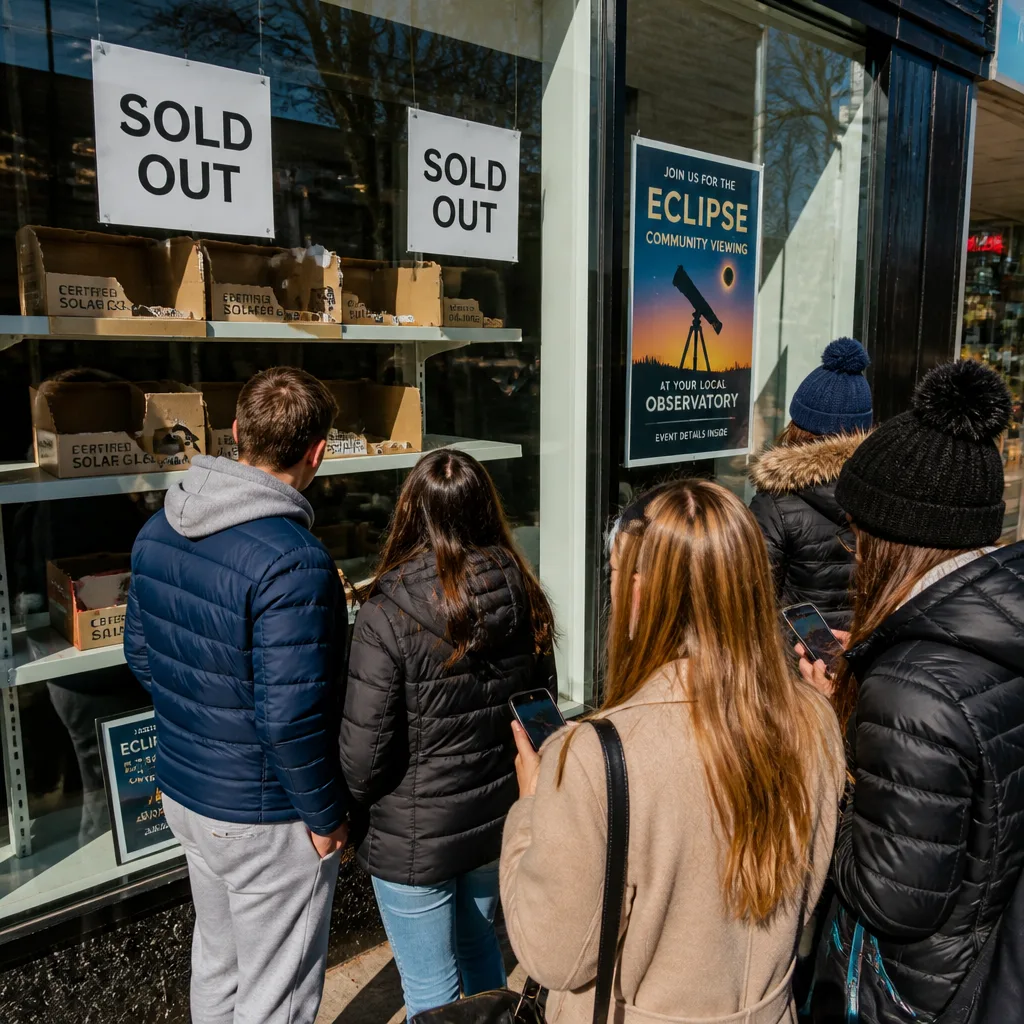
A surge in demand for certified solar-viewing eyewear has left many UK shops and online retailers out of stock just days before a partial solar eclipse on Wednesday, raising safety concerns for people hoping to observe the event.
The Royal Observatory Greenwich said it had exhausted its supply, both in-store and online, after an ‘‘unprecedented volume of orders’’. Ordinary sunglasses are not safe for looking at the Sun and consumer groups have been urging people for weeks to buy specialised eclipse glasses. For many shoppers, however, orders are now arriving too late.
“We have sold out of solar eclipse glasses, both online and in our shops, due to an unprecedented volume of orders.”
Last-minute demand and supply lag
High street chains and internet marketplaces are displaying out-of-stock messages or delivery estimates that miss the eclipse, with some sellers showing projected arrival dates after the event. One widely listed product returned a delivery estimate of Thursday 13 August, a day beyond the eclipse.
Not every supplier is empty-handed. A UK-based astronomy coordinator who imports protective eyewear said he had brought in 300,000 pairs from the United States and had distributed a portion at discount to community groups and clubs. Even so, much of that stock has not reached potential observers in time.
| Metric | Quantity |
|---|---|
| Pairs imported from the US | 300,000 |
| Pairs sent out recently at discount | 100,000 |
Who is affected and what to do
People seeking to watch the partial eclipse face a few options, none without caveats. Some are sharing pairs between family members; others have been told by local opticians that they do not stock the specialised glasses. One shopper from Kent described being told to call back as staff were unwilling or unable to assist.
Experts emphasise that ordinary sunglasses are not a safe alternative. Advice from astronomy groups and consumer specialists has consistently recommended certified solar filters that meet recognised safety standards. With official and commercial stocks depleted in many locations, community and educational groups that received discounted supplies may be among the few with spare pairs to lend or distribute.
- Do not use regular sunglasses to view the Sun — they do not provide sufficient protection.
- Check with local astronomy clubs or community centres; some received discounted packs intended for outreach.
- Avoid makeshift filters or unverified products; obtain certified eclipse viewers when possible.
Context and consequences
The rush to buy certified viewers reflects both public interest in natural phenomena and a tendency to delay preparation for predictable events. One distributor characterised the problem as a timing issue rather than an absolute shortage, observing that many people did not plan ahead. Nevertheless, the immediate effect is that a significant portion of the population will lack safe means to observe the eclipse, increasing the risk of eye injury for those who attempt to watch without proper protection.
In practical terms, the shortage exposes a fragile supply chain for a low-cost but safety-critical product. Even if additional shipments arrive within days, that will do little for people hoping to enjoy this week’s event. For many, the nearest reliable option will be organised public viewings run by astronomy societies who still have access to certified equipment.
With the next comparable eclipse for the UK many decades away, the current scramble serves as a reminder: simple, inexpensive safety equipment can become scarce when public attention spikes suddenly, and planning ahead remains the surest way to avoid disappointment — and danger.