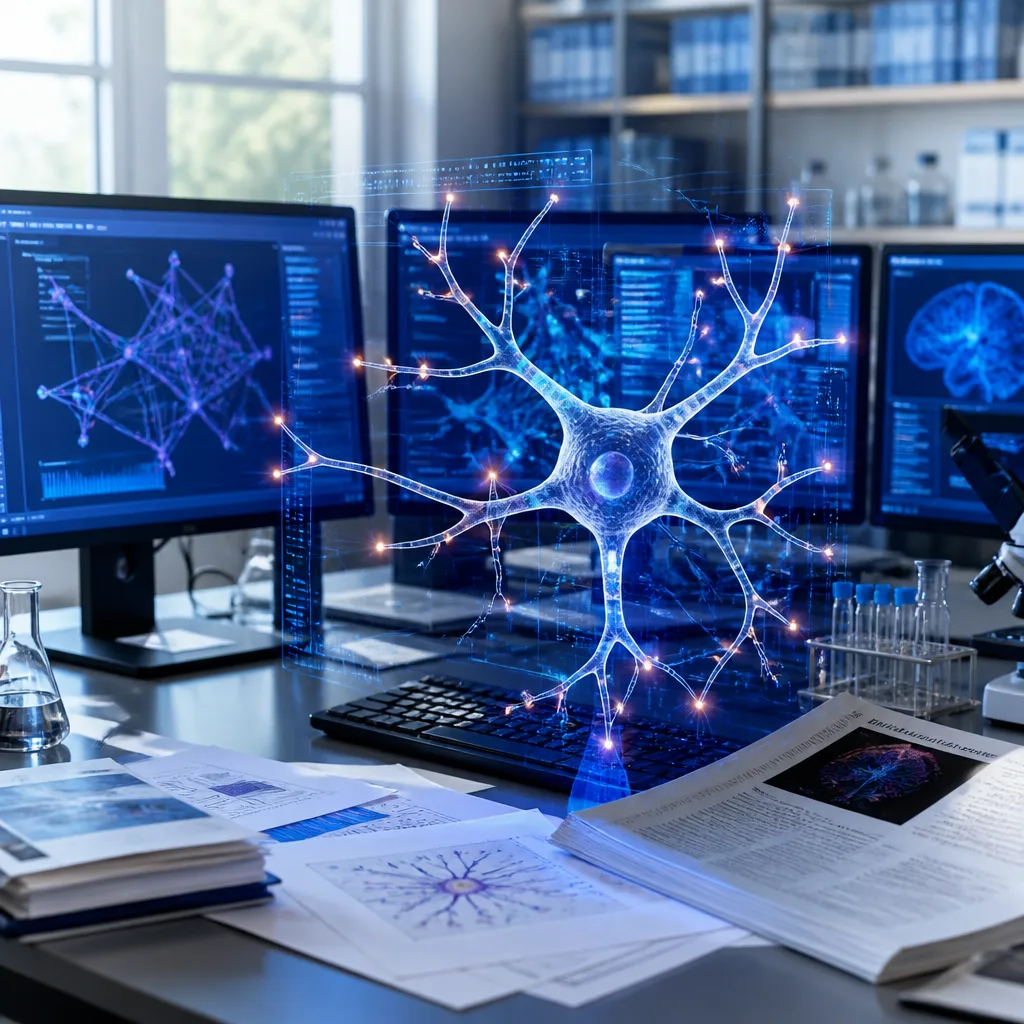
The basic units of the human cortex may be far more computationally capable than neuroscientists have long assumed, according to a study published in the Proceedings of the National Academy of Sciences. Researchers who combined detailed computer modelling with artificial intelligence conclude that single human cortical neurons can perform sophisticated information processing, approaching the complexity of miniature biological computers.
Measuring a neuron's 'computational complexity'
The team, led by researchers at the Hebrew University’s Edmond and Lily Safra Center for Brain Sciences (ELSC), devised a fresh approach to quantify how much computation a single neuron can carry out. Rather than classifying neurons as simple binary switches, they asked how difficult it would be for an advanced artificial neural network (ANN) to learn and reproduce the relationship between the inputs to a cell and the outputs it produces.
Using a combination of high-fidelity modelling and machine‑learning techniques, the investigators trained ANNs to emulate the input–output mapping of individual cortical neurons. The core idea is pragmatic: if an ANN needs a great deal of complexity to mimic a biological cell, then the cell itself must be doing substantial internal processing.
"People often think of a neuron as a simple switch that either turns on or off. What we show is that a single human neuron is itself an extraordinarily sophisticated computing device."
The remark, from Professor Idan Segev of Hebrew University, encapsulates the study’s challenge to a long-standing simplification in neuroscience. The experimental group included Professors Idan Segev and Mickey London, PhD students Ido Aizenbud and Daniela Yoeli, and a collaborator, Professor Chris de Kock of the Free University, Amsterdam.
What the findings mean
The results imply that some of the human brain’s distinctive capacities — language, abstract thought, mathematics, imagination — might be explained not only by sheer neuron number and connectivity, but also by more powerful processing at the level of individual cells. If a single neuron can implement complex transformations of incoming signals, the brain’s computational economy changes: fewer cells, or simpler networks, may be required to achieve sophisticated behaviours.
The study does not claim to have solved how language or creativity arise. Rather, it supplies a plausible mechanistic contribution: the elementary building blocks of the cortex themselves possess nontrivial computing capability. That shifts a piece of explanatory weight from macroscopic architecture down to the cellular scale.
Method and caution
Key to the work was the novel metric of computational complexity. By training ANNs to replicate neuronal input–output functions and quantifying the difficulty of the task, the authors produced an operational measure of what a neuron computes. This is complementary to more traditional laboratory techniques and offers a route to compare human neurons with those of other mammals.
As ever with computational neuroscience, interpretation requires care. The ANN’s difficulty in emulating a neuron depends on model choices, the nature of the inputs supplied, and the biophysical detail retained in the simulated cell. The paper situates its claims within these technical boundaries and reports findings as a step towards reframing how neuroscientists think about neuronal function, not as a definitive account of human cognition.
Practical consequences may follow for brain-inspired computing. If single neurons embody richer computations, then biologically inspired hardware and algorithms might exploit more complex unit behaviour rather than relying solely on large artificial networks of simple units.
- Study published in: Proceedings of the National Academy of Sciences (PNAS)
- Lead institutions: Hebrew University, Edmond and Lily Safra Center for Brain Sciences; collaboration with Free University, Amsterdam
- Approach: Biophysical neuronal modelling combined with AI (ANN) training to quantify input–output complexity
| Team members | Affiliation |
|---|---|
| Idan Segev | Hebrew University (ELSC) |
| Mickey London | Hebrew University (ELSC) |
| Ido Aizenbud | PhD student, Hebrew University |
| Daniela Yoeli | PhD student, Hebrew University |
| Chris de Kock | Free University, Amsterdam |
Further experimental work and cross‑species comparisons will be needed to map how widespread such cellular complexity is across animals, and how it scales with behaviour. For now, the study offers a precise, testable claim: the human cortex’s microcomponents may do considerably more of the heavy cognitive lifting than previously recognised.