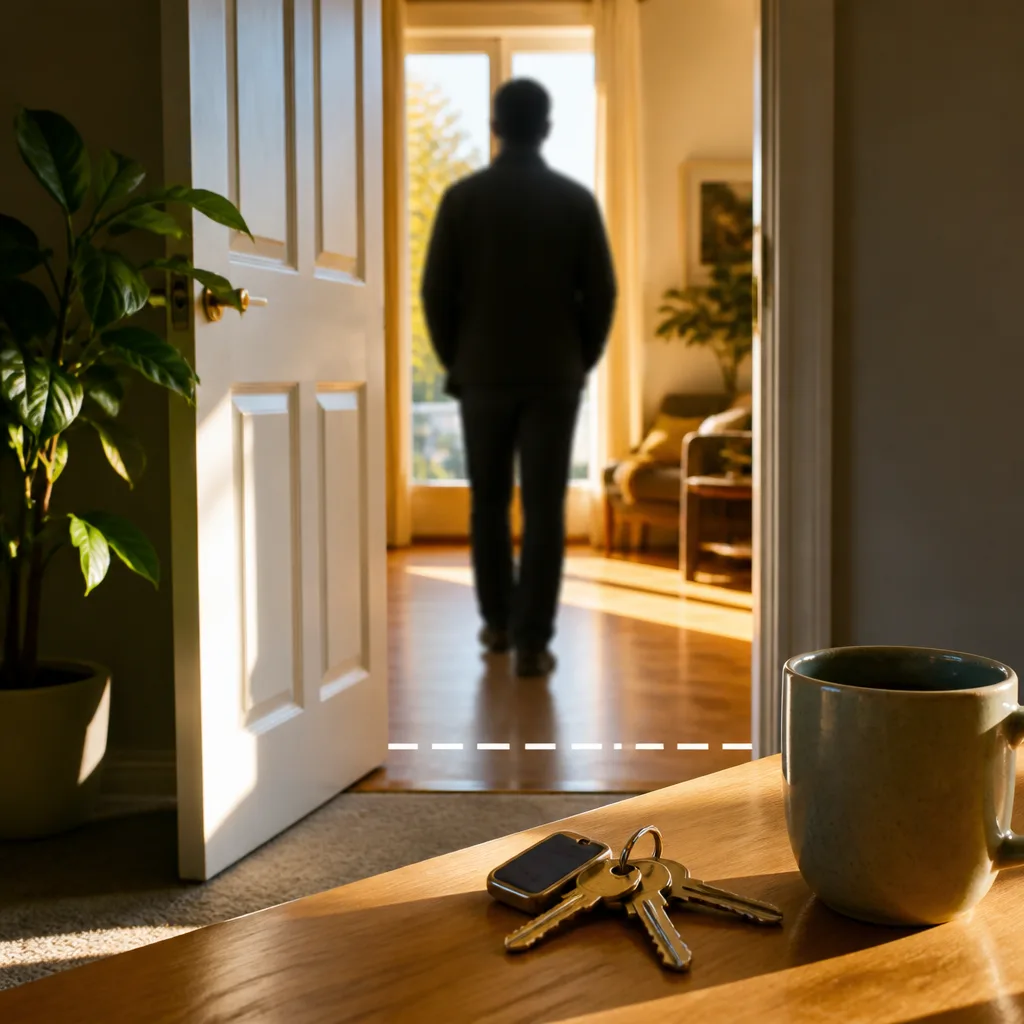
Walking purposefully into a room, pausing and asking yourself why you came in — then frantically retracing your steps — is a familiar irritation. Researchers argue this commonplace lapse is not a harbinger of dementia but a normal feature of how the brain organises experience. Experimental work points to physical boundaries, such as doorways, acting as cognitive separators that can cause short‑term forgetting.
What the experiments show
Investigators at the University of Notre Dame examined memory for objects and actions when people either moved between locations or remained within the same space. The team reported that participants were more likely to forget what they were holding or doing after they had crossed a boundary — a doorway — than after walking the same distance without changing rooms.
The effect has been given a name in the literature: the Doorway Effect. The researchers interpret a doorway as an "event boundary" that prompts the brain to segment continuous experience into separate mental models. In plain terms, passing through an opening looks to the mind like the end of one episode and the start of another; information judged no longer relevant to the new episode can be dropped from active memory.
"segment experience into separate event models"
Why the brain does this
This is not portrayed as a malfunction but as an organisational strategy. Cognitive systems face a constant stream of incoming information and must decide what to keep in focus for immediate use. Treating a doorway as a cut‑point helps the brain catalogue activity by context: certain tasks are bound to particular places and environments, so memory prioritisation follows location cues.
The pragmatic consequence is that intentions tied to one context — for example, "pick up the stapler" in the living room — risk being deprioritised when you step into a different context. The mind effectively resets its short‑term workspace at the threshold and, if the original goal is not sufficiently cued in the new location, the reason for having entered may slip away.
Factors that increase the effect
Existing research also indicates this phenomenon can be amplified by tiredness. Earlier studies have shown that poor sleep impairs short‑term memory, which would make the Doorway Effect more pronounced for someone who is sleep‑deprived. Importantly, while chronic poor sleep is linked to longer‑term memory problems, the doorway‑linked lapses themselves are not, on their own, a sign of dementia.
- Context change: Moving through a doorway signals the brain to treat experience as a new event.
- Memory pruning: The mind sheds information judged irrelevant to the new episode.
- Sleep status: Reduced sleep can worsen short‑term memory and thus magnify the effect.
Practical takeaways
For most people, the Doorway Effect is an everyday quirk of cognition rather than a medical concern. Simple strategies that preserve or re‑cue the original intention — for example, repeating the task aloud, carrying a visual reminder, or pausing to re‑state your goal on entering — should reduce the chance the brain will discard the information at the threshold.
| Condition | Likely memory outcome |
|---|---|
| Crossing a doorway | Higher chance of forgetting the immediate intention |
| Walking same distance within one room | Lower chance of forgetting |
Far from being a sign of catastrophic decline, these episodes serve as a reminder that our memories are organised around events and places. Understanding that the brain prefers tidy parcels of experience may not stop the occasional blank, but it does reframe that blank as a predictable consequence of an otherwise efficient system.