
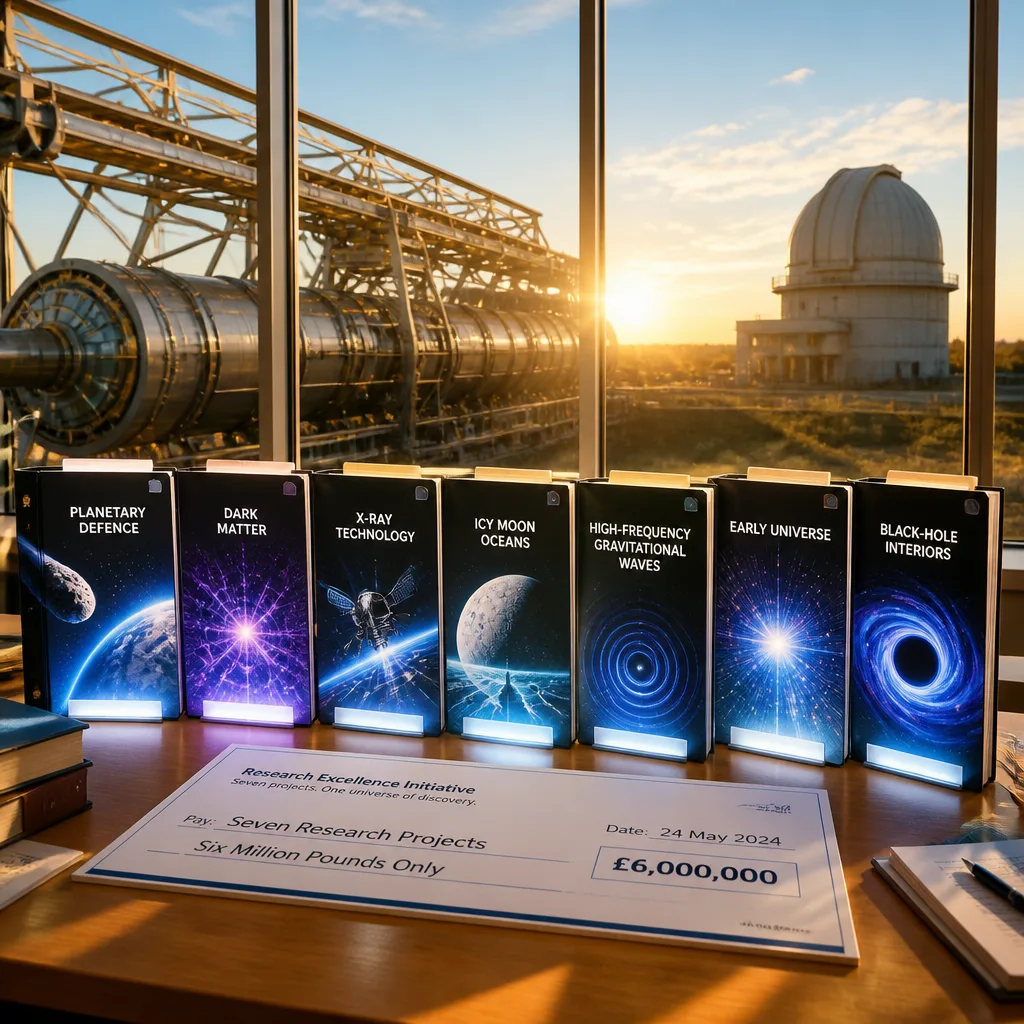
The Science and Technology Facilities Council (STFC) has awarded seven early‑career researchers the 2025 Ernest Rutherford Fellowship, providing a combined investment of about £6 million to enable each fellow to lead an independent research programme at a UK university during the fellowship period.
Scope of the new cohort
The successful proposals span a wide range of fundamental physics and astronomy topics. According to STFC, the 2025 cohort will work on projects that include:
- planetary defence
- searches for dark matter at the Large Hadron Collider
- new X‑ray technology
- investigations of the hidden oceans of icy moons
- high‑frequency gravitational waves
- studies of the Universe’s earliest moments
- the internal structure of black holes
STFC said the programme, now in its 16th consecutive year, has supported more than 100 early‑career researchers, several of whom have progressed to permanent positions within UK research institutes.
Selection and support
STFC described this year’s selection as competitive. Professor Grahame Blair, Executive Director of Programmes at STFC, highlighted the breadth of the subjects chosen and the challenge of selecting from a strong field of applicants. He said:
“Reading through the proposals from this year’s Ernest Rutherford applicants, what stands out is the range of questions our early‑career researchers are choosing to take on, from the origins of the Universe to the physics of what happens inside a black hole. We had a strong field of applicants this year, which made the selection process a difficult one. I’d like to congratulate the 2025 Ernest Rutherford Fellows, and I look forward to seeing where their research takes them.”
Each fellow will lead an autonomous research programme at a UK university for the duration of the award. The fellowships are one of the principal routes by which the UK supports nascent independent researchers in particle physics, astronomy and nuclear physics — fields in which sustained, long‑term investment and access to large facilities are often essential.
Examples from the cohort
STFC provided a short profile for at least one of the new fellows. Dr Aleksandra Sokolowska, based at The University of Glasgow, will work on planetary phenomena described as “SPACEFORCE: studying planetary airbursts and cratering: explosions and fluxes from objects resulting in catastrophic events.” The outline emphasises that, although Earth’s atmosphere typically shields the planet by fragmenting smaller incoming bodies, larger objects can still cause significant damage.
| Research theme | Area addressed (as stated by STFC) |
|---|---|
| Planetary defence | Planetary airbursts and cratering, including catastrophic impacts |
| Dark matter | Searches at the Large Hadron Collider |
| X‑ray technology | Development of new instrumentation |
| Icy moons | Investigating hidden oceans |
| Gravitational waves | High‑frequency signals |
| Early Universe | Probing the earliest moments after the Big Bang |
| Black holes | Internal structure and physics inside black holes |
The announcement underlines both the diversity of fundamental questions being pursued in UK physics and the continuing role of targeted fellowships in building research capability. For early‑career scientists, such awards provide time, resources and institutional standing to establish independent groups — often a critical step towards permanent academic posts.
Looking ahead, the fellowships will be judged by their scientific outputs and the subsequent career trajectories of the awardees. Given the historic record of the scheme — supporting more than 100 researchers over 16 years — this cohort’s work will be watched closely by UK research funders and the institutions hosting them, as well as by international collaborators in areas such as particle physics and planetary science.









