
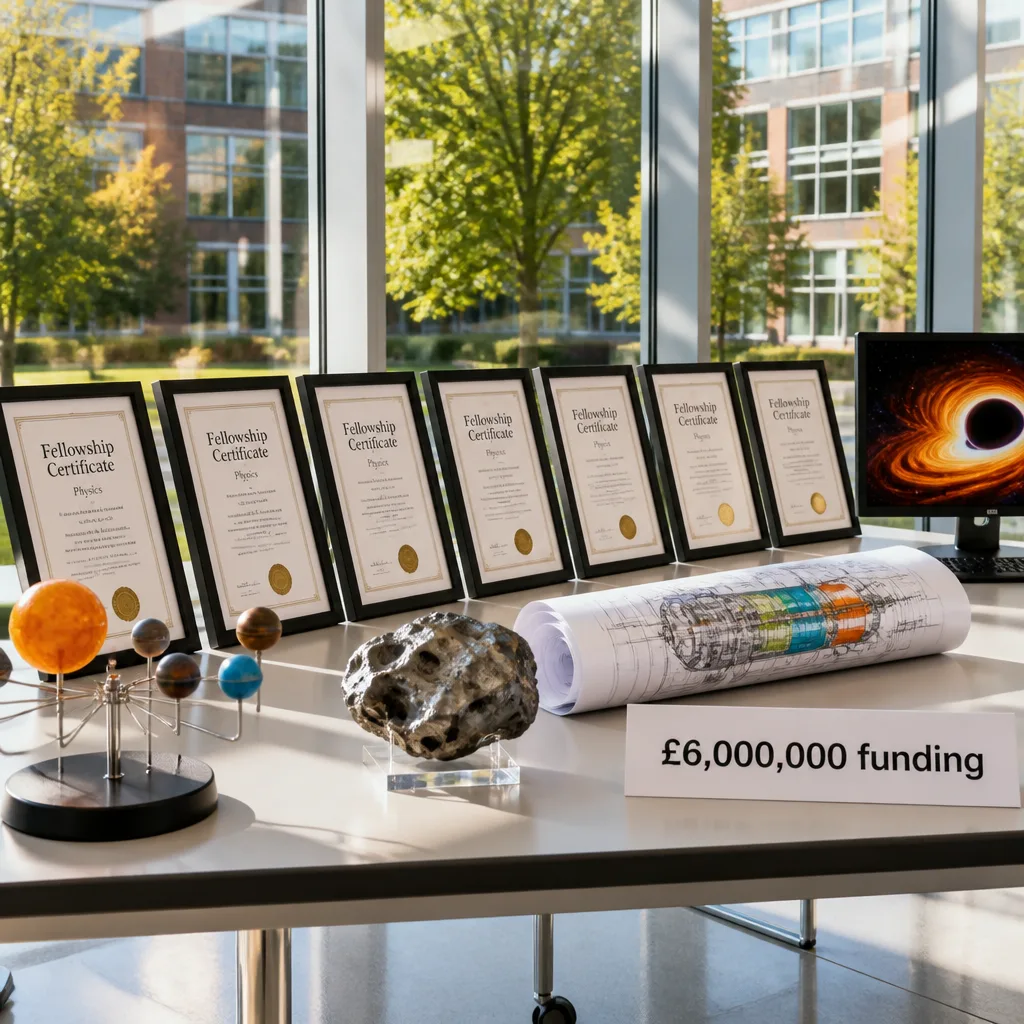
The Science and Technology Facilities Council (STFC) has appointed seven researchers to the 2025 Ernest Rutherford Fellowship scheme, providing a total investment of £6 million to support independent research programmes at UK universities.
Fellowships aimed at fast-tracking research leaders
The Rutherford fellowship is one of the principal routes for early-career physicists to establish independent research in areas such as particle physics, astronomy and nuclear physics. The 2025 cohort will pursue projects ranging from planetary defence to investigations of black hole interiors and the earliest moments of the Universe.
"Reading through the proposals from this year’s Ernest Rutherford applicants, what stands out is the range of questions our early-career researchers are choosing to take on, from the origins of the Universe to the physics of what happens inside a black hole," said Professor Grahame Blair, Executive Director of Programmes at STFC.
The fellows will each lead their own research programme at a UK university for the duration of the award, which is designed to help researchers build a track record and move into permanent academic positions. Now in its 16th consecutive year, the scheme has supported more than 100 early-career researchers, several of whom have taken up permanent roles in UK research institutes.
Research themes and national capability
The topics selected by the 2025 fellows highlight the breadth of the UK’s ambitions in fundamental physics and space science. The projects named in the announcement include work on:
- Planetary defence — studying atmospheric airbursts and cratering from hazardous objects;
- Dark matter searches at the Large Hadron Collider;
- New X‑ray technology for astrophysical observation;
- Subsurface oceans of icy moons — probing their hidden interiors;
- High‑frequency gravitational waves — targeting signals from early cosmic epochs;
- Early Universe physics — investigations of the Universe’s first moments;
- Internal structure of black holes — theoretical and observational studies.
Only one fellow was named in the body of the announcement: Dr Aleksandra Sokolowska of the University of Glasgow, who will pursue a project titled SPACEFORCE focused on planetary airbursts and cratering.
| Metric | Value |
|---|---|
| Number of fellows | 7 |
| Investment | £6 million |
| Years programme active | 16 |
| Researchers supported to date | 100+ |
Why this matters
Fellowships of this kind perform several practical functions for the UK research ecosystem. They provide salary and project funding that allows early‑career scientists to establish a research group, hire students and postdocs, and build a publication and grant record. That, in turn, strengthens the pipeline of talent available to universities, national laboratories and collaborations such as those at CERN.
By supporting work on planetary defence and instrument development alongside fundamental theoretical and experimental physics, the awards also balance curiosity‑driven science with capabilities that have societal relevance — for example improving our understanding of impact hazards or advancing observational technologies.
STFC said this year’s selection process was competitive, with a strong field of applicants. The council’s continued backing underlines government and sector confidence in maintaining the UK’s presence in key international physics programmes and in nurturing the next generation of research leaders.
Recipients will take up their fellowships at universities across the UK and begin work on their projects as set out in their awarded proposals.









