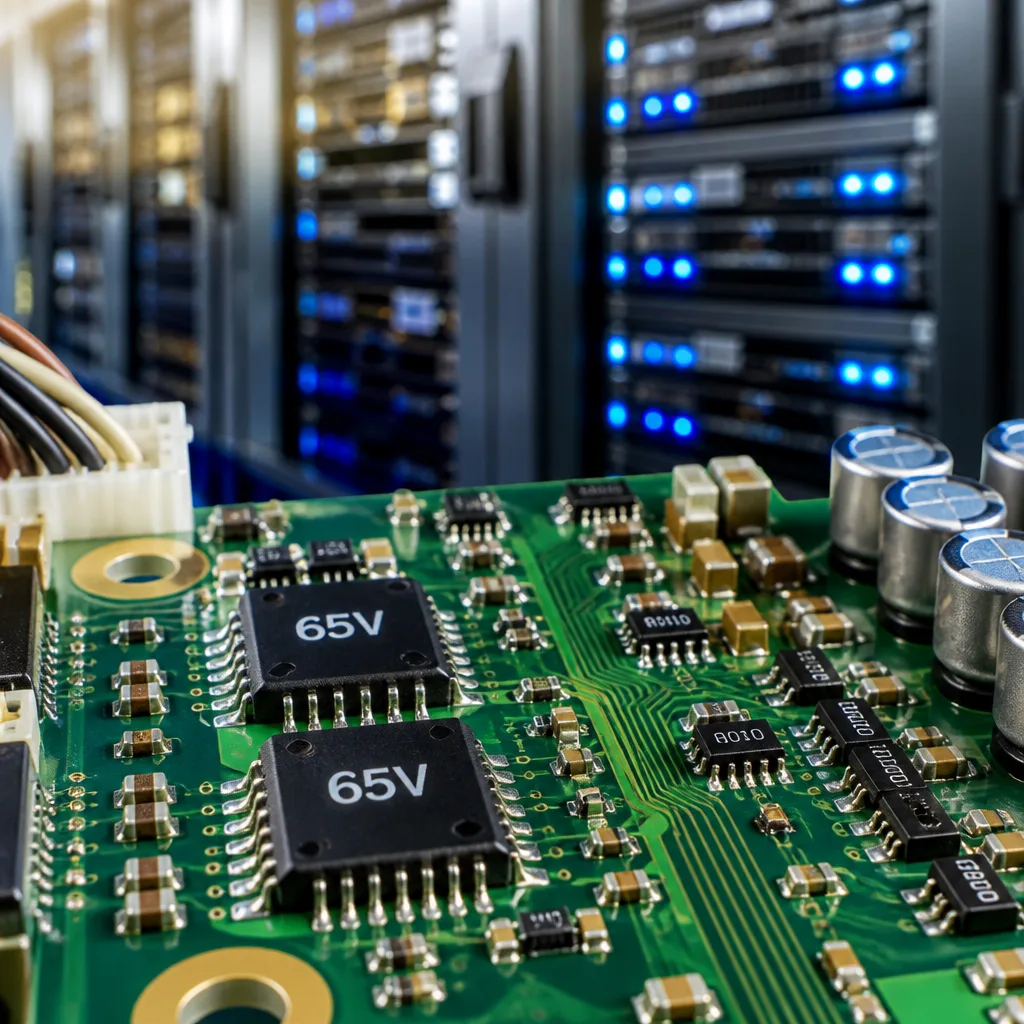
Microchip Technology has unveiled two new families of digital power monitors designed for higher-voltage environments, a move that explicitly targets 48V power architectures used across data centres, AI infrastructure, networking, industrial and automotive systems.
What Microchip has released
The company introduced the PAC1761 and PAC1861 families of 65V power monitors. According to Microchip, the devices combine increased voltage headroom with spike protection and energy-aware monitoring functions. The firm says these features will help equipment makers tune efficiency, manage power excursions and ease redesign risk through pin-compatible options and supplied software tools.
Why the move matters
The announcement matters because the industry is shifting in places from traditional low-voltage rails towards 48V distribution on racks and in telecom, PoE, server and industrial gear. Higher-voltage distribution can reduce currents for a given power level, potentially lowering losses and cable mass. But it also raises design challenges around transient protection and accurate energy measurement — gaps Microchip is explicitly seeking to address with these monitors.
- 65V headroom gives more margin for spikes and switching transients compared with lower-voltage monitors.
- Energy-aware analytics aim to provide actionable data for efficiency optimisation and anomaly detection.
- Pin compatibility and software tools are intended to shorten evaluation cycles and reduce redesign work for customers.
Context: where this fits in Microchip's strategy
The launch reinforces Microchip’s positioning in power-management and mixed-signal chips that sit at the intersection of industrial, automotive and data-centre demand. For investors and customers alike, the critical test will be whether the company can convert design wins and evaluation activity into sustained volume shipments. Microchip itself, and industry analysts, point to AI and data-centre projects as future revenue drivers — but execution depends on foundry capacity, packaging and how quickly customers standardise around 48V approaches.
Microchip’s new parts do not alter the company’s immediate financial outlook on their own. They are, however, a tactical product-level move that aligns with broader trends in higher-voltage power distribution for compute-dense environments.
Potential benefits and limitations
Manufacturers of racks and telecom equipment will judge the monitors on several practical criteria beyond the basic spec sheet: integration complexity, software maturity, long-term reliability in noisy power environments and the real-world quality of spike protection. Energy-aware monitoring only becomes useful if the analytics can be tied into system-level controls or operations workflows that deliver tangible savings or improve uptime.
| Item | Detail |
|---|---|
| Models announced | PAC1761, PAC1861 |
| Voltage capability | 65V headroom, aimed at 48V systems |
| Primary targets | Data centres, AI, networking, industrial, automotive, telecom/PoE |
| Notable features | Spike protection, energy-aware monitoring, pin-compatible options, software tools |
Those assessing the announcement should also weigh it against Microchip’s broader operational backdrop. The company must manage inventory levels and convert engineering momentum into shipped products while navigating foundry and packaging constraints that affect the entire semiconductor supply chain.
Where this could lead
If industry adoption of 48V distribution expands, components that reliably measure and protect in that envelope will become more valuable. That could open opportunities for suppliers of power-management silicon and associated software. The commercial outcome will depend on customers’ willingness to redesign around 48V, the comparative cost and performance benefits, and how quickly the ecosystem — connectors, power supplies and monitoring — standardises.
At present, Microchip’s announcement is a technical and strategic signal rather than a market-moving revelation. It highlights a clear direction in which compute and power-distribution design are evolving, and it underlines the kinds of product-level innovation required to make that transition workable for system builders.