
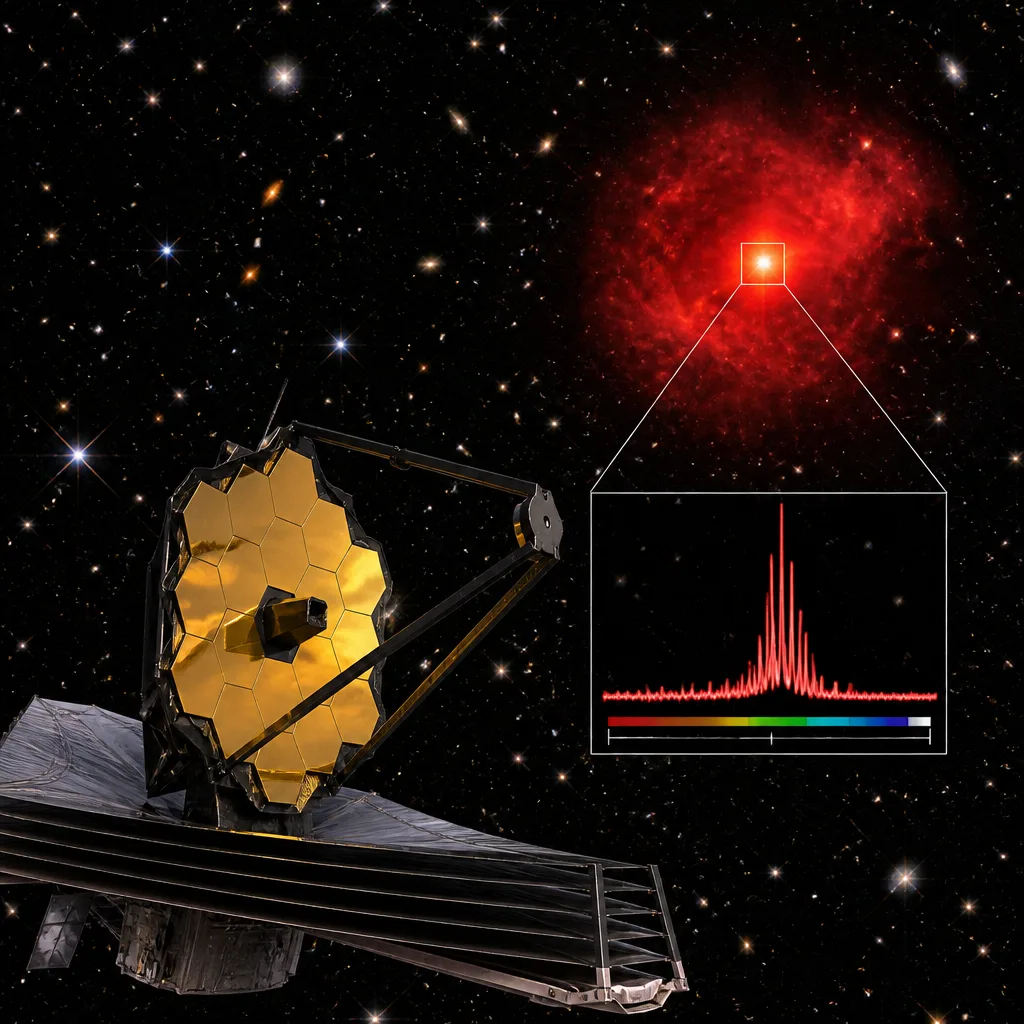
Astronomers using the James Webb Space Telescope (JWST) say they have identified a novel astrophysical object: a compact source that displays the spectral signs of a star while releasing energy more typical of a black hole. The object, catalogued as MoM-BH*-1, is located in the constellation Cetus and is reported to lie roughly 30 billion light years from Earth, forming about 660 million years after the Big Bang.
What the team found and how
The discovery follows analysis of an unusually red point in JWST imaging. The team, led in part by researchers at the Kavli Institute for Astrophysics and Space Research at MIT, examined the object's spectrum and broad-band colours and compared them with models of known sources. They found a combination of characteristics that cannot be comfortably assigned to any previously established class of object.
Most strikingly, the inferred luminosity of the source is enormous — the signal corresponds to an energy output the researchers say is about 100 billion times greater than any ordinary star can produce. At the same time, the object's light shows features typically associated with stellar atmospheres rather than the classical power-law spectra of unobscured accreting black holes.
“We have found a new type of astrophysical object, a black hole star,” said Dr Rohan Naidu of the Kavli Institute for Astrophysics and Space Research. It “shines with the energy typically associated with black holes, but at the same time bears signatures classically associated with stars.”
To reconcile those facts the researchers applied radiative-transfer and cosmological formation simulations. Their favoured interpretation is of a massive black hole enshrouded in dense, optically thick gas. That gas absorbs energetic photons produced by accretion and reprocesses them so that the emergent spectrum resembles that of a very bright, red-hued star.
Why this matters
If confirmed, the finding would expand the taxonomy of early-universe objects and affect how astronomers interpret faint, red point sources in deep JWST fields. The team suggests that many of the so-called Little Red Dots (LRDs) ubiquitous in JWST deep surveys might be similar objects — black holes whose accretion flows are cloaked in thick gas and dust so they mimic stellar spectra.
- Object name: MoM-BH*-1
- Distance: ~30 billion light years
- Formation epoch: ~660 million years after the Big Bang
- Apparent energy output: ~100 billion times that of known stars
Translated into observational practice, the result cautions that photometric classification alone — colours and apparent morphology — may misidentify some accreting black holes as extremely luminous stars in the first billion years of cosmic history.
| Property | Reported value |
|---|---|
| Catalogue | MoM-BH*-1 |
| Distance | ~30 billion light years |
| Epoch after Big Bang | ~660 million years |
| Energy compared with stars | ~100 billion times greater |
Uncertainties and next steps
The interpretation rests on the synthesis of imaging, spectral break features and simulations; it is not a direct, unambiguous measurement of a black hole. The authors acknowledge that alternative explanations must be tested and that robust confirmation requires follow-up observations — for example, deeper spectroscopy to resolve emission or absorption lines, variability studies to probe accretion behaviour, and multi-wavelength data that can pierce the surrounding shroud.
Moreover, the cosmological distance quoted is derived from the red colour and spectral break characteristic of early-universe objects; such photometric redshifts carry systematic uncertainties that the team will need to quantify further. If other LRDs are the same class of object, a population study will be required to assess their abundance and their role in the early growth of black holes and galaxies.
The discovery, published in Nature, underscores JWST’s capacity to reveal unexpected phenomena at the cosmic frontier. Whether black hole stars become a firmly established class or an intriguing one-off, the claim is a reminder that the universe still has the capacity to surprise even in regimes thought to be well explored.









