
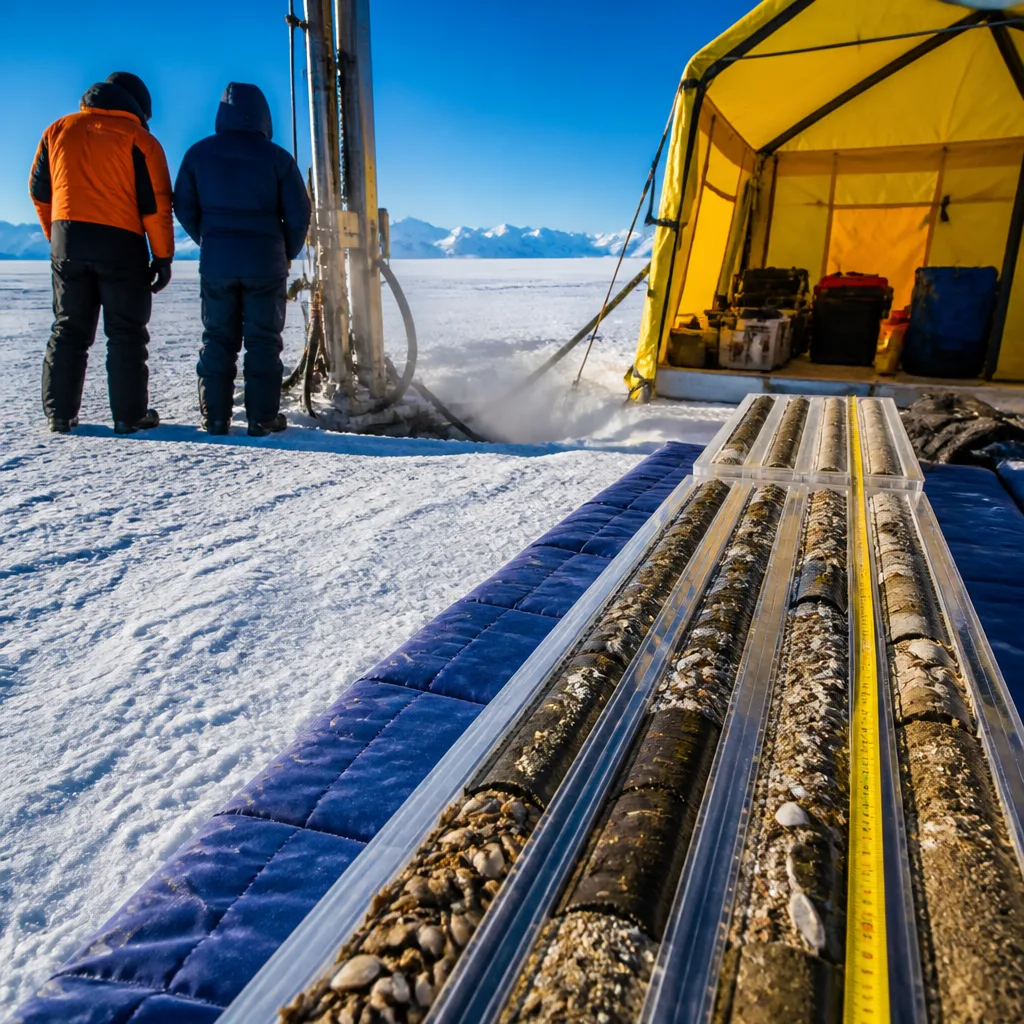
An international research team has recovered a record-length sediment core beneath West Antarctica that contains fragments of shell and other remains of organisms that need sunlight to live, indicating that at times the area now covered by thick ice was once open to the sky.
What the expedition found
Scientists used a hot-water drill at Crary Ice Rise, a grounded dome at the inner edge of the Ross Ice Shelf, to melt through 523 metres of ice (about 1,716 feet) and then extract a continuous sediment column from beneath. The drilling returned a core of mud, gravel and rock measuring 228 metres in length (about 748 feet) — a depth the team says exceeds previous Antarctic sub-ice sediment recoveries by a large margin.
The material contains a mix of deposits. Some layers match sediments typically formed beneath an ice sheet like that which currently overlies Crary Ice Rise; other intervals contain remains of marine organisms that require light, implying episodes when the surface above was open water rather than thick ice.
“To our knowledge, the longest sediment cores previously drilled under an ice sheet are less than ten metres. We exceeded our target of 200 metres. This is Antarctic frontier science.”
The quote comes from co-chief scientist Molly Patterson of Binghamton University, who led the operation and described the variability within the recovered sequence.
Interpreting light-dependent remains
The presence of organisms that depend upon sunlight should not be read as evidence of a modern, rapid ice collapse. Instead, the fossilised remains are a stratified record of past environments — a vertical archive laid down through successive periods of different conditions. The team has refined the ages of the sedimentary layers, but the precise timing, duration and rates of ice retreat recorded by the core still require further detailed analysis.
The scientific value lies in the diversity of the core. As the researchers stress, the sequence does not present a single uniform history; it shows alternating intervals consistent with both ice-covered and ice-free conditions at different times. That variability gives palaeoclimatologists material with which to test models of ice-sheet dynamics and of ocean–ice interactions in past climates.
Why this matters
Recovering such a long sedimentary record from beneath an ice sheet is significant for three key reasons:
- It provides direct geological evidence for past open-water conditions at a site now buried beneath substantial ice.
- It supplies a stratified archive that can constrain the timing and character of past ice retreat and advance.
- It offers material to compare with numerical models of ice-sheet response to climatic forcing, improving understanding of possible rates and patterns of collapse.
However, the core itself does not quantify how quickly the modern West Antarctic Ice Sheet might change in the future. The authors and associated institutions warn that disentangling when particular layers formed — and whether those intervals corresponded to brief pulses of retreat or long-standing open-water conditions — is a task for subsequent study.
| Parameter | Value |
|---|---|
| Ice thickness melted through | 523 m (~1,716 ft) |
| Length of sediment core recovered | 228 m (~748 ft) |
Scientists will now apply geochronology, palaeoecological analysis and sedimentological study to the core to develop a timeline of environmental change. These follow-up analyses are essential before the record can be used to draw robust conclusions about the rates of ice loss in past warm periods — and what that might, or might not, imply for the coming decades.
Although the finding cannot be used directly to forecast near-term sea-level rise, it does rewrite elements of regional Antarctic history and opens new avenues for testing how ice sheets have behaved under previous climatic conditions. For policymakers and model developers, the new data will be a valuable constraint; for the wider public, it is a reminder that the Antarctic continent has a complex and changeable past encoded in sediments now revealed beneath the ice.









