
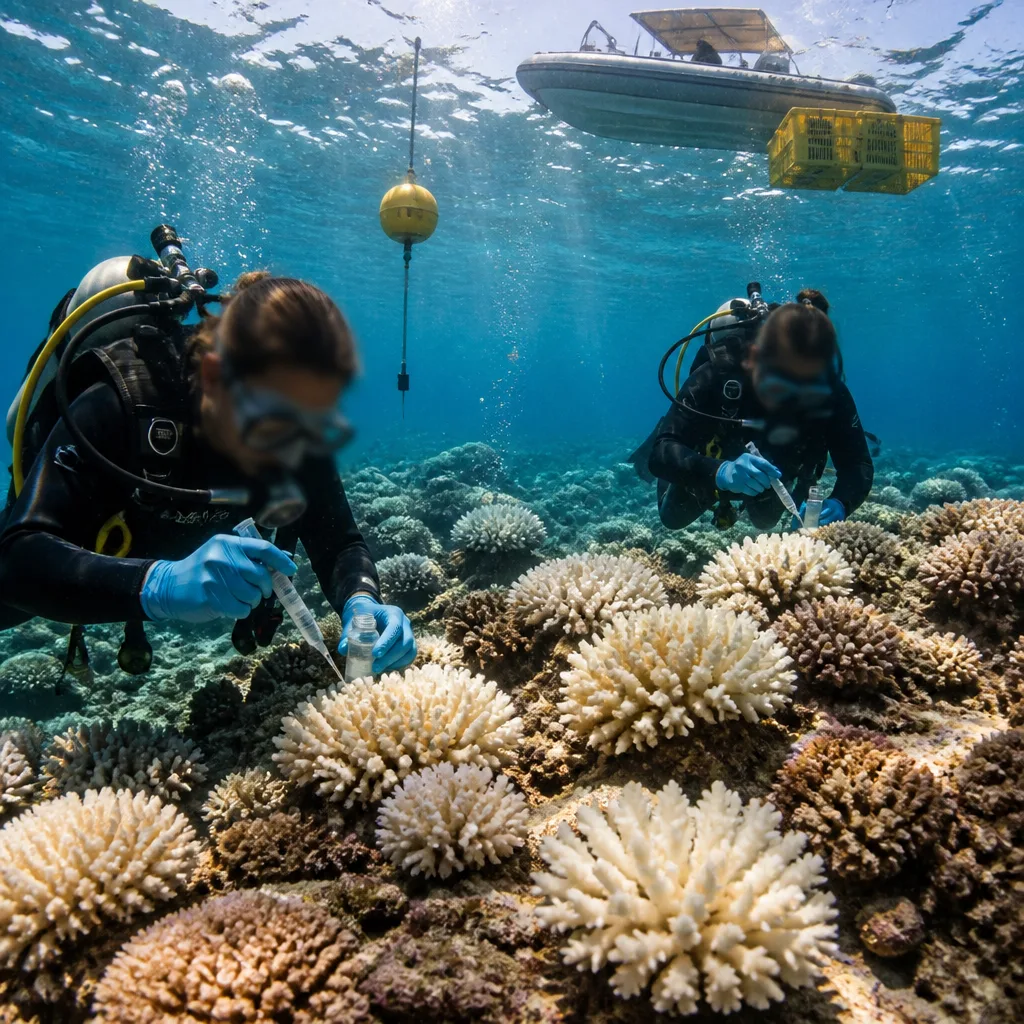
Marine scientists have for the first time used both live bacterial treatments and inactivated microbial products to restore corals suffering from thermal stress in the open sea, the team behind the experiment reports in Cell Reports. The work, carried out at the Al Fahal Reef in the Red Sea by researchers including staff from King Abdullah University of Science and Technology (KAUST), demonstrates that microbial therapy can operate beyond aquarium tanks and may be developed as a practical intervention during marine heatwaves.
What the researchers did and found
Previous laboratory studies had shown that adding beneficial bacteria to corals can improve their tolerance to high temperatures. The new study translated those findings into a field setting, applying two types of microbial treatments directly on reef corals while the animals were experiencing a natural marine heat event. One approach used living bacterial communities sourced from healthy corals — commonly termed probiotics — while the other employed postbiotics, defined as inactivated microbes and/or their bioactive products.
The experiment demonstrated that both approaches improved coral health during thermal stress, representing the first recorded success of probiotic and postbiotic treatments in the open ocean. The authors describe this as an important step towards interventions that could protect reefs facing increasingly frequent and severe warming episodes due to climate change.
“We urgently need to understand both the natural mechanisms that allow some corals to tolerate heat and how we can safely enhance those mechanisms,”
said Erika Santoro, a postdoctoral fellow at KAUST’s Marine Microbiomes Lab and co‑lead author of the paper. The report also notes the potential advantage of postbiotics for scaling up interventions because they use inactivated material rather than live organisms.
Why this matters
Coral reefs are globally significant ecosystems, supporting at least 25% of marine species. Rising sea temperatures — a consequence of global warming — are a major driver of reef decline through mass bleaching and mortality. Demonstrating a field‑ready treatment that bolsters coral resilience addresses an urgent conservation need, offering a potential tool to safeguard reefs during acute warming events while broader climate mitigation proceeds.
- Field demonstration: First application of both probiotics and postbiotics in open ocean conditions.
- Scalability potential: Postbiotics may be easier to deploy widely because they do not require maintaining live bacteria.
- Conservation relevance: Offers a supplementary approach to protect reefs subjected to heatwaves.
Probiotics versus postbiotics — a quick comparison
| Approach | What it is | Potential advantage |
|---|---|---|
| Probiotic | Live microbes derived from healthy corals | May actively colonise coral microbiomes and provide ongoing benefits |
| Postbiotic | Inactivated microbes and/or their bioactive components | Safer and easier to store, ship and scale for broad deployment |
The research was carried out at the Coral Probiotics Village at Al Fahal Reef, with imagery accompanying the study featuring KAUST researchers active on site. While the results are promising, the authors note that further work is needed to quantify long‑term benefits, ecological risks and logistics for widescale use. They also emphasise that microbial therapy is not a substitute for tackling the root cause of reef decline — rising greenhouse gas emissions — but could provide a tactical measure to reduce losses while global mitigation and adaptation efforts continue.
Conservationists and reef managers will likely view this field test as an important proof of concept. If subsequent trials confirm safety, efficacy and cost‑effectiveness, microbial interventions could become part of a growing toolkit to protect critical reef habitats from the accelerating impacts of climate change.









