Scientists in Italy have published a precise, repeatable method to cook an egg so that the white and yolk each reach their ideal textures — but it involves strict timing and moving the egg between two baths every two minutes for a total of 32 minutes. The procedure, reported in the journal Communications Engineering on 6 February 2025, was developed by researchers at the University of Naples Federico II and the National Research Council’s Institute on Polymers, Composites and Biomaterials.
Why the ordinary boil fails
The team frame the problem as a matter of materials science: an egg contains two chemically distinct substances enclosed in one shell. The white (albumen) and the yolk each contain different proteins that coagulate at different temperatures. The white's dominant protein, ovalbumin, begins to set at about 85°C; the yolk's principal proteins, including livetins and phosvitin, coagulate nearer 65°C. Conventional methods — from a hard boil at 100°C to a brief soft boil — are, at best, compromises in which one component is optimised and the other is not.
Method: two baths, strict timing
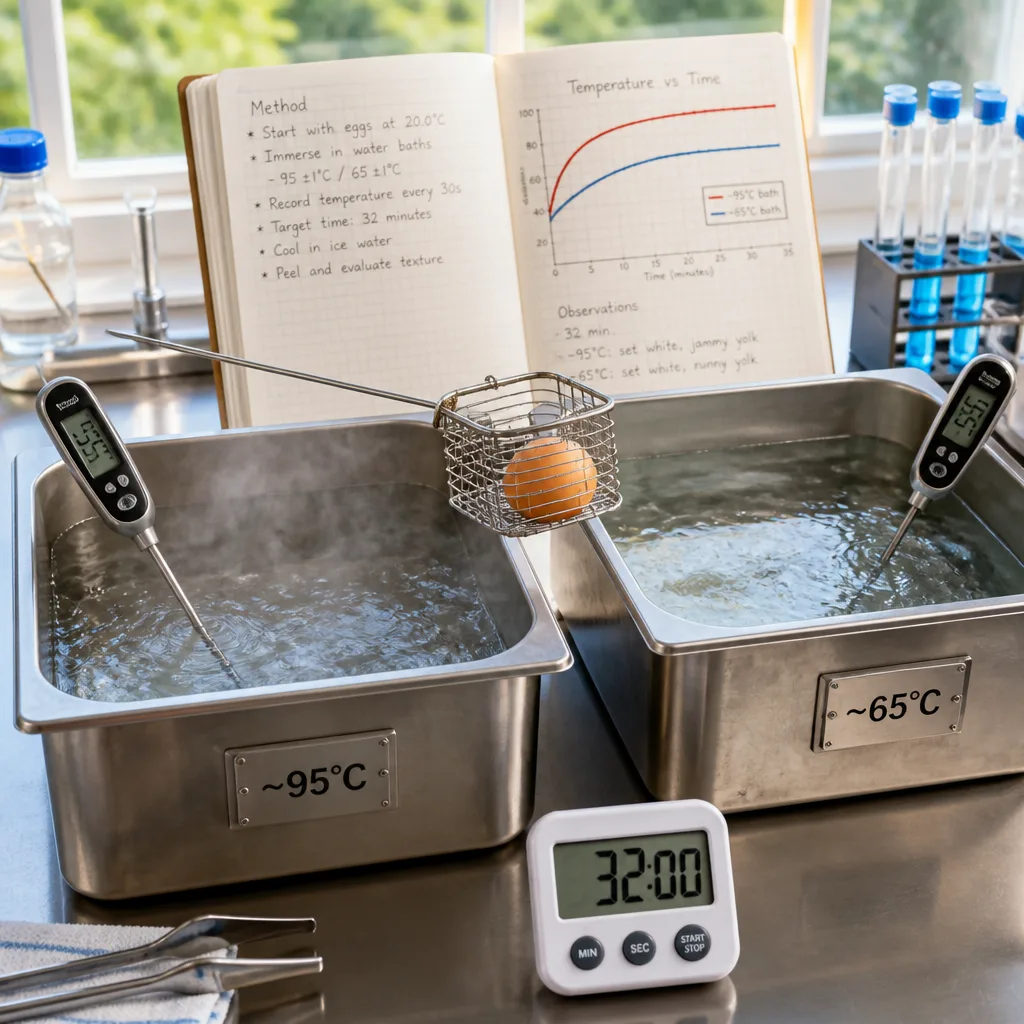
The published protocol reads more like a laboratory SOP than a recipe. It requires two containers of water kept at very different temperatures: one at a rolling boil and one maintained at roughly 30°C — warm to the touch but well below body temperature. An egg, placed in a wire basket, is immersed in the boiling bath for exactly two minutes, then transferred to the warm bath for exactly two minutes. This cycle is repeated without deviation for a total of 32 minutes. After the final transfer the egg is cooled under running water before peeling.
- The method relies on alternately exposing egg components to higher and lower temperatures so each protein fraction approaches its optimum without overshoot.
- Strict timing is central: every two‑minute interval is specified to control heat diffusion into the yolk and albumen.
- The researchers report the technique reliably produces an egg where yolk and white have distinct, preferred textures.
Data at a glance
| Component | Key proteins | Approximate coagulation temperature |
|---|---|---|
| Albumen (white) | Ovalbumin | ~85°C |
| Yolk | Livetins, phosvitin | ~65°C |
| Protocol duration | 32 minutes (2 min cycles) | |
Context and consequences
The paper takes aim at a deceptively simple thermodynamic puzzle: how to cook two different materials enclosed within the same membrane so each attains its own optimum state. It is not presented as a culinary convenience but as an engineered solution to heat‑transfer constraints. The authors contrast their approach with alternative techniques such as long sous‑vide at 60–70°C for an hour, which tends to bring entire eggs to an intermediate state rather than tailor each part independently.
Practically speaking, the routine will feel onerous for most home cooks. It demands continuous attention and equipment capable of maintaining two steady temperatures. Yet the experiment is valuable beyond breakfast: it demonstrates a systematic way to manage competing thermal responses in composite materials — a concept relevant in food science, biomaterials and industrial processing.
Reporters, chefs and the curious will note the paper's twin virtues: reproducibility and clear mechanistic explanation. By quantifying the temperatures at which specific proteins change state and by controlling the thermal history of the egg, the team turned a subjective culinary debate into an objective engineering exercise. Whether that converts into a mass‑market cooking technique is another matter, but the study neatly illustrates how everyday phenomena can reveal subtle physics when examined closely.
For now, the ‘perfect’ boiled egg looks less like a convenient breakfast hack and more like a small laboratory project — one that highlights how often the demands of chemistry and human appetites diverge.