
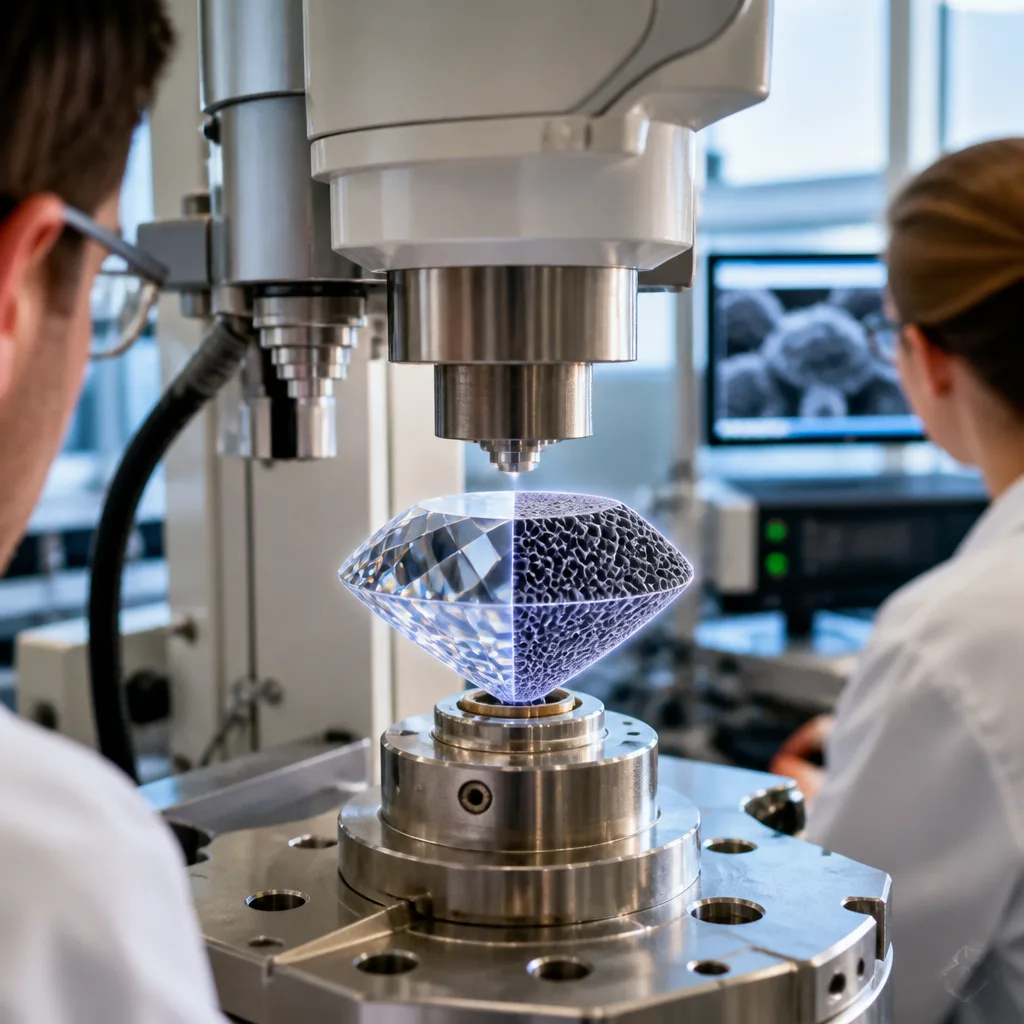
Researchers in China say they have engineered a diamond-like material that combines the mineral’s signature hardness with vastly improved resistance to cracking, a longstanding goal in materials science. The team, from the Institute of Physics at the Chinese Academy of Sciences and Beihang University, describe a structure in which an internal scaffold made of multi-walled carbon nanotubes (MWCNTs) strengthens the crystal against catastrophic fracture without reducing hardness, according to a paper published online on 9 July in the journal Nature Synthesis.
Hardness preserved, toughness amplified
Diamond is valued because it is the hardest natural substance, but that very rigidity comes with a drawback: it can be brittle. A hard blow can shatter a diamond much like it can shatter glass. The Chinese group report a route around this trade-off by building a sub‑microscopic support within the crystal lattice. The result, they say, increases the material’s toughness—its resistance to crack initiation and propagation—by about six times while leaving its hardness effectively unchanged.
The reinforcing elements are multi-walled carbon nanotubes, extremely thin tubular forms of carbon. The authors note these nanotubes are on the order of one ten‑thousandth of the width of a human hair in diameter and have tensile strengths measured in tens of gigapascals, making them many times stronger than steel by weight. Embedded in a diamond matrix, the nanotubes act like internal cords or stitches that arrest and blunt cracks as they form.
- Institutions involved: Institute of Physics, Chinese Academy of Sciences; Beihang University.
- Publication: Nature Synthesis, published online 9 July.
- Key reported performance: roughly 6× increase in toughness with hardness retained.
The authors compare the new material’s toughness favourably to that of certain tungsten alloys used in armour‑piercing projectiles, signalling potential for demanding industrial or defence uses. The claim rests on measurements reported in the paper; independent replication under full weapons‑qualification regimes would be a separate and more onerous step.
How the structure works and what it means
In plain terms, the innovation is analogous to reinforcing a ceramic bowl with a fine internal net of fibres. A ceramic alone is hard but can shatter when struck; add flexible, high‑strength fibres and the assembly absorbs and redistributes energy, making it far more damage tolerant. In this case the fibres are carbon nanotubes and the ceramic is diamond. Embedding such a scaffold inside a crystalline solid without degrading its desirable atomic arrangement is technically exacting, which is why the method—if robust—would be notable.
Practical consequences depend on scale-up and reproducibility. Laboratory proof of concept is an early but necessary stage; manufacturing consistent, bulk quantities of such a composite at industrially relevant sizes and costs is a separate challenge. The researchers’ measurements suggest the composite could outperform certain hard metals in applications where both surface durability and resistance to fracture are essential, such as in cutting tools, abrasives or specialised protective components.
| Property | Conventional diamond | Composite reported |
|---|---|---|
| Hardness | Extremely high | Approximately unchanged |
| Toughness | Relatively low (brittle) | ~6× higher |
Materials scientists will read the paper with interest and scepticism in equal measure: replication and standardised testing will be required to confirm performance claims. If confirmed, the approach would be an elegant example of how combining carbon allotropes at the micro‑ and nano‑scale can yield composites with emergent properties that neither constituent displays alone.
The wider implications extend to industries that rely on extreme materials. However, the route between a promising laboratory result and widespread industrial deployment can be long. Key questions include whether the nanotube scaffold can be uniformly distributed at scale, whether the process is economically viable, and how the composite behaves under real‑world fatigue, thermal and impact conditions.
For now, the paper marks a notable advance in the quest to reconcile hardness with toughness—a pair of properties that have often been mutually exclusive. Embedding a microscopic web of carbon cords into what is effectively a crystalline fortress may be the materials equivalent of stitching flexibility into armour.









