
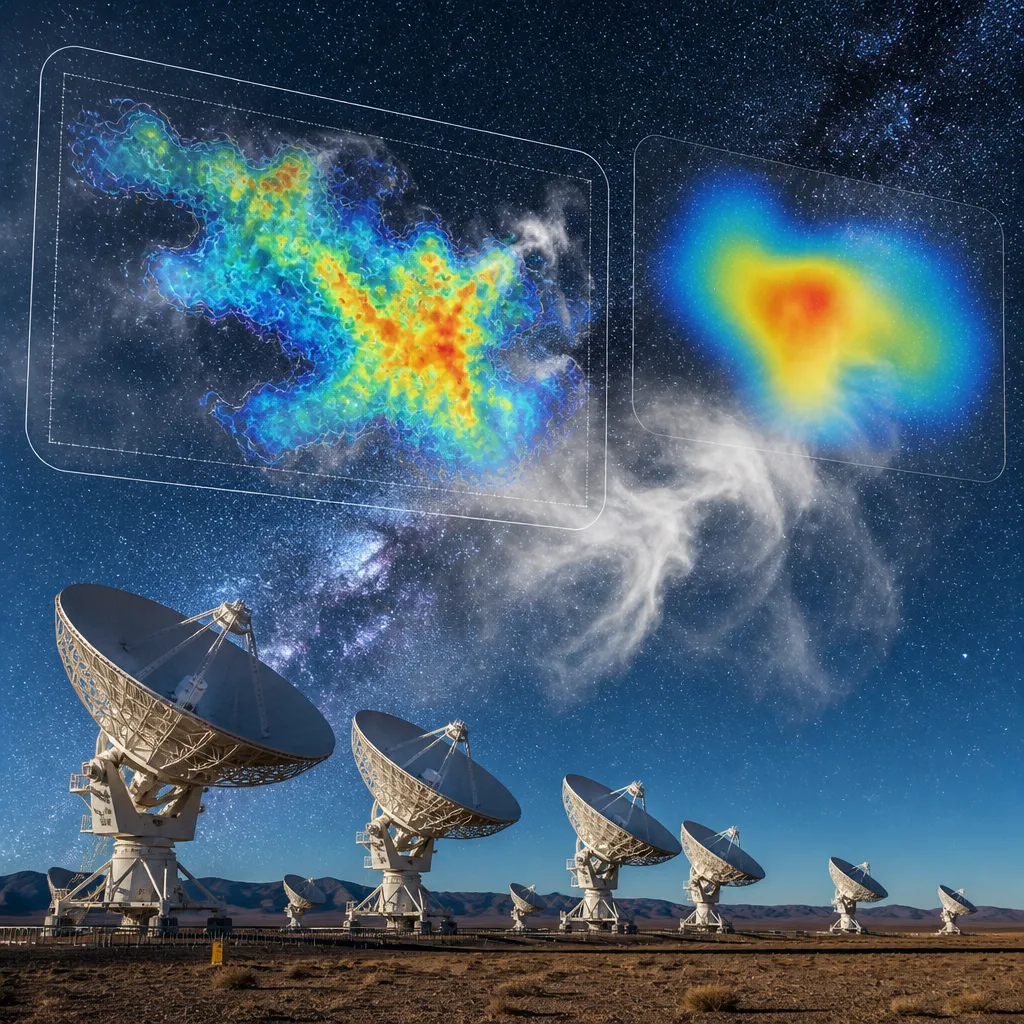
Radio telescopes are giving astronomers a sharper view of the chemical landscapes inside the cold, diffuse clouds where stars are born. By mapping the distribution, temperature and motion of molecules within these so-called molecular clouds, researchers have compared the latest high-resolution techniques with the earlier surveys to check that past maps remain reliable while also exposing new, finer-scale structure.
Cosmic laboratories too distant to visit
Astronomers describe star-forming regions as interstellar laboratories. They are remote, frigid and exceedingly diffuse compared with terrestrial environments. Typical molecular-cloud conditions quoted by the researchers put initial temperatures at roughly -263°C (about -442°F) and particle densities near 100 molecules per cubic centimetre. For scale, ordinary air contains on the order of 1019 molecules per cubic centimetre.
| Stage | Temperature | Typical density |
|---|---|---|
| Quiescent cloud | -263°C (~-442°F) | ~100 molecules cm-3 |
| Infant star region | -173°C to -73°C (~-279°F to -100°F) | ≥107 molecules cm-3 |
As a dense clump within a cloud collapses to form a new star, temperatures climb and densities can rise above 10 million molecules per cubic centimetre. Those changing conditions enable the basic chemical reactions that progressively build larger molecules — the molecular raw material that, in time, may be incorporated into planets and, ultimately, into the rocky and organic matter familiar on Earth.
Mapping molecules to read physical conditions
Radio astronomy is particularly well suited to this task because many interstellar molecules emit characteristic radio-frequency lines. By mapping those spectral lines across a cloud, astronomers can infer three central properties:
- Abundance: how much of each molecule is present in different locations;
- Temperature: derived from line ratios and line shapes;
- Velocity: the motion of gas revealed by Doppler shifts in the lines.
The team whose work is reported compared modern, higher-precision maps with the earlier generations of molecular surveys to test consistency. Such cross-checks are important: improved instrumentation and mapping techniques can reveal details that older, lower-resolution maps smoothed over or missed, but they must still be reconciled with the large-scale picture accumulated over decades.
“we are made of star-stuff.”
The famous line from the astronomer Carl Sagan still captures the essence of this research. The elements produced in the hearts of ancient stars are redistributed into clouds that host the next generation of stars and planets. Tracking the chemistry inside those clouds is a way of tracing how simple ingredients assemble into the more complex molecules that ultimately seed planetary systems.
Why the comparison matters
Verifying that new maps align with older results does two things. First, it validates the broad conclusions drawn from legacy surveys about where particular molecules are abundant and how gas is moving at kilometre-scale resolutions across whole clouds. Second, it highlights the new information obtainable with modern instruments: finer spatial detail, more accurate temperature estimates and subtler velocity structure. Together, these advances help refine theoretical models of star formation and chemical evolution.
The study focuses on high-mass, star-forming regions — nebulae destined to produce stars substantially heavier than the Sun. These environments are especially important because massive stars strongly influence their surroundings through radiation and winds, accelerating chemical and physical evolution within their natal clouds.
In practice, mapping molecular chemistry across these regions is akin to reading a recipe written in spectral lines: some ingredients appear only after a cloud warms or densifies; others survive only in the cold, outer reaches. By comparing maps taken with successive generations of radio telescopes, astronomers can be more confident that the recipes they infer are not artefacts of measurement but reflections of the real, evolving chemistry of star formation.
The next steps will be to use the validated maps to constrain chemical networks and dynamical models more tightly, and to extend such comparisons across a wider sample of clouds to understand how universal — or variable — these chemical pathways are in the Galaxy.









