
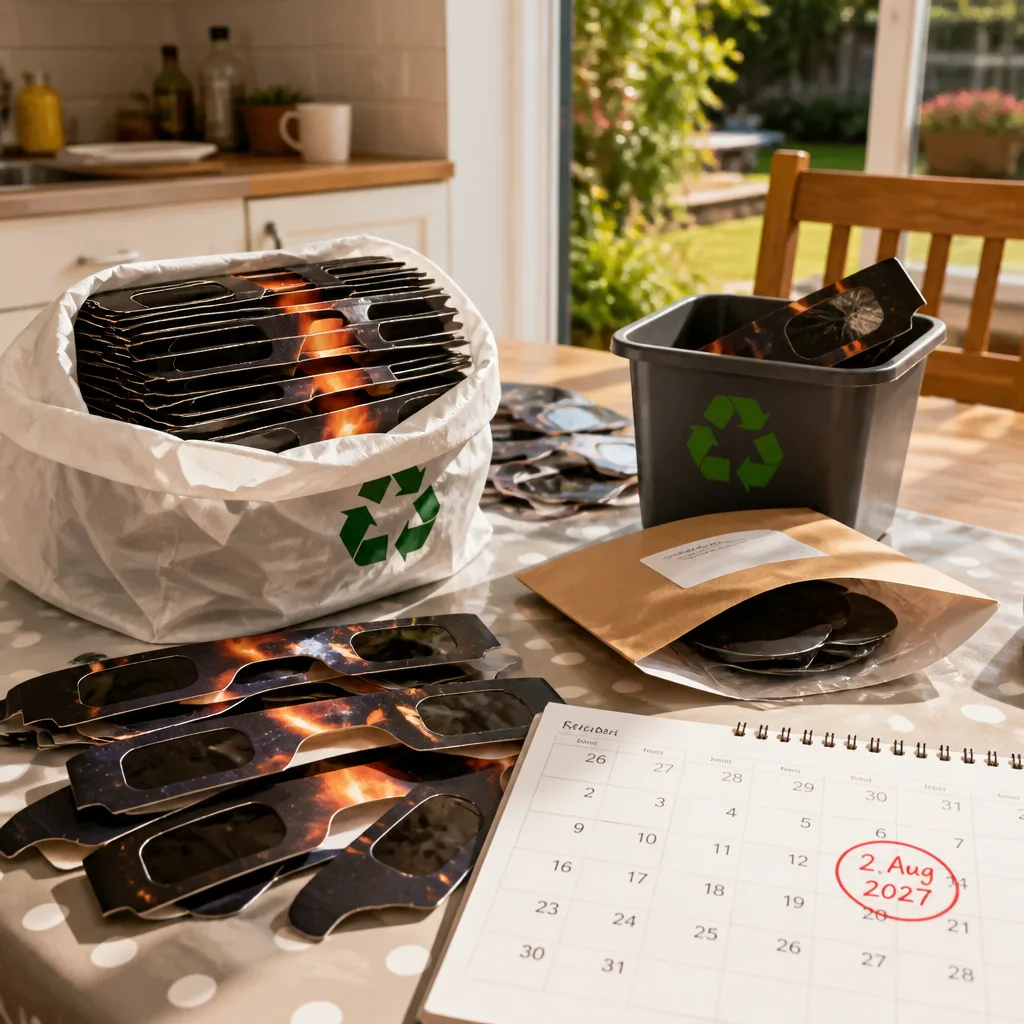
Millions of people scrambled to obtain special solar eclipse glasses for mainland Europe’s recent total eclipse, leaving many UK households wondering what to do with the protective spectacles now the event has passed.
Eye safety, waste and future use
While the lenses are the critical safety component, they are also the part of the product most challenging to recycle. Recycling guidance from the national scheme Recycle Now says cardboard frames can be recycled if the lenses are first separated, but the dark polymer filters themselves often cannot be processed via household recycling streams.
"Eclipse glasses are a great example of our single-use culture," said Dr Renee Tonkin, founder of environmental education group Science Owl, noting how mixed materials complicate recycling.
That tension — between the need for a robust, light-blocking filter to protect eyesight and the environmental cost of single-use plastic — is why experts suggest a handful of practical options rather than consigning the glasses to general waste.
Practical options for your eclipse glasses
- Keep them for future totalities: A major eclipse will occur on 2 August 2027. Parts of southern Spain, northern Africa and the Arabian peninsula will fall under the Moon’s full shadow; the longest period of totality on land for that event is expected to be 6 minutes 23 seconds, and viewing conditions in northern Africa are likely to be favourable.
- Separate and recycle cardboard: If the frames are paper- or cardboard-based, peel away the filters and recycle the cardboard through standard municipal collections.
- Reuse for safe viewing: Store undamaged glasses in a cool, dry place and check them before each subsequent use for scratches or holes; damaged filters must not be used to view the Sun.
Dr Ed Bloomer, an astronomer at the Royal Observatory Greenwich, emphasised the significance of the 2027 event — sometimes called the "eclipse of the century" because of its unusually long duration on land — as a reason some people might choose to retain their spectacles for future use.
Why some parts of the product are hard to recycle
The difficulty stems from material composition: manufacturers typically bond a dark polymer film to cardboard or plastic frames so that only a narrow band of sunlight reaches the eye. That laminated structure is valuable for safety but problematic for separation and processing in routine recycling facilities.
| Component | Recyclability |
|---|---|
| Cardboard frame | Usually recyclable if separated |
| Polymer filter lenses | Often not recyclable via household streams |
Given those constraints, the best immediate advice for householders is to follow Recycle Now’s guidance: dismantle what you can, recycle the paper elements and either retain intact filters for future use or dispose of unusable lenses in general waste if no specialist scheme is available.
Policy and public behaviour
This episode underlines broader tensions between short-term public demand for safety equipment and longer-term environmental responsibility. The spike in purchases around an astronomical event exposes the limits of a system built around single-use items, particularly where mixed materials are involved.
Organisers of future eclipse-viewing campaigns and manufacturers could reduce waste by designing spectacles that are easier to disassemble and recycle or by promoting durable, reusable viewing solutions. In the meantime, the combination of separating recyclable parts, holding on to intact glasses for the 2027 totality and following safety checks offers a balanced approach for most households.
For anyone planning to travel to see the next total eclipse, remember to inspect filters before each use: even small scratches or pinholes can allow dangerous levels of sunlight through and render the glasses unsafe.









