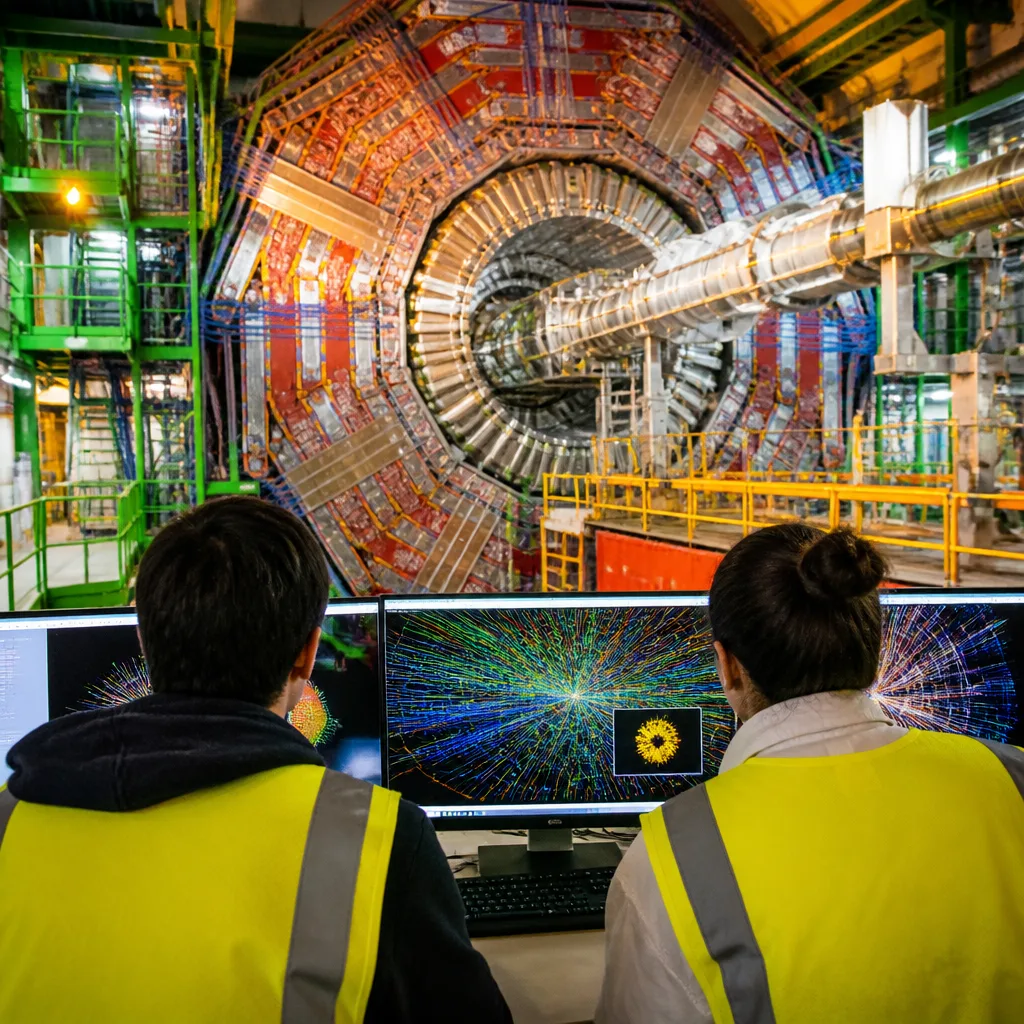
Scientists operating the ALICE detector at CERN’s Large Hadron Collider have, in effect, produced a trace quantity of gold from collisions of lead nuclei — not by magic but by the extreme physics of near-miss encounters between fast-moving atomic nuclei.
How a near-miss can change an element
Modern chemistry recognises that elements differ by their number of protons. A lead nucleus contains exactly three more protons than a gold nucleus, so in principle removing three protons from lead will yield gold. Researchers have now observed that condition arise, albeit fleetingly and at vanishing scale, when bundles of lead nuclei are accelerated to almost the speed of light and made to pass very close to each other inside the ALICE experiment.
The collisions are not the head-on, violent smash-ups that destroy nuclei, but instead so-called electromagnetic or peripheral interactions, in which nuclei merely graze past one another. At the tiny separations involved, the electric fields between the positively charged nuclei become enormous. Those fields are strong enough to pull protons out of a nucleus, overcoming the short-range binding of the strong nuclear force for a moment.
To put the intensity in context, the electric fields involved are roughly a million times stronger than those that produce lightning in Earth’s atmosphere. The effect is brief and rare, yet real: the ALICE team estimates they produced a total of approximately 29 trillionths of a gram of gold across their dataset.
Measurement and meaning
The amount of gold formed is infinitesimal — far from anything useful commercially — but the result is a neat empirical demonstration of nuclear transmutation under controlled experimental conditions. It confirms theoretical expectations about electromagnetic interactions between heavy nuclei at relativistic velocities and illustrates how varying the geometry of a collision switches the dominant forces at work.
Key points of the process include:
- Lead and gold differ by three protons; removing three from lead yields gold in principle.
- Peripheral, near-miss collisions create extremely strong electric fields over very short distances, sufficient to eject protons from a nucleus.
- The ALICE experiment observed a cumulative yield of about 29 trillionths of a gram of gold.
| Parameter | Reported value |
|---|---|
| Difference in proton number (Pb → Au) | 3 protons |
| Amount of gold produced | 29 trillionths of a gram |
| Relative electric field strength | ~1,000,000 times lightning |
Scientific context and consequences
The observation sits at the intersection of nuclear physics and high-energy experimental technique. ALICE was designed to study the quark–gluon plasma and the behaviour of strongly interacting matter under extreme conditions, but the detector is sensitive to a wide range of phenomena that occur in heavy-ion collisions. Peripheral electromagnetic interactions are a textbook consequence of Lorentz-boosted charged objects: at high speed, the electric and magnetic fields are concentrated and can momentarily rival the forces that bind nuclei together.
While the headline of transmuting lead into gold will capture the public imagination, the practical implications are limited. The quantity produced is astronomically small compared with commercial needs, and the energy and infrastructure required are enormous. Instead, the value of the finding is conceptual: it provides a tangible demonstration of how manipulating collision parameters reveals different aspects of nuclear forces and lets physicists test models of nuclear structure and reaction mechanisms.
The work also highlights how modern experiments can reproduce, in their own way, scenarios very far removed from everyday experience — the conditions mimic processes that might have occurred in the early universe or in astrophysical events, albeit at vastly different scales. For researchers, the incidental production of gold is a precision testbed rather than an alchemical triumph.
Additional analysis of the ALICE data, and comparison with theoretical models, will refine the rate and mechanisms of such transmutations and may inform future experiments that deliberately explore electromagnetic interactions in heavy-ion runs.
The result is a reminder that even in highly specialised programmes, surprising and illustrative phenomena can emerge when the building blocks of matter are pushed to their extremes.