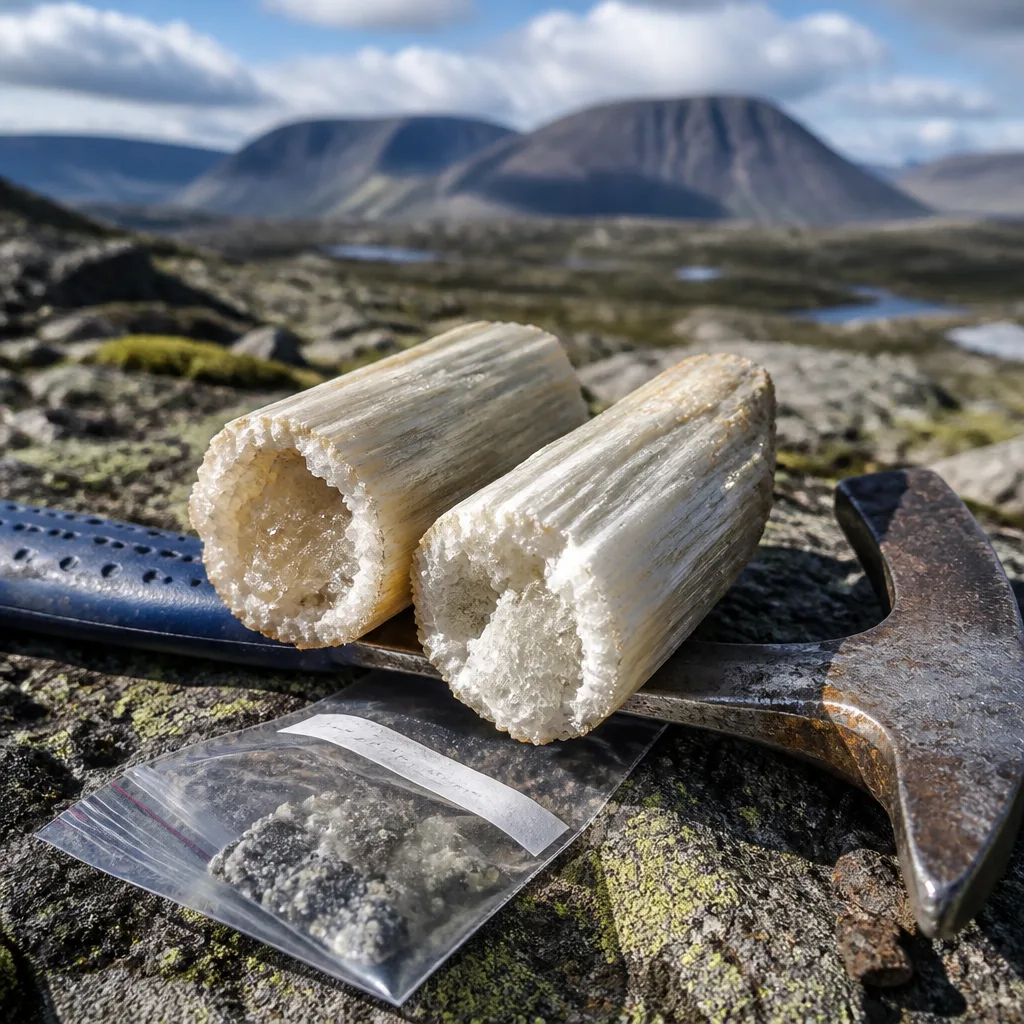
Scientists working in north‑west Russia have reported the discovery of a previously unknown mineral in the Khibiny massif on the Kola Peninsula that is rich in rare‑earth elements and has an unusually complex crystalline architecture. The mineral, provisionally called Kola Ashcroftine, was found by teams from Saint Petersburg State University, the Kola Science Centre of the Russian Academy of Sciences and the A. E. Fersman Mineralogical Museum.
Structure, composition and origin
Laboratory study shows the material contains a mixture of elements including yttrium, silicon, potassium, sodium, calcium, manganese, fluorine and various rare‑earth elements. Researchers emphasise the mineral’s crystalline framework is highly intricate: it comprises silicate nanotubes linked by a zeolite‑like network. The team notes this places the discovery within the roughly 3.5 per cent of known minerals judged to be among the most structurally complex.
“The mineral’s crystalline structure is particularly complex,”
— Sergey Krivovichev, director of the Kola Science Centre and professor at Saint Petersburg State University, who led aspects of the work.
Field and laboratory evidence indicate the mineral likely formed in a hydrothermal environment at relatively low temperatures. That genesis is important because it suggests pathways for reproducing the mineral synthetically using so‑called “gentle chemistry” techniques rather than extreme heat or pressure.
Potential uses and scientific value
Scientists highlight two aspects of the find. First, the capacity of the crystal lattice to accommodate a variety of rare‑earth elements means the mineral is both a repository of geochemical information — useful for reconstructing the chemical processes that operated in the crust where it formed — and a potential source of such elements for technology. Second, the presence of silicate nanotubes and a zeolite‑like topology implies ion‑exchange properties, a characteristic exploited across industries.
Possible applications mentioned by the research partners include:
- water purification by ion exchange;
- pharmaceuticals and separation science;
- metallurgy and nuclear energy, where selective uptake or release of ions can be valuable.
The team says the relatively low‑temperature formation boosts the prospect of laboratory synthesis, which would be a prerequisite for industrial use or detailed property testing.
Context and consequences
The discovery sits within a broader pattern of mineral finds across BRICS countries reported in recent months, underlining the continuing scientific and strategic interest in rare‑earth and critical‑mineral resources. The Khibiny alkaline massif itself is already known for its diverse mineralogy and significant rare‑earth potential.
Beyond the immediate scientific novelty, the find may have longer‑term ramifications. If the mineral can be synthesised and its ion‑exchange behaviour harnessed, it could offer new materials for separation technologies that are central to clean water, advanced manufacturing and certain energy technologies. However, the research to date is descriptive: establishing scalable synthesis routes and quantifying performance in real applications will require further experimental work.
| Attribute | Reported detail |
|---|---|
| Location | Khibiny alkaline massif, Kola Peninsula |
| Key elements | Y, Si, K, Na, Ca, Mn, F and various rare‑earths |
| Crystal type | Silicate nanotubes joined by a zeolite‑like structure |
| Formation environment | Hydrothermal, relatively low temperatures |
For mineralogists and material scientists the immediate value lies in the new structural motifs the mineral introduces to the catalogue of natural materials. For technologists, the attraction will be whether those motifs translate into demonstrable utility in ion exchange or other separation processes.
At present the announcement is a scientific report of discovery and potential. The next steps will be independent characterisation, publication in a peer‑reviewed mineralogical journal, and experimental programmes to test synthesis and functional behaviour — tasks the discoverers have flagged as logical follow‑ons to their field and laboratory work.
As ever in mineral discovery, the path from single specimens in a massif to engineered materials is long. But the combination of rare‑earth content, unusual nanotube architecture and a benign formation history gives Kola Ashcroftine a clear place on the list of minerals warranting rapid follow‑up study.