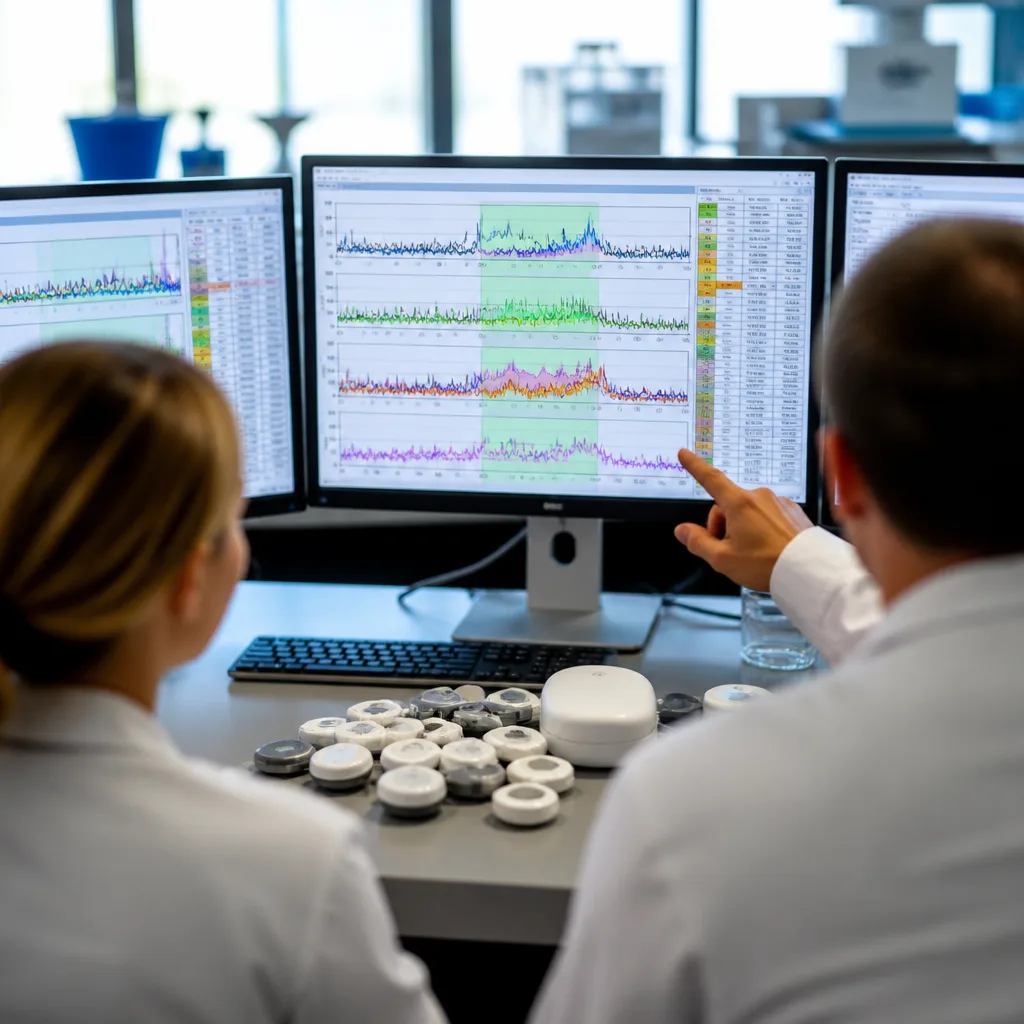
Researchers have released a new analytical platform intended to harmonise and scale how continuous glucose monitoring (CGM) data are analysed in metabolic research. The tool, called GVC‑Calc, was described in a paper published in Nature Metabolism and involves contributors from institutions in the United States and the United Kingdom, including King’s College London and Pennington Biomedical Research Center.
Why a new tool matters
Continuous glucose monitors generate dense time-series data on blood glucose across the day and night. But, as the authors note, differences in how studies preprocess raw files and define commonly used metrics make it difficult to compare results across cohorts or to combine datasets for large-scale statistical and machine-learning analyses. The new platform is designed to address those barriers by providing a standardised, transparent workflow for CGM processing and metric calculation.
Key capabilities of GVC‑Calc include:
- Processing of raw CGM files without dependence on a single manufacturer or proprietary software;
- Batch processing across hundreds of participants, while preserving links between individual-level traces and aggregated cohort metrics;
- Calculation of consensus clinical metrics alongside exploratory measures of glucose dynamics, incorporating both geometric and probabilistic approaches.
Who contributed
The initiative is collaborative. Among the named contributors in the published report are Dr Kaja Falkenhain (postdoctoral researcher) and Dr Leanne Redman (adjunct professor at Pennington Biomedical and Academic Director of the Charles Perkins Centre). Institutional partners listed in the publication include:
| Institution | Country |
|---|---|
| Pennington Biomedical Research Center | United States |
| United States Military Academy at West Point | United States |
| King’s College London | United Kingdom |
| Boston Children’s Hospital | United States |
| Harvard Medical School | United States |
Design choices and transparency
The authors emphasise two intertwined aims: reproducibility and accessibility. By accepting raw CGM files irrespective of device manufacturer, the platform reduces dependence on bespoke, sometimes opaque, preprocessing pipelines. That matters because small differences in artefact removal, calibration choices or imputation can alter summary metrics such as mean glucose, time-above-range or measures of glycaemic variability.
GVC‑Calc also preserves the connection between each participant’s trace and the cohort-level outputs, which is important when researchers wish to diagnose whether cohort trends are driven by a subset of individuals or reflect a population-wide effect. The platform’s metric set pairs established clinical measures with newer, exploratory descriptors of glucose dynamics, some drawing on geometric and probabilistic mathematics, enabling both routine clinical comparisons and experimental analyses.
Implications for research and practice
As CGMs are used increasingly outside specialist diabetes clinics — in metabolic research, clinical trials and population studies — consistent analytical standards will be essential. Tools like GVC‑Calc offer one route towards comparability across studies and the large-scale integration required for robust machine-learning models and meta-analyses.
For UK researchers and clinical groups, participation in or adoption of open, standardised workflows can reduce duplicated effort and facilitate cross-centre collaboration. The involvement of King’s College London in the project may accelerate local uptake and validation in British cohorts.
Whether GVC‑Calc becomes a near-universal standard will depend on independent replication, community acceptance and continued maintenance of the software. The paper reports the development and evaluation of the platform; subsequent work by other groups will be needed to test its performance across device types, ethnic groups and differing clinical contexts.
In short: GVC‑Calc is presented as a practical tool to make CGM data analysis more transparent, comparable and scalable — a potentially important step towards better, more reproducible metabolic science.