Mercury may have lost far more of its girth than scientists previously believed, researchers report, with a new analysis suggesting the innermost planet’s diameter could have decreased by as much as 14 miles — roughly 30% more than earlier assessments.
Re‑measuring a shrinking world
The study, published in Geophysical Research Letters by scientists at the German Aerospace Center’s Institute of Space Research and collaborators including Hokkaido University, re‑examined how Mercury’s surface records internal contraction. The planet has been contracting since its formation about 4.5 billion years ago as its large iron core cooled, pulling the crust and mantle inward and creating a suite of compressional faults and scarps.
Previous estimates of Mercury’s net shrinkage were based largely on maps of contractional landforms derived from NASA’s Messenger mission in the 2010s and on fewer earlier observations by Mariner 10 in the 1970s. The new work overlays those maps with fresh measurements of surface roughness and finds that the roughest terrains show fewer visible shrinkage wrinkles. The authors interpret this as an effect of impact debris obscuring older faults, meaning some contractional features have been hidden from prior surveys.
“We are quite excited,” Nishiyama said in an email.
Method and implications
By accounting for regions where impact ejecta may conceal scarps, the team increased the estimated total diameter loss. The adjustment raises two closely linked points of interest:
- The planet’s contractionary history may be more pronounced than available fault maps alone implied.
- Understanding buried or obscured tectonic features is essential for interpreting the thermal evolution of small rocky worlds.
The result is modest in absolute terms — a change of a few miles on a body roughly 3,000 miles across — but proportionally significant. A 30% upward revision in total inferred shrinkage alters the scale of internal cooling required to generate the observed deformation and therefore affects models of Mercury’s thermal and mechanical evolution.
What BepiColombo will test
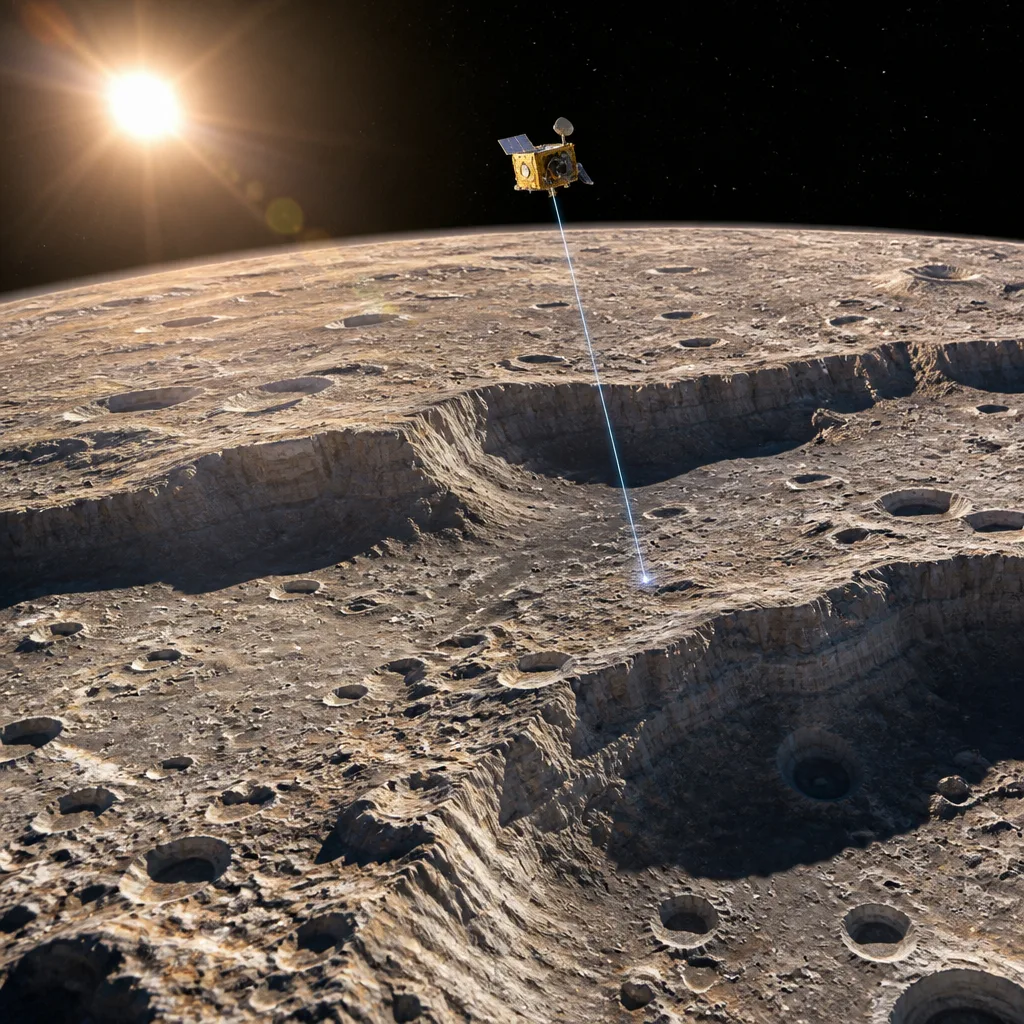
The findings come as the European Space Agency and the Japan Aerospace Exploration Agency’s twin spacecraft, BepiColombo, approach Mercury. The pair are scheduled to enter orbit in November; after separation they will conduct a more comprehensive survey than previous missions. The study’s lead author, Gaku Nishiyama, is a participant in the mission and said BepiColombo’s laser altimeter should be able to confirm whether the new estimate of greater shrinkage is correct.
If the increased contraction is confirmed, it will have consequences beyond Mercury. The work shows that surface roughness and impact‑related cover can mask tectonic records on small planets and moons, a caveat that may apply when interpreting geological histories elsewhere.
| Item | Value / note |
|---|---|
| Estimated maximum diameter loss (new) | 14 miles |
| Relative change from earlier estimates | About 30% greater |
| Mercury diameter (approx.) | 3,000 miles |
The authors caution that the new figure is an estimate arising from a different treatment of the surface record rather than a direct measurement of global radius change. The upcoming in situ observations from BepiColombo will provide finer topographic data that can either corroborate or refine the adjusted estimate.
For planetary scientists, the study is a reminder that a planet’s present surface is a palimpsest: impacts and later processes can obscure earlier tectonic signatures. Recovering those buried signals is essential for reconstructing the thermal and mechanical history of worlds small enough for their cores and mantles to cool substantially over gigayears.