The Esports World Cup (EWC) in Paris — a seven-week live production running from 6 July to 23 August 2026 — relied on an unusually large and tightly integrated communications and signal-distribution system to coordinate eight simultaneous competition stages, multiple production areas and international broadcast feeds in 35 languages.
Scale and the technical challenge
Organisers ESL FACEIT Group engaged technical service providers Charco, Gravity Media and Riedel Communications to build the on-site backbone that connected each of the eight stages with four production areas, central broadcast facilities and supporting technical spaces. The production brought together more than 2,000 players from 200 clubs, competing for a combined prize pool of $75 million.
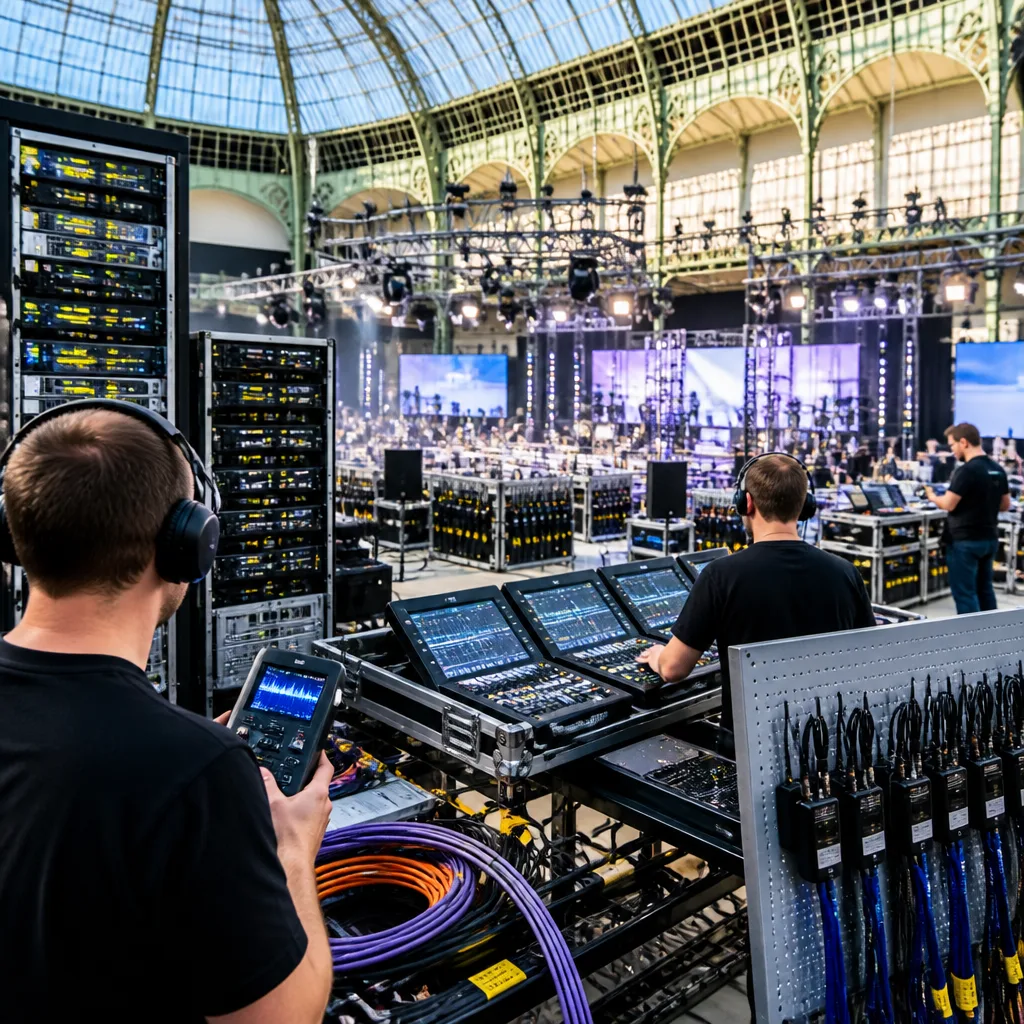
Each stage operated as a full broadcast environment with dedicated operators and production managers preparing content for the world feed. That meant the communications fabric needed to be both resilient and flexible: crews, directors, producers and referees across stages had to coordinate timing, camera coverage and match adjudication in real time.
What was deployed
ESL FACEIT Group and Charco jointly designed an intercom infrastructure built around a Riedel ecosystem. The deployment included:
- Five Artist-1024 frames
- 341 Bolero wireless beltpacks
- 79 Bolero antennas
- 330 SmartPanels
| Item | Quantity |
|---|---|
| Artist-1024 frames | 5 |
| Bolero beltpacks | 341 |
| Bolero antennas | 79 |
| SmartPanels | 330 |
Record density and RF management
Operating up to 341 Bolero beltpacks simultaneously inside one enclosed venue presented one of the project’s most demanding technical challenges — the highest density of Bolero wireless intercom beltpacks ever reported in a single indoor setting. Achieving this required meticulous radio-frequency (RF) planning and active spectrum management.
To manage the crowded RF environment the team used Bolero’s Frequency Scanner functionality and implemented seven dedicated scanner antennas that continuously monitored signals during production. The French National Frequency Agency also made additional frequency spectrum available, enabling the technical team to minimise potential interference before it affected operations.
“Delivering dependable communications in such a dense RF environment
The quote above, provided in source material, highlights the complexity of maintaining reliable wireless links when hundreds of devices operate in close proximity.
Operational consequences
The dense intercom deployment was not an exercise in hardware for hardware’s sake. Producers, directors, referees and international production crews relied on the system to coordinate activities across all eight stages for the duration of the tournament. The scale of the deployment meant that the communications network had to be both highly available and simple for a rotating roster of international crews to use.
From a broadcast-technology perspective, the EWC demonstrates how modern live-event engineering scales when multiple, simultaneous productions must be run under a single roof and distributed to global audiences in many languages. The combination of hardware density, continuous RF scanning and regulatory cooperation was central to delivering that outcome.
What this means for future events
The Paris event sets a benchmark for large-scale esports production and will be of interest to broadcast engineers planning multi-stage events, sports federations preparing multi-venue competitions, and venues adapting to growing wireless device densities. The techniques used — active spectrum monitoring, regulatory engagement and scaled intercom architectures — will likely become standard practice for similarly sized events.
While the technical partners named were Charco, Gravity Media and Riedel Communications, ARRI camera systems supported the main-stage camera deployment, reflecting a multi-vendor approach to delivering complex live productions.
For organisers and venue operators, the takeaway is straightforward: as wireless device counts rise, careful RF planning, continuous monitoring and collaboration with spectrum authorities will be indispensable to keep live broadcasts on air.