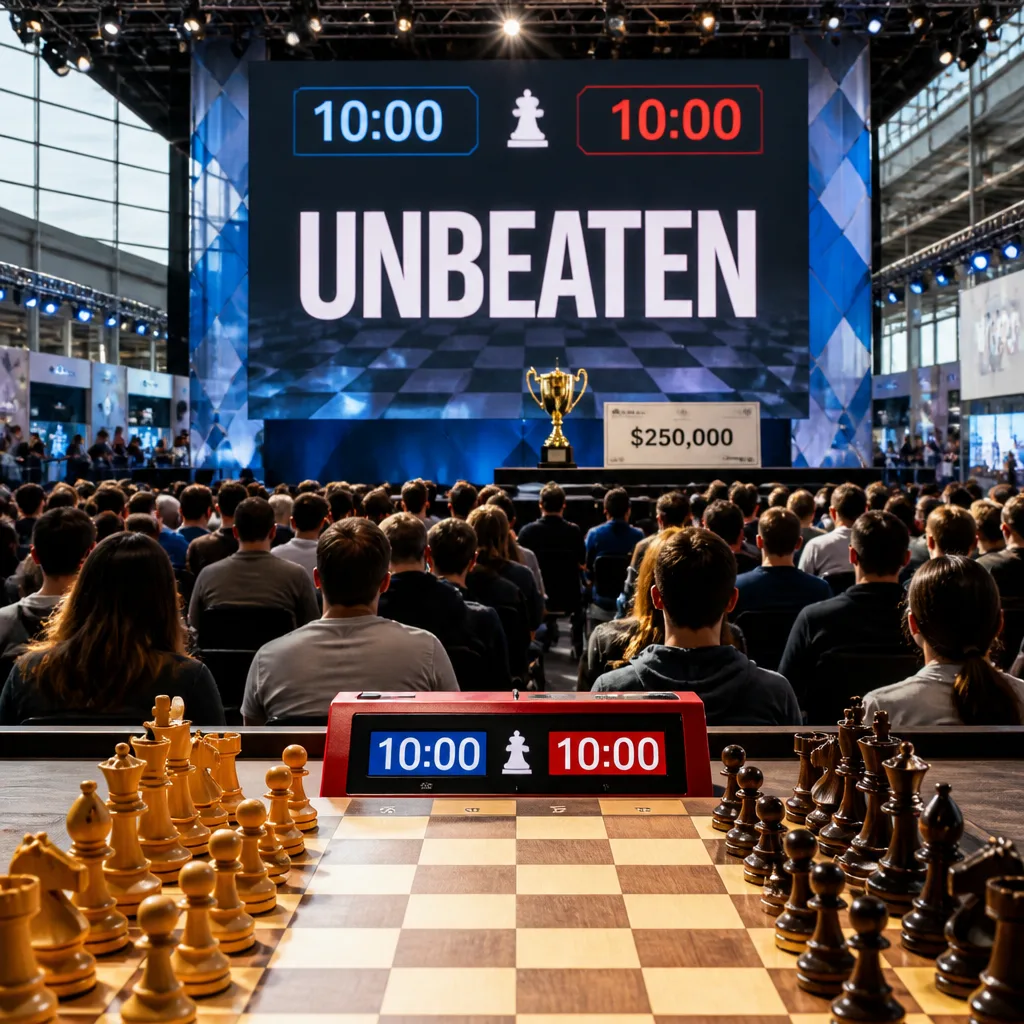
Magnus Carlsen retained the Esports World Cup crown in Paris last weekend, emerging unbeaten from a four-day event at the Paris Expo Porte de Versailles to collect the $250,000 (£183,000) first prize.
Carlsen’s cautious strategy and decisive moments
The Norway world No 1 defended the title he won in Riyadh in 2025 under a rapid time control — 10 minutes per player with no increment — a format that compresses decision-making and increases the risk of tactical errors. Carlsen said:
"To go undefeated was part of my strategy,"adding that his approach was to play "pretty tight chess and take whatever chances I could find."
Across the tournament he avoided defeat against a field that combined established grandmasters and quicker online specialists. Notable results included victories over Russia’s Andrey Esipenko and the United States’ Hans Niemann (each 1.5-0.5 in the group stage); India’s Nihal Sarin (2.5-0.5 in the quarter-finals); France’s Alireza Firouzja (4-1 in the semi-finals); and Belarus’s Denis Lazavik in the final, where Carlsen won two sets by 3-1 scores.
- Champion: Magnus Carlsen — $250,000
- Runner-up: Denis Lazavik — $190,000
- Venue: Paris Expo Porte de Versailles
- Time control: 10 minutes, no increment
Final, format and an emergent debate
Carlsen’s last game stood out: he sprung a prepared line that included a positional queen sacrifice — a resource he had identified from Lazavik’s earlier defensive choices — instead of opting for an earlier perpetual check that would have offered a quick draw. The decision underlined a preference for playing for a win rather than settling for safety, even when speed chess prizes riskier play.
The event also highlighted a recurring criticism of ultra-fast formats: they can produce entertaining mistakes for spectators but also encourage behaviour dubbed "dirty flagging", where drawn positions are effectively decided by whose clock runs out first or by a player’s mouse dexterity. That tension between spectacle and sporting purity is likely to be a continuing theme as chess moves further into staged, live, fast-paced events.
Denis Lazavik: a rising speed specialist
The 19-year-old Belarusian was the surprise of the tournament. Although his classical rating places him at around world No 110, he is increasingly recognised as a super-elite blitz player and has shown strong form in major online speed competitions. Carlsen praised his opponent’s steadiness:
"He just doesn’t beat himself! He plays very solid positional chess and doesn’t put his pieces on bad squares."
Lazavik’s run to the final emphasises the widening gap between classical and rapid/blitz specialists — a trend fuelled by online play and younger players whose training focuses heavily on speed formats.
| Stage | Opponent | Score |
|---|---|---|
| Group | Andrey Esipenko | 1.5-0.5 |
| Group | Hans Niemann | 1.5-0.5 |
| Quarter-final | Nihal Sarin | 2.5-0.5 |
| Semi-final | Alireza Firouzja | 4-1 |
| Final (two sets) | Denis Lazavik | 3-1, 3-1 |
Aside from the prize-money figures, the event demonstrated the commercial pull of rapid online chess in large, televised venues. A capacity audience attended the Paris staging, which combined on-site spectacle with online broadcasting. For players, the mixture of classical prestige and esports-style presentation is changing incentives and preparing the ground for future tournaments that prioritise viewer engagement as much as scoring purity.
While the format rewards quick intuition and nerves of steel, it also sharpens debate about whether such events skew competitive integrity. For now, however, Carlsen’s clean sheet and his willingness to play for wins — rather than settling early for draws — were enough to see him carry off the title for a second consecutive year.