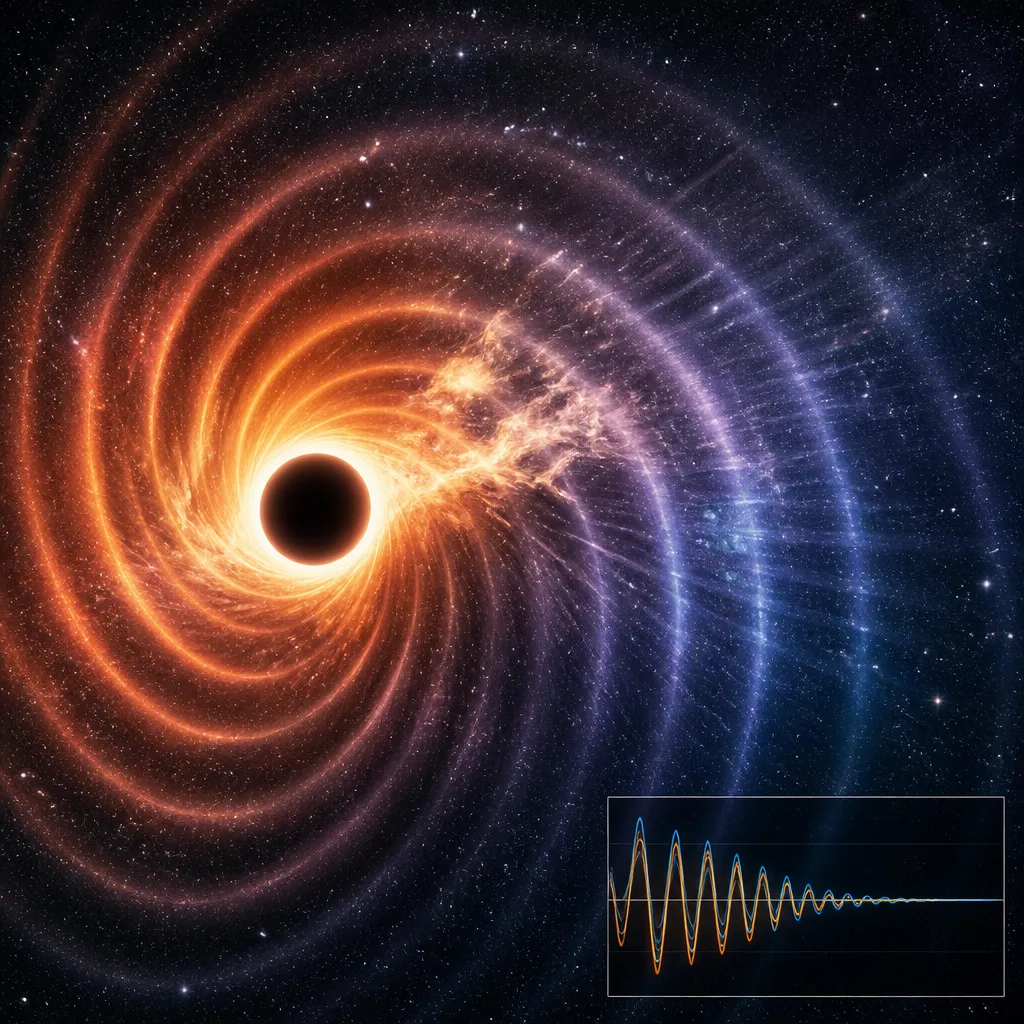
Researchers at Nagoya University have outlined a practical way to look for additional structure — colloquially known as black hole hair — by analysing subtle, differential changes in the brief gravitational‑wave signal called the ringdown that follows a black hole merger.
Ringdown: a ringing bell for spacetime
When two black holes coalesce the newborn object emits a short burst of gravitational waves as it settles down; the signal, known as the ringdown, is characterised by well‑defined oscillation frequencies and how rapidly they fade away. Under the simplest interpretation of Einstein’s general relativity, those characteristics depend only on a black hole’s mass and spin. The Nagoya team asked what would happen to that ringing if the black hole were surrounded by additional matter — the hypothetical ‘hair’. Their answer: the two key observables, the frequency and the damping (fade‑out) rate, would not be affected in the same way.
The study, published in the Journal of Cosmology and Astroparticle Physics, shows that hidden matter changes the frequency and the damping time by different amounts and in a pattern that depends on how the matter’s pressure is distributed around the hole. For spinning black holes the effect also differs according to whether the perturbations propagate with or against the direction of the hole’s rotation.
Why the difference matters
That asymmetric response is important because it provides a specific observational signature to look for. If both frequency and damping shifted by the same relative amount, the change could be mistaken for a modest revision of the inferred mass or spin. But a mismatch — for example a larger fractional change in damping than in frequency — would be difficult to mimic by simply varying mass or spin and would therefore point to the presence of surrounding matter.
- Frequency shift: altered by surrounding matter but in a different proportion to damping.
- Damping change: responds differently to the matter’s pressure profile and to wave direction relative to spin.
- Spin dependence: rotating holes show distinct signatures for co‑rotating and counter‑rotating perturbations.
The paper provides explicit patterns to search for in gravitational‑wave data, effectively telling observers what combination of frequency and damping deviations would indicate a ‘hairy’ black hole rather than an ordinary Kerr black hole described by vacuum general relativity.
Implications for tests of general relativity
Detecting such a pattern would have substantial implications. It would signal either the presence of matter in the near‑horizon region arranged in a way that breaks the vacuum assumption, or point to modifications of the classical black hole picture. Conversely, absence of the predicted pattern in increasingly precise ringdown measurements would strengthen confidence that black holes are well described by the standard two‑parameter (mass, spin) family.
While current gravitational‑wave detectors have observed ringdown phases, their signal‑to‑noise ratios are often limited. The Nagoya team’s result is timely because it gives theorists and data analysts a concrete diagnostic to apply as detector sensitivity improves and as next‑generation observatories come online.
| Observable | Effect of hidden matter |
|---|---|
| Frequency | Shifts by an amount dependent on matter distribution |
| Damping rate | Changes differently to frequency; sensitive to pressure profile and spin direction |
In short, the work transforms a qualitative idea — that extra structure around a black hole would leave imprints on gravitational waves — into a quantitative test that can be applied to real data. As detectors accumulate higher‑quality ringdown signals, these prescriptions will let observers distinguish an ordinary black hole from one with 'hair' by checking whether frequency and damping depart from their vacuum relation in the predicted, asymmetric way.
The result is not a detection of hair, but a sharpened experimental roadmap: measure both parts of the ringdown precisely, compare their relative shifts, and the universe will tell us whether black holes are as bald as Einstein supposed or a little more adorned than that elegant theory predicts.