
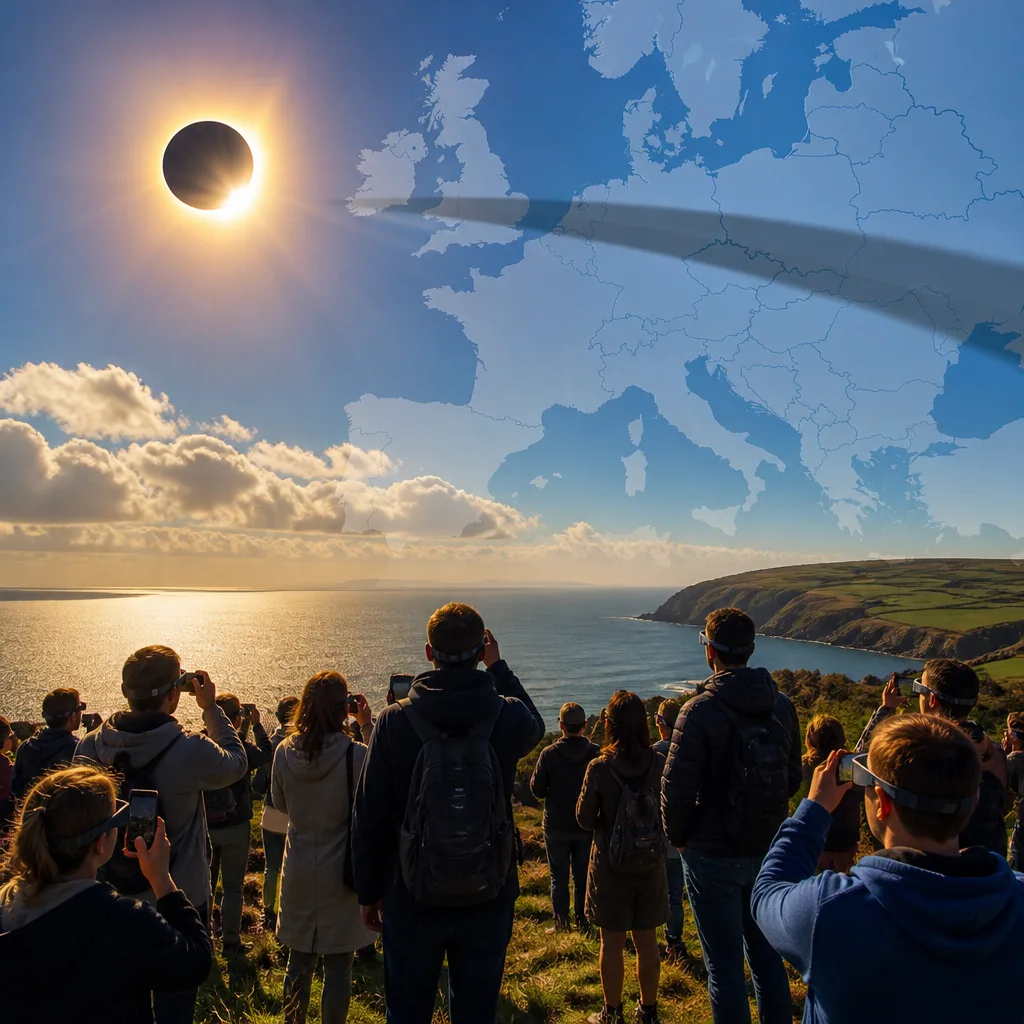
Millions of people across Europe will experience a solar eclipse on Wednesday evening, with a narrow band through parts of the continent seeing the sun briefly completely obscured by the moon.
Where totality will be seen
The path of totality — where the moon fully blocks the sun — runs through north and central Spain, a narrow strip of Portugal and parts of Greenland and Iceland. Observers inside that band will experience the dramatic darkness of a total eclipse as the sun is fully covered.
Outside that narrow track, a much wider area of western Europe will see a partial eclipse, with the sun partially obscured as the moon’s penumbra passes overhead. This includes the United Kingdom, France, Belgium, Switzerland and parts of northern Italy, where the setting sun will be noticeably dimmed.
| Type of eclipse | Regions affected (excerpt) |
|---|---|
| Totality | North and central Spain; narrow part of Portugal; parts of Greenland and Iceland |
| Partial | UK, France, Belgium, Switzerland, northern Italy and much of western Europe |
Why totality is confined to a narrow track
A solar eclipse occurs when the moon passes directly between the Earth and the sun, casting a shadow on the surface. The dark central shadow, the umbra, produces totality but covers only a narrow corridor on Earth. Slight differences in the moon’s orbital tilt and the precise geometry of the alignment mean total eclipses are visible only from specific locations along that corridor; everyone else in the broader shadow will witness a partial eclipse.
“The moon and sun have to line up precisely for the moon to fully cover the sun and for you to see a total eclipse,” said Dr Megan Argo, reader in astrophysics at the University of Lancashire and vice-president of the Society for Popular Astronomy.
Rarity and context
This event is notable because a total eclipse visible in mainland Europe occurs only infrequently. The last comparable event that reached parts of the UK occurred in 1999, when observers in Devon and Cornwall experienced totality. For the UK specifically, a total solar eclipse will not be visible again until 2090, according to public records of eclipse tracks.
For much of western Europe the spectacle will be a deep partial eclipse coinciding with sunset, which can amplify the visual effect but also presents additional safety considerations for viewing.
- Where to see totality: north and central Spain, a small part of Portugal, parts of Greenland and Iceland.
- Where partial eclipse will be visible: large areas of western Europe including the UK, France, Belgium, Switzerland and northern Italy.
- Historical context: Last total eclipse reaching parts of the UK was in 1999; next UK totality is not expected until 2090.
Viewing safety
Although totality briefly renders the sun invisible to the naked eye for those in the path, observers outside that track must never look directly at the sun without appropriate protection. Special eclipse glasses or solar filters designed for direct solar viewing are essential to avoid permanent eye damage. When the sun is only partially obscured, it remains dangerous to view without certified protection.
Public bodies and astronomy groups typically issue guidance ahead of such events; viewers should follow official safety advice and use only standards-compliant eye protection when observing the partial phases.
The coming eclipse offers both a spectacular natural spectacle and an important opportunity for public engagement with astronomy. For those within the narrow lane of totality the experience is brief and dramatic; for millions more across Europe it will be a striking reminder of the celestial mechanics that govern our sky.









