
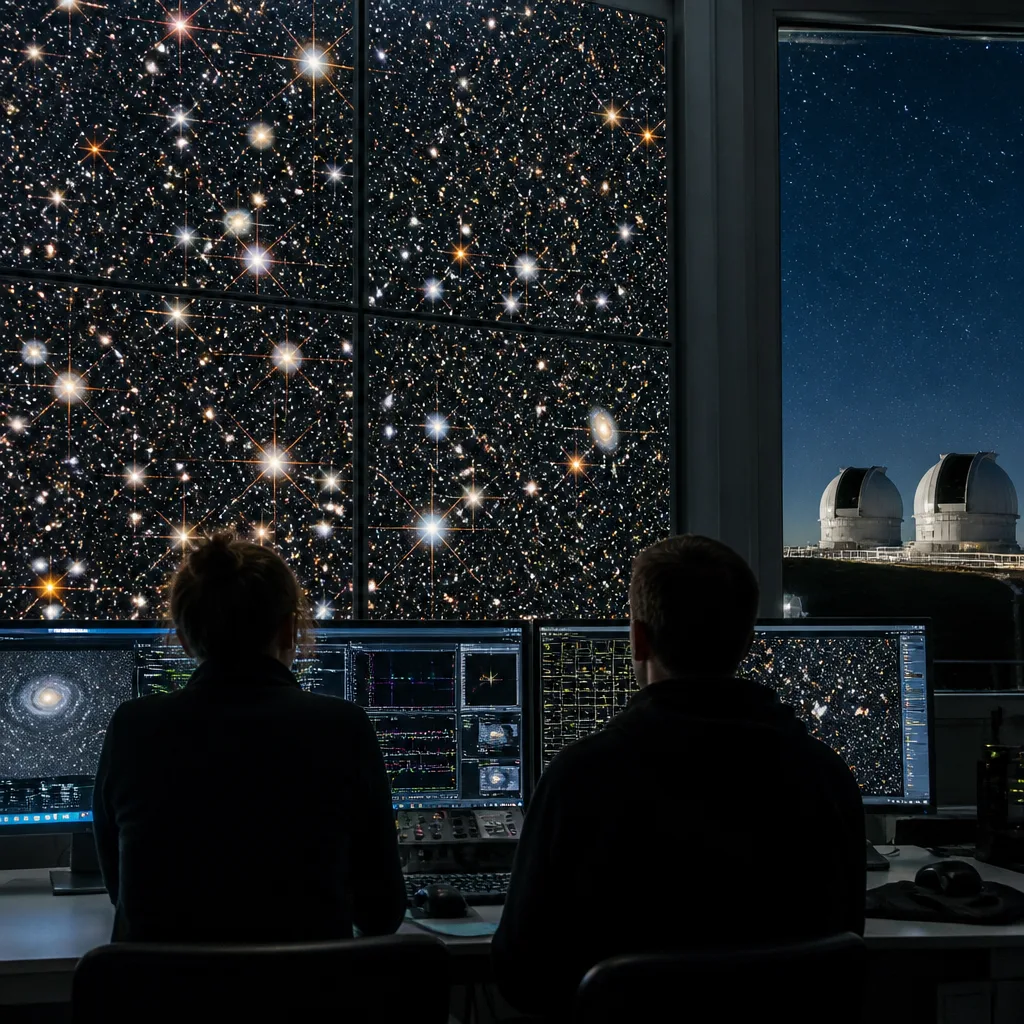
A new, 5.6‑trillion‑pixel image that charts almost 75 per cent of the sky has been published by an international team of astronomers, presenting what its authors describe as the most extensive two‑dimensional survey of the cosmos to date. Compiled over 13 years from hundreds of thousands of telescope observations, the map catalogues nearly four billion stars, galaxies and transient events in visible and near‑infrared light.
How the atlas was made
The dataset, produced by the DESI Legacy Imaging Surveys consortium and led from the United States’ Lawrence Berkeley National Laboratory, knits together observations from two principal facilities: the National Science Foundation’s Arizona Mayall telescope and the Chilean Blanco telescope. The work involved more than 160 scientists and approximately 263,407 individual telescope sessions to assemble and process the imagery.
By combining visible‑wavelength exposures with near‑infrared imaging, the team has produced a panoramic view that suppresses the obscuring effect of dust in the plane of our own Milky Way, enabling clearer detection of distant galaxies and faint structures.
What the map will enable
The survey will serve as both a public resource for skywatchers and a practical tool for professional researchers. Its immediate scientific uses include:
- searching for rare gravitational lenses that magnify distant galaxies;
- locating and characterising transient events such as supernovae;
- providing targets and reference frames for upcoming facilities and missions;
- training machine‑learning algorithms to automate discovery in very large datasets.
Project organisers have emphasised that the map is not merely aesthetic: it is constructed as a scientific reference to guide future instrumentation and to supply the input catalogues necessary for spectroscopic follow‑ups.
"Researchers expect it will remain the most comprehensive 2D map of our Universe for years to come,"
The team also highlighted the catalogue’s utility for addressing two of modern cosmology’s deepest puzzles: the nature of dark matter, which dominates mass on galactic and larger scales, and dark energy, the agent of the universe’s accelerating expansion. While a two‑dimensional image cannot by itself measure distances in three dimensions, it provides the essential photometric measurements used to select objects for spectroscopic surveys that do.
Scale and technical detail
The finished image spans an extraordinary pixel count and registers nearly four billion distinct sources. Its scale and depth make it suitable as the baseline imaging layer for several major projects planned over the next decade, including space missions and ground‑based facilities.
| Parameter | Value |
|---|---|
| Sky coverage | 75% |
| Pixel count | 5.6 trillion |
| Objects catalogued | Nearly 4 billion |
| Survey duration | 13 years |
| Contributing sessions | ~263,407 |
Because the map draws on multiple instruments, its creators invested significant effort in homogenising calibration across time and telescopes. That harmonisation reduces systematic errors when the map is used as an input to algorithms that compute photometric redshifts or search for subtle features in galaxy clustering.
Context and consequences
Large‑area imaging surveys are the backbone upon which modern observational cosmology is built. This two‑dimensional atlas will feed into spectroscopic campaigns that measure galaxy distances and motions, which in turn constrain cosmological parameters and theories of structure formation. The map will also act as a practical reference for new observatories under construction, helping to plan observations and to vet targets.
For the public, the release offers a striking visual of the night sky’s richness and a wealth of data for citizen scientists and educators. For the professional community it is a precursor: two‑dimensional imaging tells us where things are and what they look like; the next step is to measure their distances and motions — the work that will test models of dark matter and dark energy.
The dataset has been made available to researchers and the public, and is expected to underpin discovery for years, informing both targeted studies and broad searches for the universe’s rarest phenomena.









