
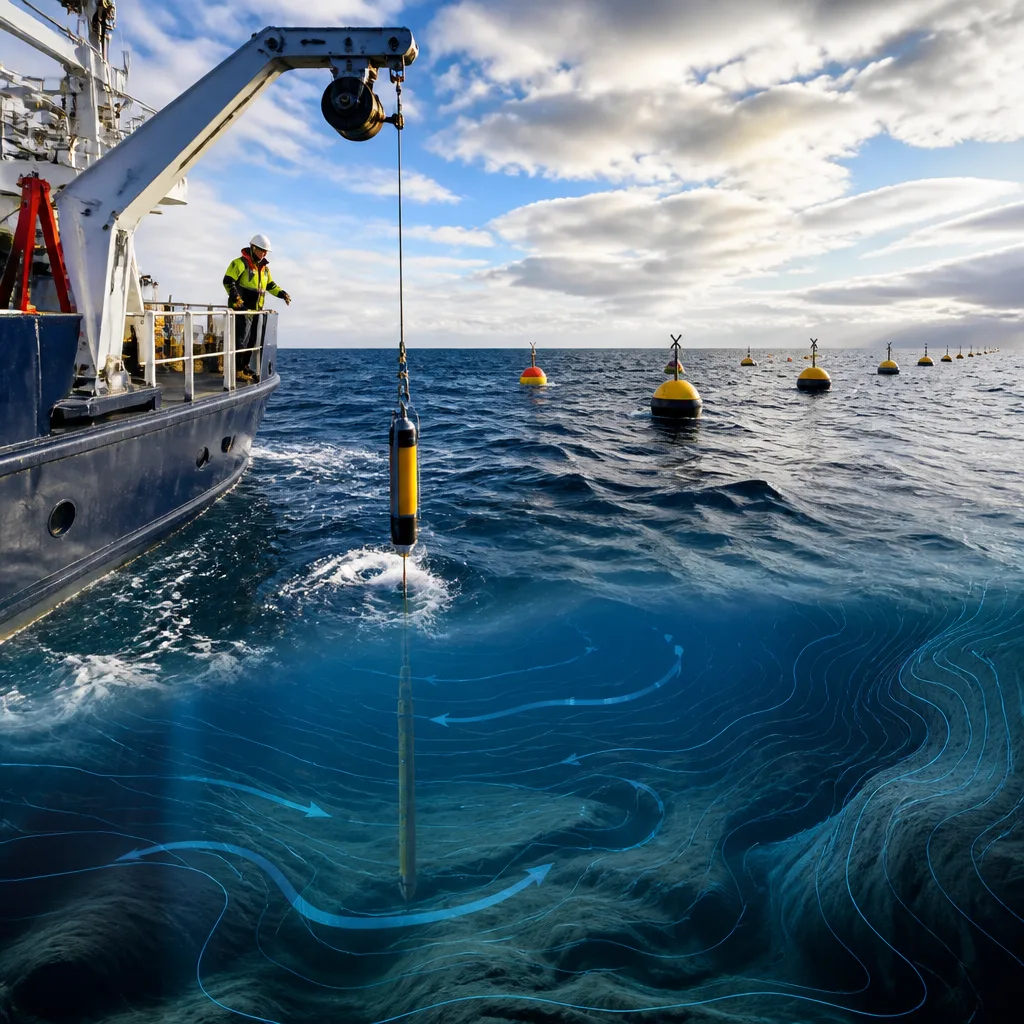
New observational analysis indicates that a pivotal component of the Atlantic Ocean’s circulation system has been losing strength for nearly two decades. The trend, detected across a wide swathe of the western North Atlantic, may have consequences for weather patterns, rainfall distribution, storm intensity and regional sea-level change.
Direct, multi-site evidence for a long-term decline
The research, led by scientists at the University of Miami Rosenstiel School of Marine, Atmospheric and Earth Science, draws on continuous measurements from four independent ocean-monitoring arrays arrayed along the western flank of the North Atlantic. Instruments anchored to the seafloor recorded pressure, temperature, density and currents, enabling researchers to infer the movement of deep water beneath roughly 1,000 metres.
By applying a consistent analytical approach at all four locations and comparing observations across time and space, the team sought changes that persisted across the basin rather than short-lived local fluctuations. The resulting picture is of a coherent weakening of the overturning system — the large-scale conveyor that transports warm surface water northwards and returns colder, denser water southwards at depth.
Why the overturning circulation matters
The Atlantic Meridional Overturning Circulation (AMOC) redistributes vast quantities of heat within the Atlantic. That redistribution helps to set regional temperatures and influences precipitation patterns, storm tracks and coastal sea levels. A slowdown therefore has the potential to alter regional climates and coastal risks in ways that extend beyond the ocean basin.
“A weaker AMOC can shift weather patterns, potentially leading to more extreme storms, changes in rainfall, or colder winters in some regions,”
The study’s senior author, a physical oceanographer at the Rosenstiel School, emphasised the circulation’s capacity to affect sea-level rise along coastlines, with implications for communities and infrastructure.
How the signal was extracted
Key to the analysis was the use of pressure measurements on the ocean bottom as an indicator of deep-water mass movement. Bottom pressure, when interpreted alongside temperature and density profiles, provides a robust means to estimate the flow of deep currents that form the return limb of the overturning system. Because the authors used the same method at each monitoring site, the findings reduce the chance that the trend is an artefact of differing measurement techniques or a peculiarity of a single location.
The combination of long-duration records and multi-site coverage allowed the researchers to detect persistent change — a necessary step when distinguishing a genuine trend from the Atlantic’s natural variability, which can be large on interannual and decadal timescales.
Consequences and the path ahead
While the study provides clear observational evidence of weakening, it does not on its own determine the ultimate trajectory of the circulation. The mechanisms driving the decline, and how rapidly it might continue, require further work that combines observations with model studies. Nevertheless, even a gradual decline in the AMOC can modulate regional climates in ways that matter for agriculture, flood defence and urban planning.
- Observational basis: Four long-term ocean arrays along the western North Atlantic.
- Depth focus: Changes inferred from currents and pressure below about 1,000 metres.
- Timescale: A persistent weakening observed for nearly two decades.
| Aspect | Reported detail |
|---|---|
| Monitoring locations | Four arrays along western North Atlantic |
| Depth examined | Below ~1,000 metres |
| Duration of trend | Nearly 20 years |
For policymakers and climate planners, the study underscores the value of sustained ocean observing systems. Long-term monitoring provides the empirical backbone needed to detect slow changes in the ocean that models predict but which can be elusive in short records. Continued and expanded observations will sharpen estimates of future impacts and help to guide adaptation strategies for coasts and weather-sensitive sectors.
In short, the ocean’s deep thermohaline machinery — often conceived as a planetary heat conveyor — appears to be easing its pace. That deceleration may not arrive as a single dramatic event, but its cumulative influence on weather, sea levels and climate patterns will be something to watch closely in the coming decades.









