
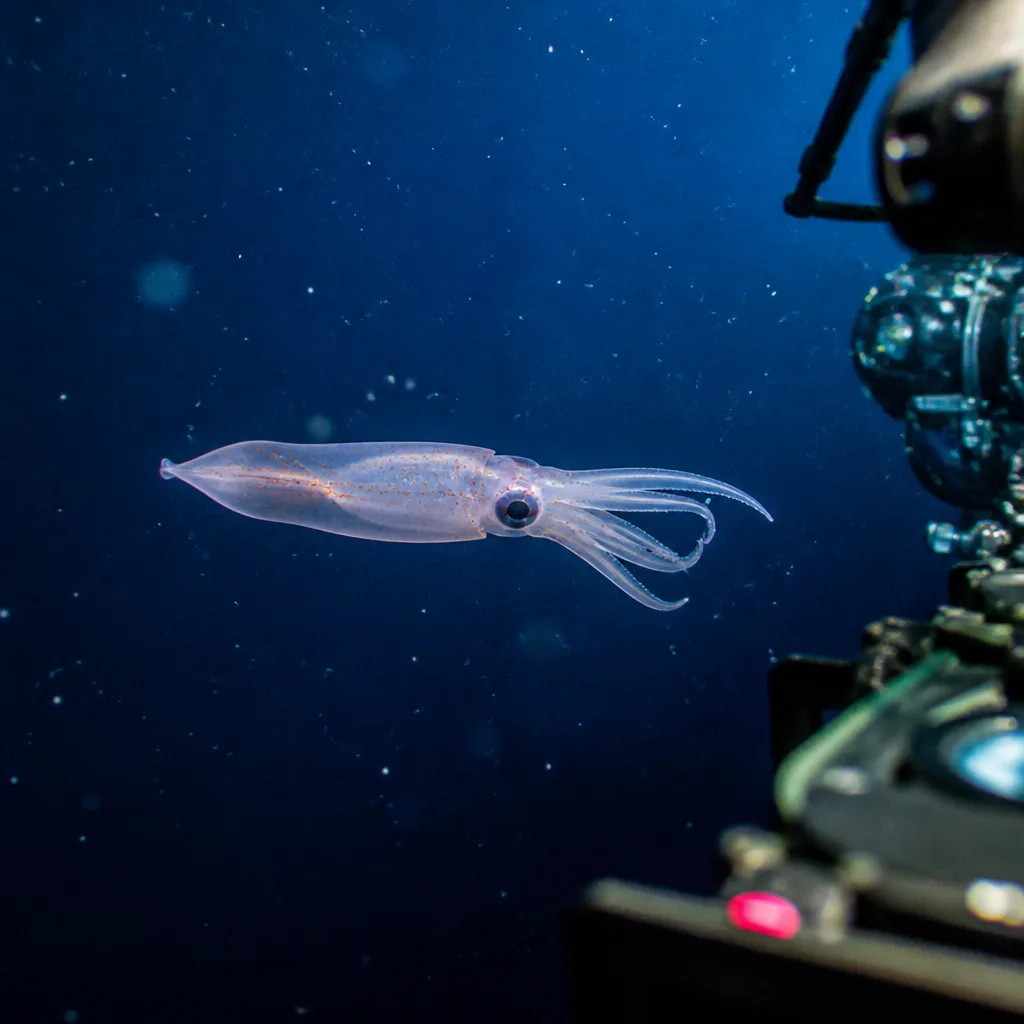
Researchers have for the first time captured confirmed live footage of a colossal squid in its natural deep‑sea environment, closing a century‑long gap between the species' scientific description and direct observation at depth. The recording, taken in March 2025 near the South Sandwich Islands, shows a translucent juvenile roughly a foot long drifting about 600 metres beneath the surface.
What the team found and where
The image was obtained by a remotely operated vehicle, SuBastian, deployed from the research vessel Falkor (too). The camera captured an animal approximately 30 centimetres in mantle length — a small, almost see‑through specimen rather than the giant often imagined from the species' common name.
- Date: March 9, 2025
- Depth: 600 metres
- Location: Vicinity of the South Sandwich Islands, South Atlantic
- Vessel/ROV: Falkor (too) / SuBastian
Why this matters
The colossal squid, Mesonychoteuthis hamiltoni, was first named in 1925 from two arm crowns recovered from a sperm whale’s stomach. For much of the last century scientists knew the species largely from parts and prey remains — beaks, hooked remains and other evidence pulled from predators or fishing catches. Complete adult specimens are rare: museum records list only nine specimens larger than juveniles since the species was described.
“For 100 years,” said Kat Bolstad, “we have mainly encountered them as prey remains in whale and seabird stomachs and as predators of harvested toothfish.”
That reliance on indirect evidence meant scientists had little opportunity to observe behaviour, shape and appearance in the animal’s living state. The new footage therefore provides a rare window on the species in life — even if the subject was an immature individual. Adult colossal squid are estimated to reach up to seven metres in total length, making them the heaviest invertebrates on Earth, but the juvenile filmed was a fraction of that size.
Verification and expert input
The recording was flagged during a live stream of the dive. Researchers consulted squid specialists to confirm the identification; the footage was examined by experts including Kat Bolstad of Auckland University of Technology and other squid biologists. Glass‑squid specialist Aaron Evans also assisted in verification.
| Attribute | Recorded value |
|---|---|
| Animal size | Approximately 30 cm (about 1 foot) |
| Depth | 600 m |
| Observation date | 9 March 2025 |
| Known adult size (estimate) | Up to 7 m |
Context and consequences
The value of in‑situ observations cannot be overstated. Direct footage enables researchers to study posture, locomotion, buoyancy strategies and body transparency — traits that do not survive intact in specimens brought to the surface or inferred from consumed remains. Even a juvenile encounter helps calibrate expectations about life stages, distribution and behaviour in the Southern Ocean.
Moreover, the event highlights the growing role of deep‑sea robotics and live streaming in marine science. ROVs such as SuBastian extend human senses into otherwise inaccessible habitats, producing data that can be rapidly shared with specialists worldwide to secure timely identifications.
While the filmed individual does not replace the need for more observations of mature animals, it is a milestone: the first confirmed sighting of a colossal squid alive and undisturbed at depth since the species was named a century earlier. That single day in March 2025 therefore marks the closing of a long observational gap and opens a clearer path for future study of one of the ocean’s most enigmatic giants.









