In the early hours of 16 July 1945, in a remote area of the New Mexico desert, a team of scientists, engineers and military personnel observed an event that would alter the course of modern history: the first detonation of a nuclear device, code‑named Trinity. A fireball rose into the sky and a concussive wave swept across the test site; the experiment that day was judged a success. New archival material and a recent illustrated history cast renewed light on the practical challenges the team faced as they designed ways to measure a blast whose energy releases were profoundly uncertain.
Measuring the unknown
The fundamental problem confronting the researchers was simple to state and fiendishly hard to resolve: the greatest unknown was the quantity of energy the device would release. That uncertainty had consequences across every aspect of planning. Instrumentation had to survive or record readings through an environment never before produced by humans; data collection had to be redundant because devices would almost certainly be destroyed; and observational priorities needed to be set with imperfect prior knowledge.
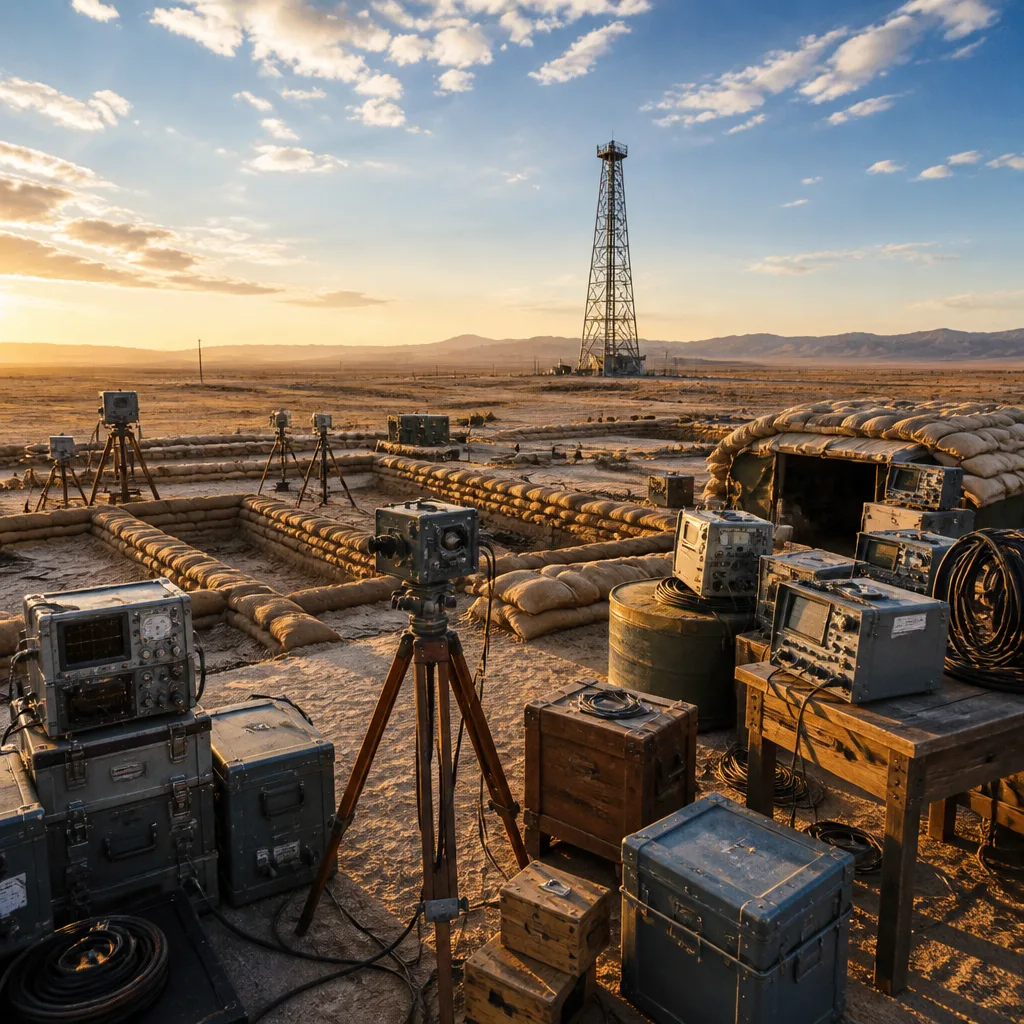
The recent book under review, drawn from the Los Alamos National Laboratory’s legacy photographic collections, emphasises the human labour behind that technical work. Teams devised experiments to establish the yield of the detonation, study the blast’s interaction with ground and atmosphere, and record thermal and radiative effects. Many of the diagnostic tools were purpose‑built, deployed at varying distances, and arranged with overlapping objectives so that failures of any single instrument would not render the event unknowable.
How they organised the instruments
Planning for Trinity was therefore an exercise in hedging. The scientists sought to capture complementary measurements — optical, pressure, seismic and photographic — each constrained by physical limits and by the practical reality that much of the apparatus would be lost in the explosion. That approach is least dramatic in description but most revealing about the project’s scientific method: rather than a single definitive measurement, the team constructed a matrix of partial observations that together would constrain the likely range of yields.
- Redundancy: multiple instruments measured similar quantities so that the failure of one did not eliminate a class of data.
- Staggered distances: diagnostics were placed at varying ranges to capture the event across different intensities.
- Different modalities: optical and pressure records, plus ground motion sensors, were combined to cross‑validate estimates.
That combination of measures allowed the team to infer outcomes with higher confidence than any single reading could provide. It also reflects a scientific culture comfortable with probabilistic conclusions — the yield could not be predicted precisely in advance, but the experimental design was intended to confine the uncertainty to a usable interval.
Context and consequences
The Trinity test was part of the broader Manhattan Project, itself a vast mobilisation of technical skill and industrial capacity. The new illustrated account underscores an aspect sometimes overlooked in popular narratives: the intense engineering and experimental work that translated theoretical physics into measurable reality under extreme conditions. The photographs and documentation gathered in the book remind readers that experimental physics at this scale is as much about logistics, survivability and measurement strategy as about equations on a blackboard.
Understanding how those first experiments were planned helps explain how subsequent nuclear testing — and later arms control monitoring — developed. The same principles of redundancy, cross‑modal measurement and staged deployment underpin modern approaches to studying high‑energy phenomena, whether in national security contexts or in civilian research into shock physics and high‑temperature plasmas.
| Item | Detail |
|---|---|
| Date | 16 July 1945 |
| Location | Remote New Mexico desert |
| Principal focus | Experimental measurement of blast energy and effects |
The visual record now published also serves as a reminder of how closely scientific endeavour is tied to ethical and political questions. The technical problem solved at Trinity — measuring an unprecedented energy release — cannot be separated from the wider implications of what that capability meant for the conduct of war and for post‑war geopolitics. For historians and scientists alike, fresh primary material prompts renewed scrutiny of both method and motive.
By examining the experimental choices made under conditions of acute uncertainty, the new collection helps modern readers appreciate the craft of large‑scale scientific measurement: the framing of hypotheses, the pragmatic engineering of instruments that might not survive, and the deliberate overlap of observations that together converted an explosive event into data.