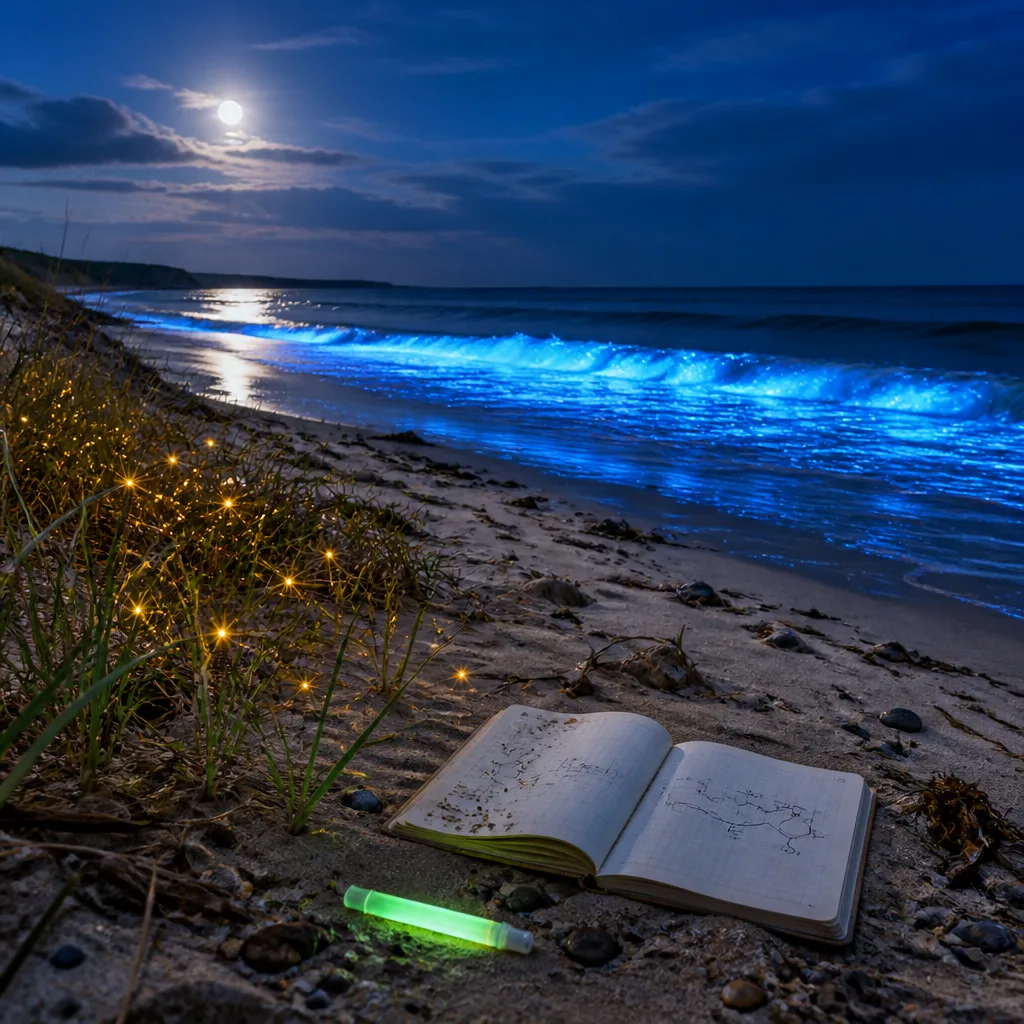
Bioluminescence — the generation of light by living organisms — is a chemical trick that can appear indistinguishable from magic. Across land and sea, a common pair of compounds combine to produce visible light, creating the flickers of fireflies and the ghostly blue of glowing waves.
The chemistry of living light
At its heart, bioluminescence is a simple chemical reaction made elegant by evolution. In many organisms the process depends on two classes of molecules: a light-emitting substrate and an enzyme that catalyses the reaction. In fireflies these are known as luciferin (the molecule that emits light) and luciferase (the enzyme that triggers the emission). Marine organisms often use chemically similar systems, with comparable roles played by substrate and catalyst.
A practical analogy that helps explain the process is the familiar glow stick. Inside a glow stick a fragile inner tube separates two reactive chemicals. Bending the stick breaks that inner tube and the previously separated solutions mix; the resulting chemical reaction produces light. In living creatures the mixing is controlled biochemically and, crucially, can be turned on and off by the animal.
When and why organisms glow
Bioluminescence appears in many contexts and serves several ecological purposes. Observers report a peak of marine displays at the start of summer when coastal waters and fields simultaneously teem with life. Broadly speaking, the light can be used for:
- Mating — patterned flashes act as courtship signals, notably in many firefly species.
- Predator deterrence — sudden light emissions can startle or confuse potential attackers, or advertise unpalatability.
- Communication and camouflage — in the ocean, bioluminescence can reveal or obscure an animal’s silhouette, depending on the context.
Marine manifestations and the summer surge
In coastal seas, a wide array of organisms — from single-celled plankton to larger animals — are capable of producing light. Because many of these species bloom seasonally, observers often see a synchronised increase in luminous displays in late spring and early summer. The effect can be ephemeral: the light is most visible under dark skies, and the creatures’ flashes or glows are often sporadic, giving the impression of spontaneity.
| Context | Typical biological role |
|---|---|
| Terrestrial (e.g. fireflies) | Mating signals; species recognition |
| Marine (e.g. plankton, fish) | Defence, communication, camouflage |
From childhood jars to coastal spectacle
Many people first encounter bioluminescence in the domestic setting of a jar of fireflies, an evocative memory that mirrors the basic science: internal chemistry producing visible light. Scientific study takes that childhood wonder further, revealing precise molecules, reaction mechanisms and adaptive benefits. Research into these systems has practical applications too — the luciferin–luciferase pair has been adapted as a laboratory tool for measuring gene expression, tracking cells and detecting small amounts of biological material.
Despite the growing body of research, the transient nature of natural displays means they still carry an element of the unexpected. Coastal observers who venture out on a summer night can witness flashes that seem improvisational; the irregular timing and scale of the glows are a consequence of ecological dynamics and the animals’ own behavioural control of the chemistry.
Bioluminescence therefore sits at the intersection of chemistry, behaviour and ecology. A handful of molecules, combined with evolutionary pressure and seasonal opportunity, can produce scenes that have inspired folklore and, as scientific understanding grows, provide tools for modern biology.