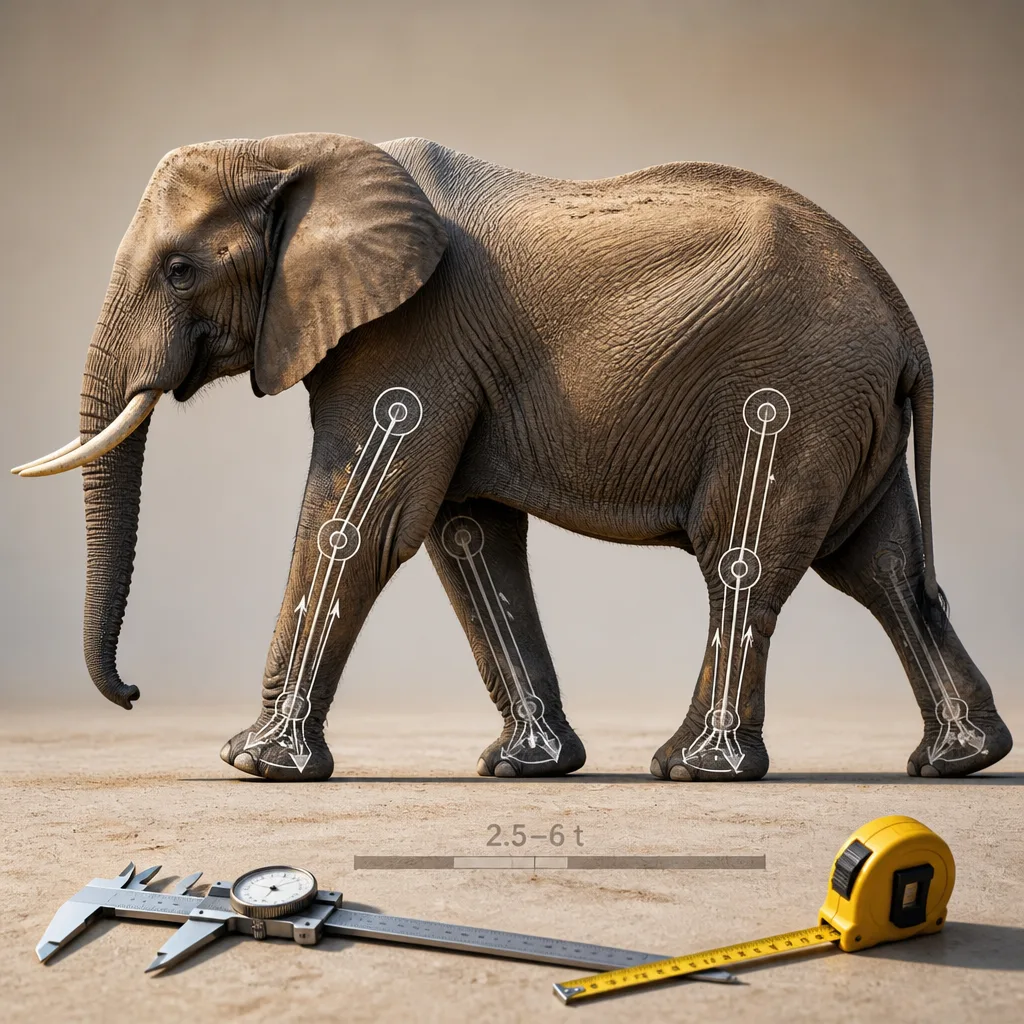
The long‑standing observation that elephants never jump has been explained not by a single dramatic discovery but by the slow accretion of biomechanical reasoning: at their enormous mass, the animal simply cannot produce the necessary forces and limb dynamics to have all four feet off the ground at once. Scientists point to basic anatomy and the laws of physics as the decisive factors behind a behaviour humans have noted for generations.
Size, structure and the limits of motion
An adult elephant can weigh between 2.5 and 6 metric tonnes, depending on species and sex. At that scale, the energetic and mechanical demands of launching the whole body into the air are vastly greater than for smaller mammals. Researchers say the phenomenon is not the result of a single oddity but of multiple, convergent constraints: body mass, limb geometry and the mechanical capacity of muscles and tendons to store and return energy.
“There hasn’t been a single study specifically designed to explain why elephants can’t jump,”
That admission from Professor John Hutchinson of the Royal Veterinary College in London underlines the point: rather than a single targeted experiment, current explanations draw on comparative anatomy, locomotive modelling and the well‑tested laws of mechanics. In practice, this means experts examine what is required for a grounded animal to become airborne — and then ask whether an elephant’s skeleton and soft tissues can meet those requirements.
Why the elephant differs from other large mammals
Not all large land animals are equally constrained. The article notes that some other heavy mammals, such as rhinoceroses, can briefly become airborne when moving fast. That difference indicates that mass alone does not fully determine jump ability — limb proportions, posture and the capacity to generate rapid force all matter. Elephants combine enormous weight with a limb and joint arrangement that favours steady support rather than explosive extension.
- Mass and energy: greater body mass raises the energetic cost of acceleration to flight.
- Limb design: elephants have columnar, weight‑bearing legs optimised for support rather than springing motion.
- Evolutionary trade‑offs: selection has favoured stability and endurance over explosive manoeuvres in elephants’ ecological niches.
Method and inference
Because no single experiment has been carried out specifically to answer the question, conclusions are inferential. Scientists combine observations of behaviour with biomechanical models and comparative data across species. These models estimate the forces muscles and tendons would need to generate, and whether the animal’s bones and soft tissues could safely support those loads. The consensus from these approaches is robust: the mechanical and energetic barriers are prohibitive.
This inferential route mirrors other questions in evolutionary biomechanics where direct experimental manipulations are impossible or unethical. By mapping known anatomical parameters onto physical equations for locomotion, researchers can rule out behaviours as physically implausible rather than merely unobserved.
Implications and broader context
Understanding why elephants never jump is more than a curiosity. It helps clarify how extreme body size shapes behaviour and ecology, and offers a cautionary note for those modelling extinct giant animals. If anatomy and physics prevent modern elephants from jumping, palaeontologists should be similarly cautious when reconstructing the locomotion of large fossil species.
Finally, explaining this familiar natural fact demonstrates how scientific explanation proceeds: combining observation, comparative evidence and the constraints imposed by basic physics to reach a conclusion. The result is at once simple and illuminating — a reminder that sometimes the most dramatic behaviours are ruled out not by choice but by the inescapable arithmetic of mass and force.
| Characteristic | Elephants |
|---|---|
| Adult mass | 2.5–6 metric tonnes |
| Observed jumping | No all‑four‑feet airborne phase recorded |
| Comparative note | Some other large mammals (e.g. rhinos) can momentarily become airborne |