
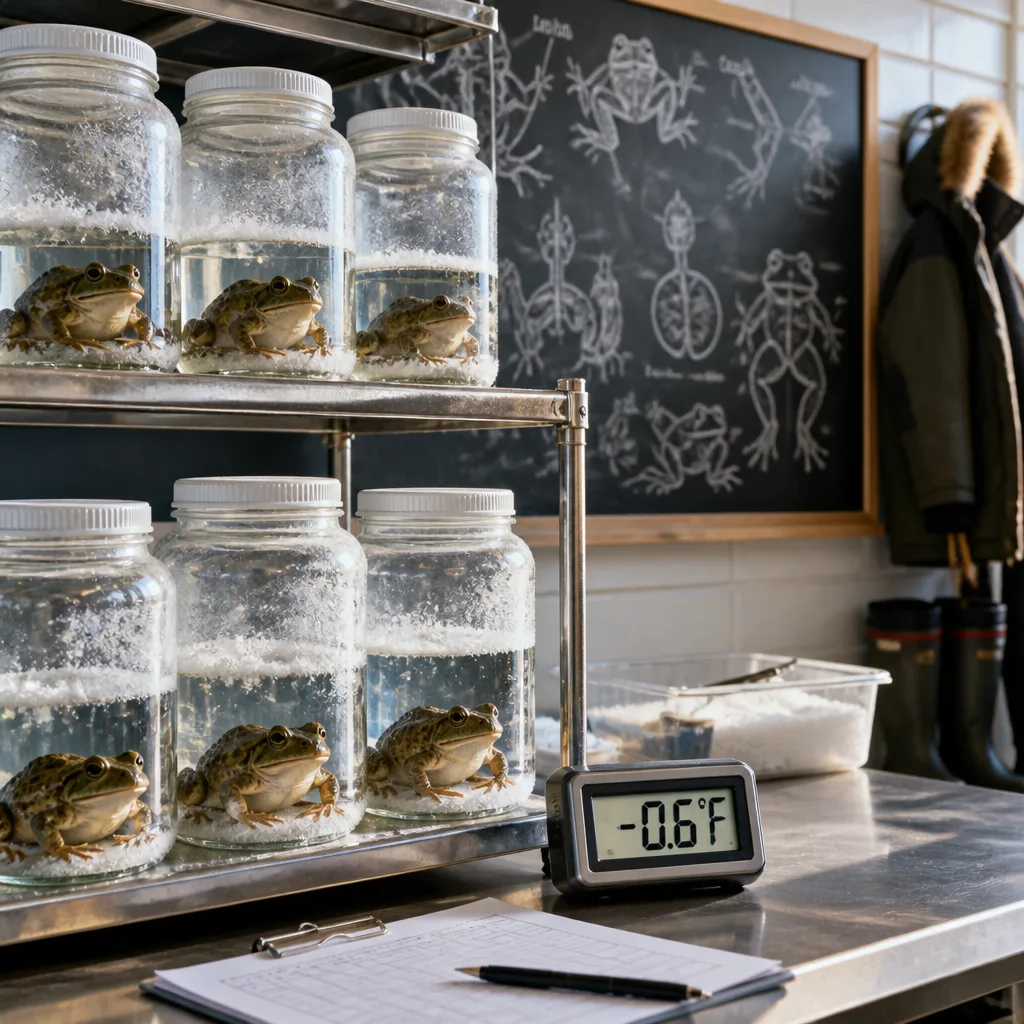
Wood frogs in Alaska can tolerate internal body temperatures that dip below freezing, a fact that continues to intrigue scientists and students alike. The University of Alaska Fairbanks (UAF) has used these amphibians both as a teaching tool and as a subject of research into how animals survive long, brutally cold winters.
A study subject that hops into the classroom
The story dates back decades. An article first published in 1996 recounts how UAF researchers sought live wood frogs for a study of overwintering biology, and how public curiosity – exemplified by an exchange between a professor and an 8‑year‑old pupil – helped supply specimens for teaching. That anecdote is preserved in the university’s archive and was accompanied by a recent editor’s note updating some of the findings and personnel status.
UAF associate professor of zoophysiology Brian Barnes placed a classified advertisement seeking wood frogs collected near Fairbanks. The ad offered small sums — “25 cents for small; $1 each for large” — and helped bridge field collection and classroom demonstration. The outreach element is obvious: specimens gathered for a class would be used to explain how northern animals prepare for and endure winter.
“He wants to keep his frogs,” Barnes said, smiling as he hung up.
What the frogs reveal
Wood frogs (Rana sylvatica) are remarkable among vertebrates for their freeze tolerance. The UAF archival note summarises later scientific work showing that these frogs’ internal temperature can fall to approximately 0.6 degrees below zero Fahrenheit while overwintering. After months in a frozen state, many individuals resume normal activity in spring, hopping about breeding ponds and forest floors as if they had not spent the winter partly frozen.
Their biology has made them an accessible natural experiment for students learning about physiology and adaptation. In one cited classroom exercise, students observed the stages of freezing and thawing, and discussed metabolic suppression, ice‑nucleating processes and the role of cryoprotectants — all subjects central to understanding how organisms bridge life and suspended states.
Why this matters beyond Alaska
There are two main strands of broader scientific relevance. First, freeze tolerance in wood frogs illustrates fundamental physiological strategies — such as controlled ice formation and solute management — that allow tissues to survive intracellular and extracellular ice. Second, these amphibians provide a tractable model for research that can inform fields from conservation physiology to cryomedicine.
Although the source material focuses on classroom and local fieldwork, the lessons scale up. Students who handle specimens and analyse datasets learn experimental design, the limits of physiological plasticity, and how species’ life histories are shaped by extreme environments. For researchers, insights from natural freeze tolerance contribute to understanding how organisms may respond to shifting winter regimes under climate change.
Key dates and facts
| Item | Detail |
|---|---|
| Original article publication | 7 August 1996 |
| Updated editorial note | Explains newer findings and retirement status of authors |
| Observed internal temperature | Approximately −0.6 °F during overwintering (as cited) |
| Specimen sourcing | Local collectors near Fairbanks; small payments offered for live frogs |
- Teaching value: live animals let students witness freeze–thaw cycles and link classroom theory to natural history.
- Research value: wood frogs serve as a model for physiological and ecological studies of freeze tolerance.
- Public engagement: local collection and storytelling helped connect the community to science.
The wood frog’s ability to pause and restart biological processes remains a neat, tangible example of nature’s solutions to extreme conditions. For a national science readership, the case underscores how modest, regionally focused studies can illuminate broad biological principles — and why preserving opportunities for hands‑on fieldwork and teaching still matters.
As classrooms and researchers continue to probe the mechanisms behind freeze tolerance, these unassuming amphibians will likely remain both a subject of curiosity and a source of insights with implications far beyond the ponds they inhabit.









