
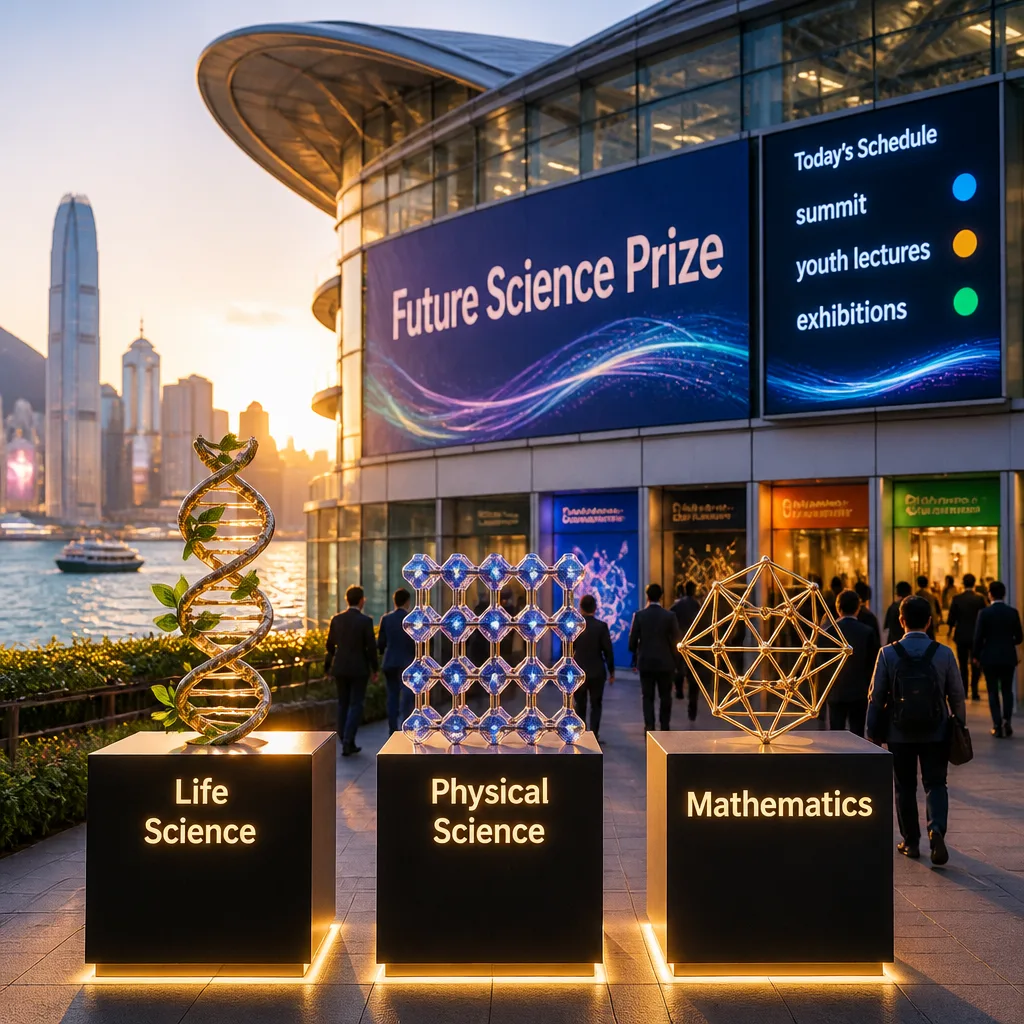
The Future Science Prize, held in Hong Kong for the fourth consecutive year, has confirmed its position as a major international showcase for scientific achievement in the Greater China region by naming three mainland researchers among this year’s laureates and staging a week-long programme expected to attract nearly 100 world-class scientists.
Laureates and their work
The awards, announced at a live-broadcast press conference on Thursday, recognised contributions across the life sciences, physical sciences and mathematics/computer science.
- Zhang Hong (Chinese Academy of Sciences) — Life Science Prize: honoured for pioneering work on the mechanism and physiological function of autophagy specific to multicellular organisms.
- Zhao Dongyuan (Fudan University) — Physical Science Prize: awarded for advances in mesoporous materials, covering synthesis control, mechanistic understanding and industrial application.
- Yuan Xinyi (Peking University) — Mathematics and Computer Science Prize: recognised for foundational contributions to arithmetic geometry.
"The award leveraged Hong Kong’s advantage as an international gateway to showcase the scientific prowess and influence of the Greater China region to the world,"
The statement, made by Sun Dong, Secretary for Innovation, Technology and Industry, framed the prize as a vehicle both for regional scientific diplomacy and for elevating research visibility on the global stage.
Programme and reach
Prize week will include a science summit, youth science lectures and exhibitions. Organisers expect the events to draw nearly 100 distinguished participants, including Nobel laureates and Fields Medal winners, bringing together senior scientists and early-career researchers for public engagement and specialist exchange.
That mix of public-facing lectures and high-level exchanges is a deliberate design: it aims to accelerate collaborations, inspire students, and advertise the region’s research strengths to an international audience. The prize has now been hosted in Hong Kong for four straight years, a continuity organisers say reinforces the city’s role as a conduit between mainland research and global networks.
What the awards signify
The three winning projects illustrate a broad sweep of contemporary priority areas in basic and applied science. Autophagy — the cellular process of self-digestion that maintains cellular health — has implications across neurodegeneration, cancer and ageing research; advances in mesoporous materials feed directly into catalysis, separation technologies and industrial chemistry; and progress in arithmetic geometry underpins deep connections between number theory and algebraic geometry with potential long-term impact on cryptography and theoretical computer science.
While the announcement did not include details of prize sums or the selection process in the public briefing, the presence of internationally eminent scholars at the associated events will offer opportunities for scrutiny, collaboration and cross-fertilisation of ideas.
| Prize | Laureate | Affiliation | Recognised work |
|---|---|---|---|
| Life Science | Zhang Hong | Chinese Academy of Sciences | Autophagy specific to multicellular organisms |
| Physical Science | Zhao Dongyuan | Fudan University | Mesoporous materials: synthesis, mechanism, application |
| Mathematics & Computer Science | Yuan Xinyi | Peking University | Foundational work in arithmetic geometry |
The event’s continued presence in Hong Kong provides a platform for the Greater China research community to engage with global scientific leaders. For organisers and local authorities the prize serves both to celebrate scientific excellence and to strengthen Hong Kong’s cultural and infrastructural role as a scientific meeting point.
Observers will watch the prize week for signs of new collaborations, public engagement reach, and the potential for the event to influence research priorities and funding flows across the region. With Nobel laureates and Fields Medal winners expected to attend, this year’s programme looks set to offer both headline-grabbing plenaries and more technical symposia where the detailed work of the laureates can be interrogated and extended.
As the Future Science Prize moves into its next edition, its organisers will hope that continuing to attract top global talent cements the award’s standing and translates recognition into sustained scientific progress.









