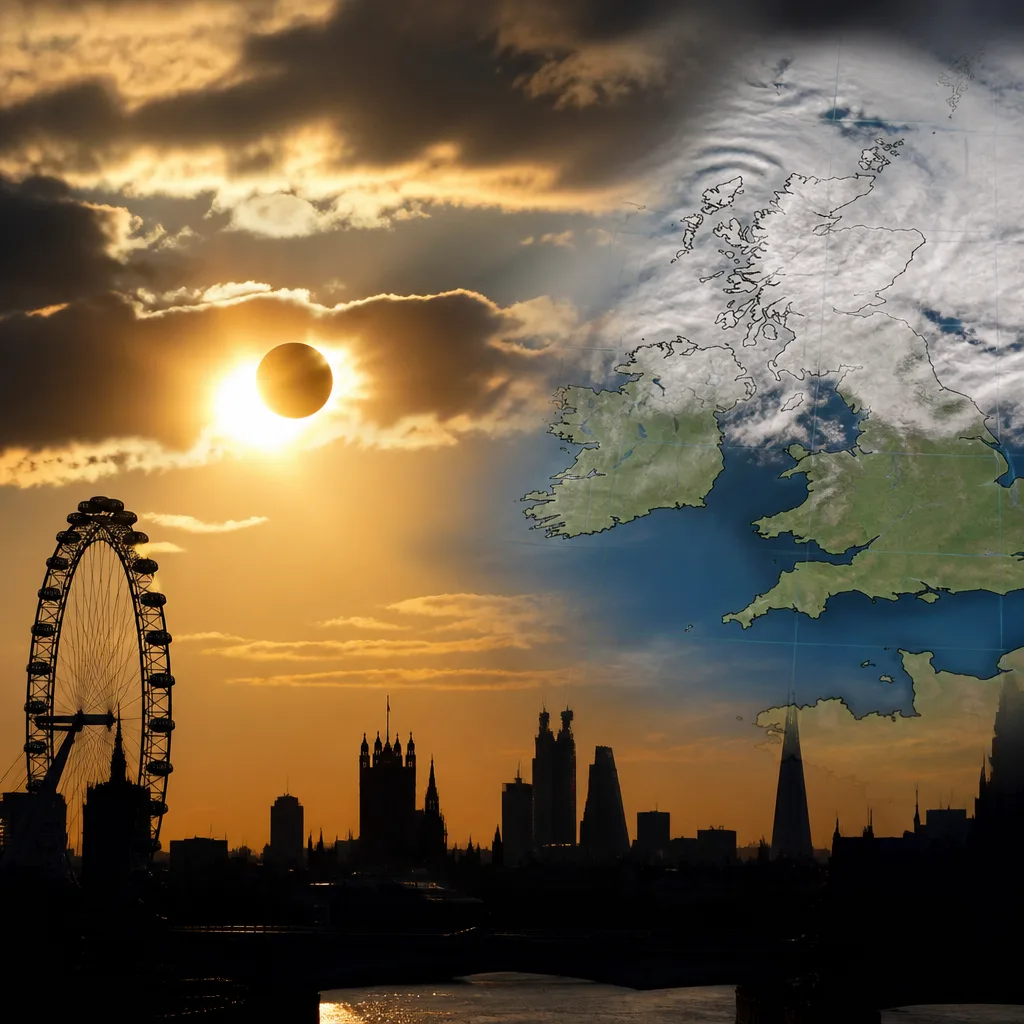
Much of the UK will have to hope for a break in the cloud on Wednesday evening if people want to see what is expected to be the country’s most striking solar eclipse in 27 years. The Moon will pass between the Sun and Earth on 12 August, producing a partial eclipse across the UK; depending on location, observers can expect roughly 90–96% of the Sun’s disc to be obscured.
When to look
The event begins in the early evening, shortly after 18:00 BST, with the greatest coverage taking place in the hour that follows. The window for maximum obscuration is not identical across the country, but currently falls between about 19:05 and 19:13 BST. Key timings for major cities are:
| Location | Approximate time of maximum eclipse (BST) |
|---|---|
| London | ~19:13 |
| Manchester | ~19:10 |
Where the view looks best — and worst
Current weather charts from the Met Office indicate a regional split in cloud cover at the time of the eclipse. Southern parts of England are forecast to have the clearest conditions around the maximum eclipse, making them the most favourable areas for viewing on present maps. By contrast, much of the north of England shows cloud over the projected peak period — including large parts of Yorkshire, the North East and the North West, as well as the Greater Manchester area.
Scotland is largely expected to be cloudier at the critical time, and some cloud is also shown over northern Wales, although its southern parts appear comparatively clearer on the latest charts. These assessments are based on model outputs available a few days before the event and therefore carry normal forecast uncertainty.
What to expect and what to do
Because the eclipse occurs close to sunset for the UK, the sky will already be dimming as the Moon covers the Sun. Even with high obscuration, the event will be partial here — the daylight will not turn to full night. For the best chance of seeing the eclipse:
- Keep an eye on localised short-range forecasts on the day for cloud trends.
- Consider travelling to lower-risk areas if you have flexibility — southern England currently shows the clearest outlook.
- Use proper eye protection designed for solar viewing at all times while looking at the Sun.
It is worth emphasising that weather maps a few days out can change; small shifts in frontal positions and local sea-breeze effects can materially alter cloud over an evening. If viewing plans are important to you, check late updates from the Met Office and local services on the morning and afternoon of 12 August.
Forecast confidence and likely impacts
Confidence in the broad-brush regional picture is moderate at this range: the models consistently suggest clearer skies in the south and greater cloudiness across many northern areas, but details — for example, whether a particular town will be under a thin layer of high cloud or a thicker overcast band — remain uncertain. There are no widespread weather hazards associated with the eclipse itself; the main impact is the potential for limited visibility of the astronomical event.
For those planning to watch, the practical priorities are safety and checking nearer-term observations: make sure any viewing equipment has approved solar filters, and verify last-minute local forecasts. If cloud threatens your location, flexibility to move a short distance or joining organised events in clearer areas may improve your chance of a good view.
Finally, remember this will be a partial eclipse across the UK. Although dramatic, it will not be total; atmospheric light levels will change, but darkness will not descend as it would under a total eclipse experienced elsewhere along the path of totality.