
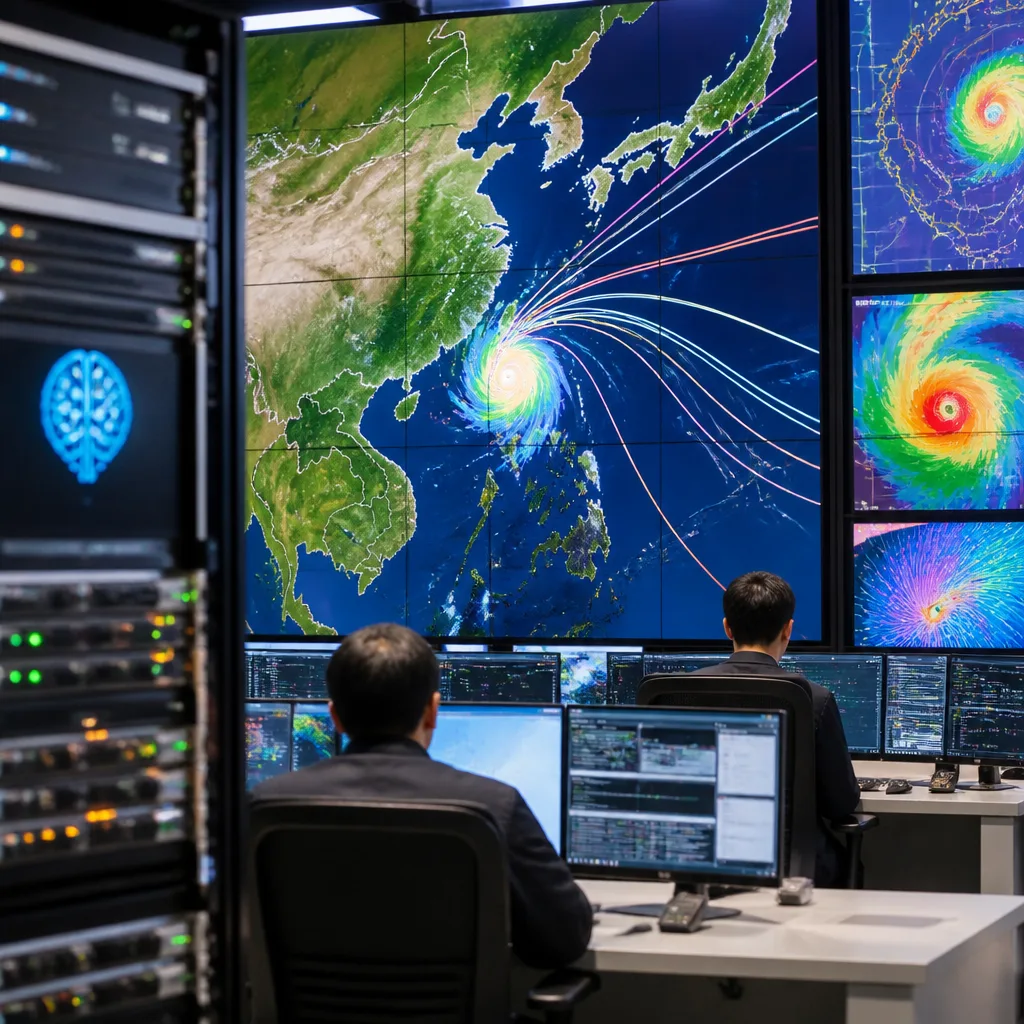
Chinese-developed artificial intelligence systems were being used alongside traditional numerical models as Typhoon Dolphin tracked towards China, underscoring a rapid shift in how weather forecasts are produced and deployed.
What is changing in forecasting
For decades, operational weather prediction has depended on numerical weather prediction (NWP) models that simulate atmospheric physics on supercomputers. Recent developments, however, have seen a new generation of AI-based forecasting models trained on vast historical records of observations. These systems can produce forecasts far more quickly than conventional methods, and in some independent comparisons they have matched or outperformed established models on particular measures of skill.
Who is building the models
China has emerged as a notable contributor to this field. Several Chinese systems have been identified among the leading AI models globally:
- Fengwu – developed by Shanghai AI Laboratory and industrial partners;
- Pangu – developed by Huawei;
- Fuxi – developed by Fudan University.
These sit alongside other internationally recognised AI models such as Google’s GraphCast and GenCast, Nvidia-backed FourCastNet, and the European Centre for Medium-Range Weather Forecasts’ AI Forecasting System (AIFS).
Performance and practical impacts
Developers of Fengwu reported that it outperformed GraphCast across roughly 80% of evaluated weather variables in their assessments and extended skilful global medium-range forecasts beyond 10 days. While such performance claims are model-specific and depend on the metrics and datasets used, any improvement in forecast accuracy or lead time can have real-world consequences during severe weather: better track forecasts can assist authorities in planning evacuations, directing flood defences and managing transport disruptions.
“With more extreme weather, people need information to make decisions, both local governments, the national government, also the average person, farmers and fisherman,” said Sun Zhi, the CTO of Techwind, a company involved in Fengwu’s industrial applications.
The speed of AI systems is one of their clearest advantages. Because they learn statistical patterns rather than solving the full set of physical equations, they can generate forecasts in a fraction of the time taken by conventional supercomputer-based models. That speed can be crucial during rapidly evolving events such as tropical cyclones, where updated guidance is needed frequently.
Competition and collaboration
The growth of AI forecasting has created a competitive landscape where technology companies, universities and national meteorological services each play roles. Competition may accelerate improvement, but it also raises questions about the criteria used to judge forecasts, data-sharing practices and the transparency of models — particularly when proprietary systems are involved.
| Model | Developer / Origin | Noted strength |
|---|---|---|
| Fengwu | Shanghai AI Laboratory (China) | Reportedly outperformed GraphCast on many variables |
| Pangu | Huawei (China) | Rapid forecast generation |
| Fuxi | Fudan University (China) | Research-led AI approach |
| GraphCast / GenCast | Google (international) | Well-known benchmark systems |
What this means for the public
For people living in the path of storms such as Typhoon Dolphin, the immediate priority remains to follow official warnings issued by meteorological and emergency authorities. AI tools are an additional layer of information rather than a replacement for established services. Their potential benefits include more frequent updates and, in some cases, improved medium-range guidance; their limitations include dependence on the quality and quantity of historical data used for training and the fact that different evaluation methods can give different impressions of relative skill.
Forecasters and emergency planners are increasingly combining outputs from multiple systems — traditional NWP models, ensemble forecasts and AI-derived guidance — to form a consensus view and to communicate risk. That approach aims to balance the strengths and weaknesses of each method and provide decision-makers with the most reliable information possible.
As AI forecasting matures, national meteorological services, research institutes and technology firms will continue to test these systems in real-world events. The outcome will shape not just technical performance but also how warnings are issued and how communities prepare for extreme weather in the years ahead.









