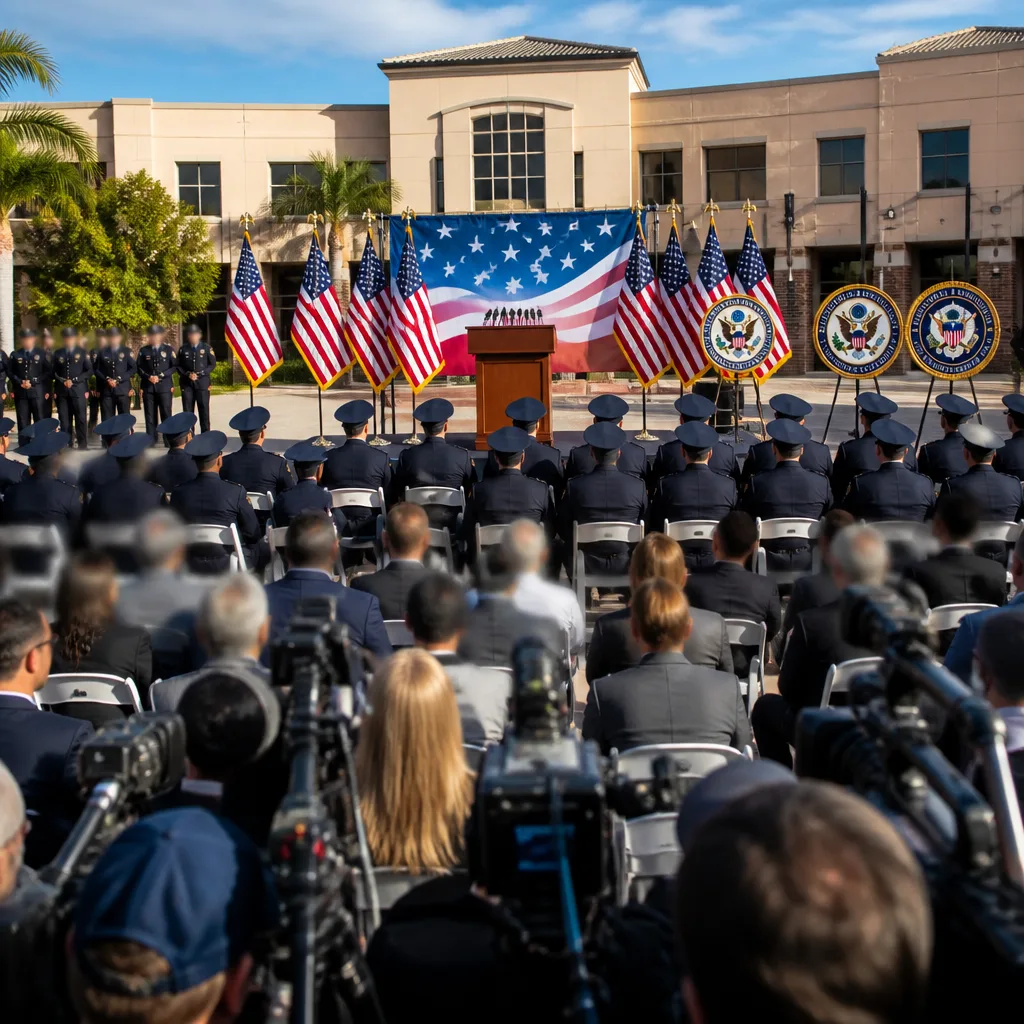
US President Donald Trump on Friday used an appearance at the Nassau County Police Academy in suburban Long Island to underscore his law-and-order message, saying recently compiled FBI data showed a fall in violent crime in 2025 and pressing the point to audiences he said should back Republican candidates in November's midterm elections.
Event blended crime statistics with political campaigning
The president framed the statistics as evidence of his administration's performance on public safety and linked the theme to an appeal for Republican support in battleground House and state races. The Nassau visit featured a visible backdrop of uniformed officers and included remarks earlier from the new US Attorney General and FBI Director—appearances that observers said blurred the customary separation between federal law-enforcement agencies and partisan political events.
"Radical Left Democrats" and "Sleepy Joe"
During his address, the president criticised his political opponents and his predecessor, using familiar epithets to drive a pointed political message. Two senior officials—Attorney General Todd Blanche and FBI Director Kash Patel—spoke at the event before the president, according to reports.
Officials from the White House and the county emphasised the theme of crime reduction, while Republican strategists framed the visit as an effort to shore up support in New York, where the president narrowly carried Nassau County in 2024. The county includes several competitive congressional districts that Republicans aim to flip or retain in the coming elections.
Concerns about norms and effectiveness
Critics noted that the public participation of top federal law-enforcement leaders in a politically charged event departs from long-standing practice that seeks to keep agencies non-partisan. The presence of those officials on stage prompted commentary about institutional norms and the independence of the Department of Justice and the FBI.
There is also debate over the political benefit of such appearances. While the president’s law-and-order theme remains central to Republican messaging, questions persist about whether this will translate into electoral gains given his fluctuating approval ratings and other national issues that may affect voter sentiment.
- Venue: Nassau County Police Academy, Long Island, New York
- Main theme: Crime reduction and law-and-order record of the administration
- Senior officials present: Attorney General Todd Blanche and FBI Director Kash Patel
- Political aim: Boost Republican candidates in competitive House and state races
| Item | Detail |
|---|---|
| Reported crime data | FBI statistics indicating a decline in violent crime for 2025 (figures to be released) |
| Location significance | Nassau County is a politically contested suburban county the president won narrowly in 2024 |
| Political stakes | Several House seats and state-level contests seen as winnable by Republicans |
Political operatives in New York highlighted Nassau County as a strategic target: it houses a large police force, contains two Democratic-held congressional districts now viewed as competitive, and is the base of the county executive who is running for governor with presidential backing. The visit was therefore cast as an attempt to consolidate suburban law-and-order voters.
Law-enforcement analysts and some civil-society groups expressed unease that the participation of the Attorney General and the FBI Director at a partisan event could be interpreted as institutional endorsement of a candidate or party. They argued that maintaining clear boundaries between law enforcement and partisan campaigning is important to preserve public trust and the perceived impartiality of federal agencies.
Supporters said the presence of senior officials was justified by the focus on crime and public safety; they described the event as an opportunity to spotlight policy achievements and to engage with local officers. Republican strategists also defended the president's appearance as a legitimate component of electioneering.
As the November contests approach, the episode is likely to intensify discussion about the role of crime narratives in electoral politics, the responsibilities of federal law-enforcement leaders in political settings, and whether appeals to public safety will be decisive with voters facing a range of economic and foreign-policy concerns.