Kochi / Minicoy, Aug 14: A naturally occurring coral assemblage exhibiting three distinct colours beneath the waters off Minicoy in Lakshadweep has provided researchers with important observations on how individual coral colonies respond differently to environmental stress, the Central Marine Fisheries Research Institute (CMFRI) said on Friday.
Distinct responses observed in neighbouring Lobophyllia colonies
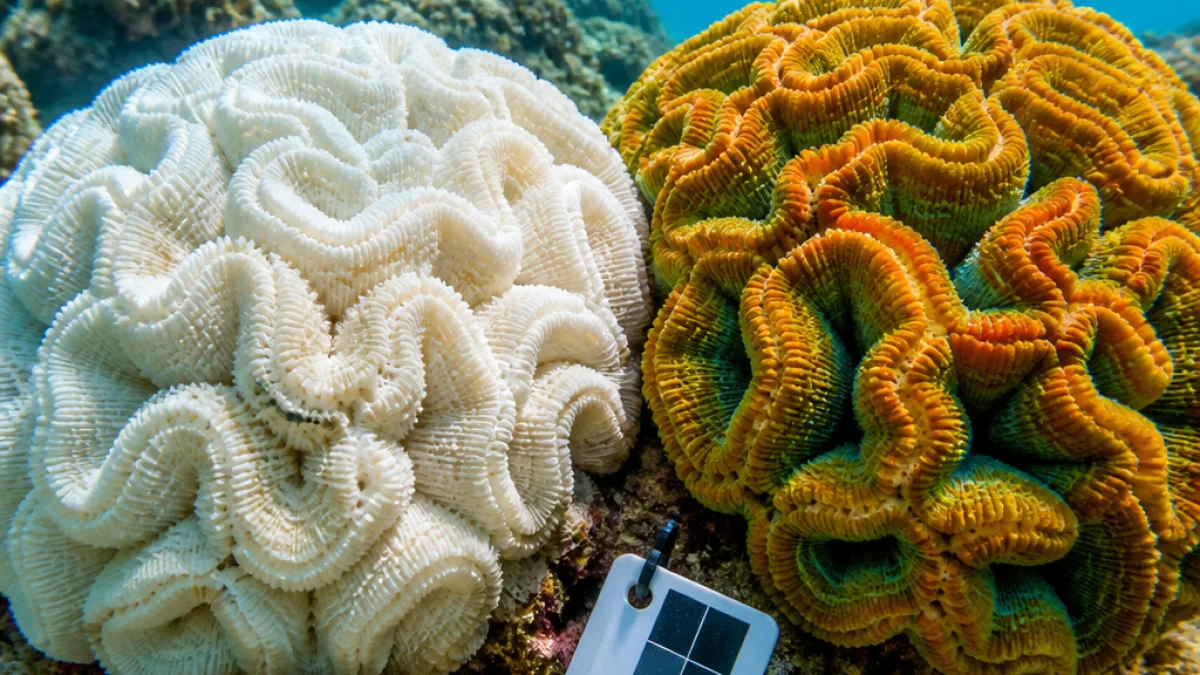
The underwater photograph, taken during a marine mammal survey by CMFRI research scholar Alvin Anto, shows two adjacent coral colonies of the genus Lobophyllia displaying orange, white and green tones. CMFRI identified the specimens as Lobophyllia corymbosa (noted for its orange coloration) and Lobophyllia radians (appearing in white and green).
Field observations recorded by the institute indicate that while one colony of L. radians had bleached after losing its symbiotic algae, the neighbouring colony of the same species remained evidently healthy and green despite their close proximity. According to CMFRI, this juxtaposition illustrates contrasting thermal stress tolerance even among individual colonies of the same taxon.
“Though this assemblage is a symbol of India’s rich marine biodiversity, it also carries an urgent message about ocean health. It tells the stark story of resilience and vulnerability to climate stress,” CMFRI Director Dr Grinson George said.
Implications for reef restoration and livelihoods
CMFRI emphasised that such mixed outcomes in neighbouring corals are important for ongoing reef-restoration strategies and climate adaptation research. The variability in response points to potential avenues for selecting resilient coral genotypes or colonies when planning restoration or assisted recovery efforts.
Dr George outlined steps the institute is pursuing with government support to bolster coastal habitats and fisheries livelihoods. These include:
- Deployment of artificial reefs to rehabilitate degraded sea-floor habitats and augment biodiversity;
- Marine fish breeding and seed production to replenish depleted stocks of economically important species;
- Sea-ranching programmes aimed at restoring wild populations and supporting artisanal fishers.
Why the observation matters
Coral bleaching occurs when corals expel the zooxanthellae — the photosynthetic algae that supply them with nutrients — usually triggered by prolonged elevated water temperatures. However, not all corals react identically. Differences in microhabitat, symbiont communities, genetic makeup and local water movement can affect resilience.
CMFRI said the Minicoy image furnishes empirical evidence of such contrasting responses at a very fine scale. Understanding these differences has practical consequences: identifying and prioritising thermally tolerant colonies could improve restoration success and reduce the risk of reintroducing vulnerable stock into warming seas.
Field data at a glance
| Feature | Detail |
|---|---|
| Location | Minicoy, Lakshadweep |
| Observer | Alvin Anto (CMFRI research scholar) |
| Coral taxa | Lobophyllia corymbosa (orange); Lobophyllia radians (white/green) |
| Noted phenomenon | Adjacent colonies showing bleaching and healthy states |
Broader context
India's coral reefs, particularly in island territories such as Lakshadweep, are valued for coastal protection, fisheries and biodiversity. Rising sea temperatures and ocean warming linked to climate change are among the principal threats to reef health. Institutes such as CMFRI are increasingly focusing on interventions that combine ecological understanding with practical restoration techniques.
CMFRI said its artificial-reef deployments and stock-recovery programmes are being scaled up with Government of India support to revive habitats and shore up artisanal fishing communities that depend on healthy nearshore ecosystems.
What scientists will study next
While the institute has flagged the Minicoy finding as significant, further work will be required to determine the physiological or genetic basis for the observed tolerance differences. Detailed monitoring, symbiont analysis and genotyping of colonies are among the standard follow-up studies scientists undertake to inform restoration practice.
The Minicoy assemblage, CMFRI said, serves as both a reminder of the richness of India's marine life and a prompt to accelerate research and conservation measures to help reefs adapt to a changing climate.