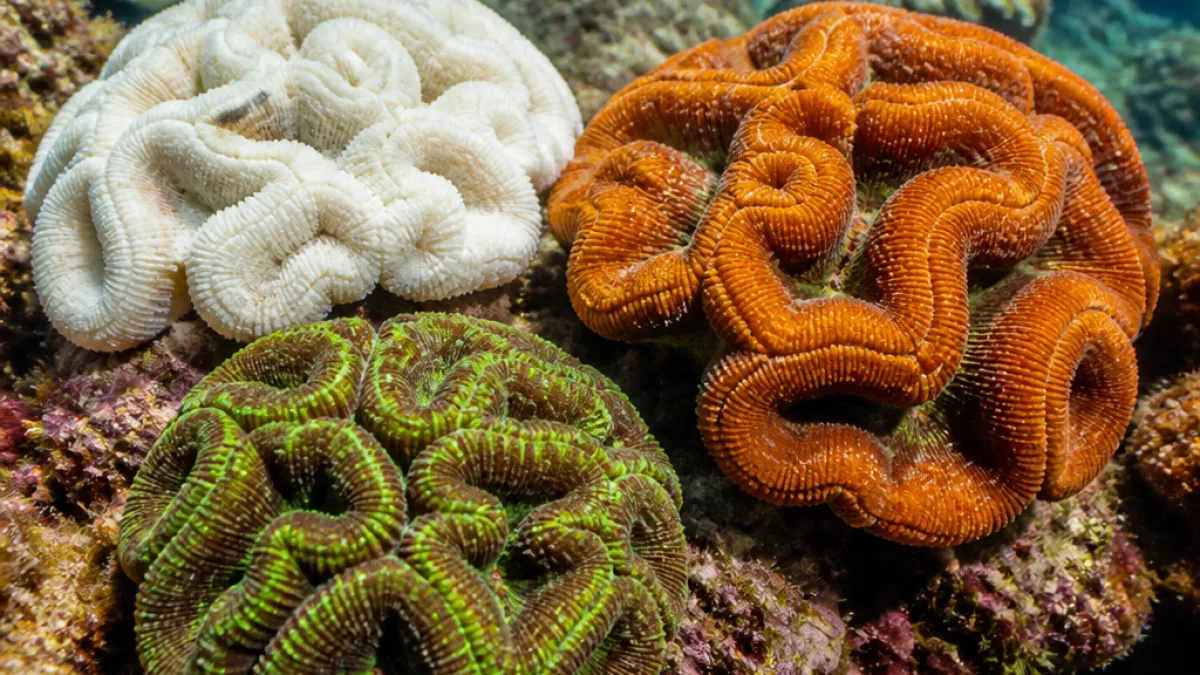
KOCHI / MINICOY ISLAND: A rare cluster of orange, white and green corals observed off Minicoy Island in Lakshadweep has drawn scientific attention because neighbouring colonies of the same species are showing markedly different responses to apparent heat stress, researchers said.
Unusual juxtaposition of species and conditions
The formation was photographed during a marine mammal survey by Alvin Anto, a research scholar with the ICAR–Central Marine Fisheries Research Institute (CMFRI). Scientists identified the orange coral as Lobophyllia corymbosa, with the adjacent white and green colonies identified as Lobophyllia radians.
What intrigued researchers was the sharply contrasting condition of two L. radians colonies growing almost side by side. One colony had bleached—having lost its symbiotic algae—while the other remained healthy and green despite being exposed to virtually the same environment.
Why the sighting matters
According to CMFRI scientists, the natural proximity of colonies of the same species but with different outcomes provides a rare opportunity to examine factors that contribute to tolerance of elevated temperatures. Understanding those factors could improve restoration methods and strategies to protect reef habitats as ocean temperatures rise.
"This is not merely a symbol of India’s rich marine biodiversity. It tells the story of both resilience and vulnerability to climate stress," CMFRI Director Dr. Grinson George said.
Coral bleaching and research priorities
Coral bleaching occurs when environmental stress—most commonly unusually warm water—causes corals to expel the algae (zooxanthellae) living within their tissues. Those algae supply much of the coral's energy and colour. Bleaching does not always result in immediate mortality, but prolonged stress can weaken colonies and ultimately lead to death.
Researchers will be able to compare biological and micro-environmental differences between neighbouring colonies of the same species, to determine why one colony retained its symbionts while the adjacent one bleached. Such comparative work could examine genetic differences, variations in associated microbial communities, micro-habitat conditions such as flow or shading, and other physiological traits that influence heat tolerance.
Restoration and support measures
CMFRI is already expanding programmes to improve the resilience of marine habitats. With support from the central government, the institute is increasing deployment of artificial reefs in coastal waters to restore degraded ecosystems, boost biodiversity and support small-scale fishing communities dependent on reef resources.
- Photograph and initial identification: Image captured by a CMFRI research scholar during a marine mammal survey; orange coral identified as L. corymbosa, white and green colonies as L. radians.
- Key scientific opportunity: Side-by-side colonies of the same species showing different bleaching outcomes enable controlled comparative study in situ.
- Management action: CMFRI expanding artificial reef deployment with central government backing to aid restoration and fishery support.
Implications for Lakshadweep and fisheries
The health of coral reefs directly affects biodiversity and the productivity of nearshore fisheries, which are a mainstay of livelihoods in Lakshadweep. By improving understanding of which coral colonies can better withstand thermal stress, scientists hope to refine restoration techniques—for example, selecting or cultivating more heat-tolerant stock for reef rehabilitation—so that restored habitats are more likely to persist under future warming scenarios.
Next steps for researchers
CMFRI's immediate priorities include detailed surveys of the Minicoy site, sampling and laboratory analyses to characterise host coral genetics and associated algal and microbial communities, and monitoring micro-environmental variables that might explain the divergent responses. Parallel restoration efforts will continue, including artificial reef deployments supported by central government funds.
| Coral species | Observed condition at Minicoy | Scientific significance |
|---|---|---|
| Lobophyllia corymbosa | Orange colony observed | Adds to species record for the area |
| Lobophyllia radians | One colony bleached; adjacent colony green and healthy | Natural experiment to study heat tolerance mechanisms |
Scientists caution that while individual observations such as the Minicoy sighting are important, broader, long-term monitoring is necessary to assess reef health trends and the success of restoration measures. For policymakers and fishing communities, the finding underscores the need to integrate scientific monitoring with conservation actions that strengthen reef resilience as ocean temperatures continue to change.