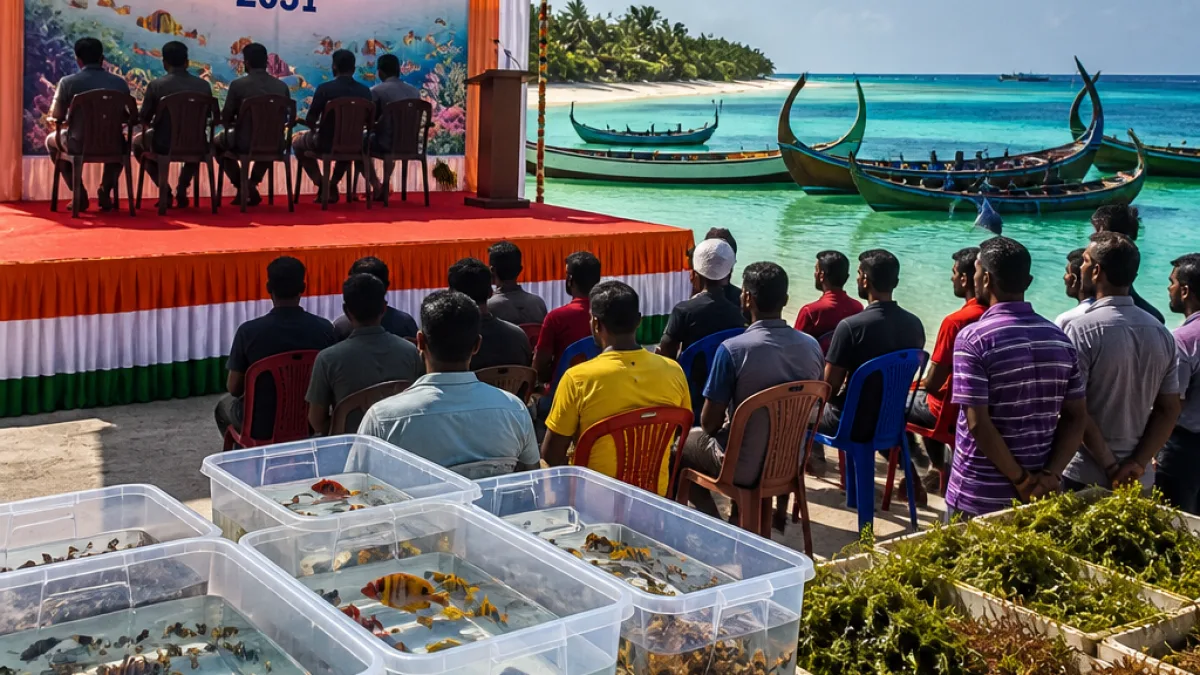
Agatti (Lakshadweep): The Vice‑President, C. P. Radhakrishnan, will formally launch Mission Rangeen Machhli 2031 in Agatti on Monday, a central government strategic action plan aimed at expanding organised ornamental fish farming and exports from Lakshadweep and elsewhere in India, the Union fisheries ministry said.
What the plan sets out to do
The scheme is designed to provide a uniform framework covering scientific management, biosecurity, quality control and regulatory compliance across the ornamental fisheries value chain. Standard Operating Procedures (SOPs) under the initiative are expected to streamline animal‑health management, transportation and trade processes, the ministry said.
The launch in Lakshadweep will be attended by Union Fisheries Minister Rajiv Ranjan Singh, Minister of State S. P. Singh Baghel and Lakshadweep Administrator Praful Khoda Patel, along with fish farmers, fishers and officials from the Department of Fisheries.
Why Lakshadweep has been chosen
The ministry highlighted Lakshadweep’s marine resource base and export potential. The Union territory’s exclusive economic zone (EEZ) is reported at about 400,000 sq km—roughly 17% of India’s total EEZ—giving it strategic importance for maritime fisheries and mariculture development.
Alongside ornamental fish, the islands have been identified as a dedicated seaweed cluster under the government’s cluster‑based approach to fisheries development. The strategy prioritises integrated, value‑chain driven growth—linking cultivation, processing, value addition and market access for local producers.
National context and scale
The ministry noted India’s coastline of about 11,099 km and a marine fisheries potential assessed at 5.86 million tonne. The sector supports around 5 million fishers and generated seafood exports valued at ₹73,890 crore in the last fiscal year, figures the ministry cited to underline the wider economic opportunity.
| Indicator | Figure |
|---|---|
| India coastline | 11,099 km |
| India EEZ | ≈2.4 million sq km |
| Lakshadweep EEZ | ≈400,000 sq km (≈17%) |
| Marine fisheries potential | 5.86 million tonne |
| Seafood exports (last FY) | ₹73,890 crore |
Expected outcomes for producers and traders
By creating standard rules for breeding, health management and quality assurance, the plan aims to make Indian ornamental fish products more consistent for both domestic and overseas markets. The ministry said the SOPs will help improve certification and facilitate access to international buyers—measures that could lift prices for producers if effectively implemented.
- Uniform SOPs to improve animal‑health and transport practices.
- Cluster approach to develop seaweed cultivation and processing in Lakshadweep.
- Strengthened market linkages and potential export growth for ornamental species.
Officials emphasised the role of capacity building for stakeholders across the chain—fish farmers, fishers, processors and exporters—to ensure adoption of best practices and compliance with international sanitary and phytosanitary standards.
Operational and regulatory issues to watch
Key implementation challenges will include establishing effective biosecurity measures in island conditions, logistics for moving live ornamental stock, and ensuring traceability to meet foreign buyers’ rules. The ministry has already moved to allow Indian‑flagged vessels to fish beyond the 200‑mile limit for high‑value species such as tuna; the new plan seeks to complement such moves with value‑chain interventions for niche segments like ornamental fish.
For Lakshadweep, the initiative could diversify livelihoods beyond traditional tuna‑based fisheries and provide avenues for local entrepreneurship in hatcheries, seaweed processing and export services—provided shore‑side infrastructure, cold chain logistics and certification systems are strengthened.
The launch of Mission Rangeen Machhli 2031 will be watched by stakeholders in the islands and across coastal India for its potential to formalise and scale up a fragmented ornamental fish sector into an export‑oriented industry.