Chandigarh: The Punjab government on Sunday asked the Union government to suspend the appointment of Justice Ashwani Kumar Mishra as Chief Justice of the Punjab and Haryana High Court, saying New Delhi issued the notification without consulting the state. The demand escalates a widening dispute between the AAP-led Punjab administration and the BJP-led Centre over the procedure for appointing a high court chief justice.
State objects to notification, seeks stay on oath
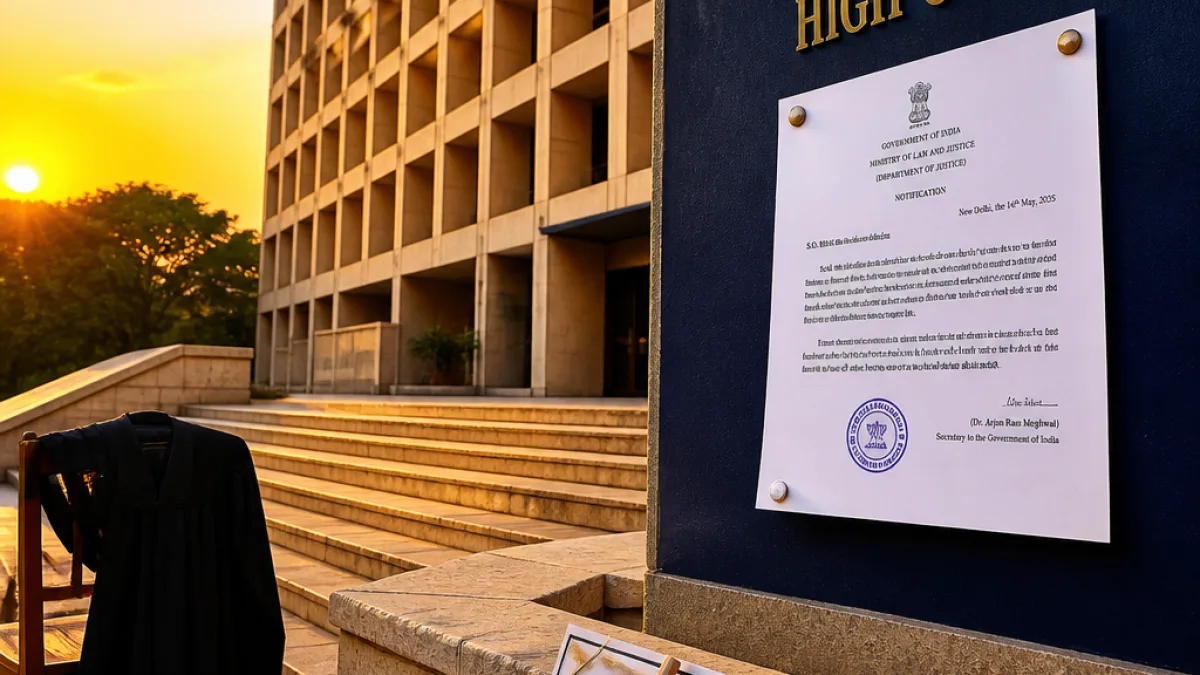
Punjab's Cabinet passed a resolution seeking that the Centre refrain from proceeding with Justice Mishra’s oath-taking until the state’s view has been asked for and properly considered. Justice Mishra, who has been serving as the Acting Chief Justice of the Punjab and Haryana High Court since 2 June, was recommended for the permanent post by the Supreme Court Collegium on 6 August, and the Centre issued the notification on 5 September.
Chief Minister Bhagwant Mann said the appointment without prior consultation constituted a breach of the established process for selecting chief justices for high courts. The Cabinet linked the complaint to other disputes with the Centre, including alleged withholding of funds and issues related to regional boards.
“The appointment without consulting the state was a violation of the established process for appointing High Court Chief Justices,” the Cabinet resolution said, according to an official account of the meeting.
Centre, collegium timeline and state role
Under the existing consultation mechanism for appointment of high court chief justices, the Collegium — headed by the Chief Justice of India — recommends a name to the Union government, which ordinarily circulates the proposal to the state government concerned for its views before issuing a notification. Punjab says its view was not sought prior to notifying Justice Mishra’s elevation.
Justice Mishra took charge as acting head of the court after the elevation of former Chief Justice Sheel Nagu to the Supreme Court. The Collegium recommendation in early August preceded the Centre's notification on 5 September.
Political reaction and broader context
Finance Minister Harpal Singh Cheema criticised the Centre for what he described as bypassing accepted steps in the appointment process. The state administration has framed the row as part of what it calls repeated central interference in matters affecting Punjab, and has cited unrelated grievances — including the withholding of approximately ₹9,000 crore from a rural development fund — as evidence of strained Centre-state relations.
The development comes amid heightened tensions between the Punjab government and the Union on multiple fronts. The state ruling party has sought to underscore procedural propriety and federal norms, while the Centre and the judiciary have their own established processes for appointments.
Possible legal and administrative pathways
Punjab has asked the Centre to reconsider the appointment in line with the procedure it says should have been followed. The state’s appeal is administrative at this stage: it seeks that the notification be held in abeyance and that the state's comments be solicited and factored into any final decision about the chief justice's confirmation.
Options available include:
- Centre defers oath-taking and requests the state’s observations on the recommendation.
- Centre proceeds with the appointment, prompting Punjab to explore legal remedies or further political protest.
- The Supreme Court or the Collegium could be approached if procedural irregularities are alleged formally.
Impact on the Punjab and Haryana High Court
The Punjab and Haryana High Court, which serves both states and is headquartered at Chandigarh, has been led by Justice Mishra in an acting capacity since June. Any delay or contestation over the permanent appointment could have administrative implications for the court’s roster and case management, especially for benches and allocation of judicial work where continuity at the top is administratively relevant.
| Key dates | Action |
|---|---|
| 2 June | Justice Mishra assumed charge as Acting Chief Justice |
| 6 August | Supreme Court Collegium recommended him for permanent post |
| 5 September | Centre issued notification of appointment |
What the state seeks next
The Cabinet resolution asks New Delhi to follow the “established procedure” and to obtain Punjab’s formal response prior to completing the appointment process. If the Centre declines to stay the notification or proceed differently, Punjab may consider further administrative or judicial steps, though the state has so far publicly limited its action to requesting a reconsideration and suspension of oath-taking.
Representatives of the Union government and the Supreme Court Collegium did not immediately issue detailed public comments responding to the Cabinet resolution. The situation will be watched closely in Chandigarh and at the High Court, where continuity of leadership and adherence to appointment norms are central to both judicial administration and federal relations.