Chandigarh: The Haryana government has issued a Standard Operating Procedure (SOP) to ensure stricter monitoring and result-oriented implementation of decisions taken at meetings chaired by the Chief Minister, an official statement said on Wednesday. The measure obliges departments and public bodies to assign responsibility, set timelines and provide verifiable evidence of compliance.
Clear tasks, accountable officers and measurable proof
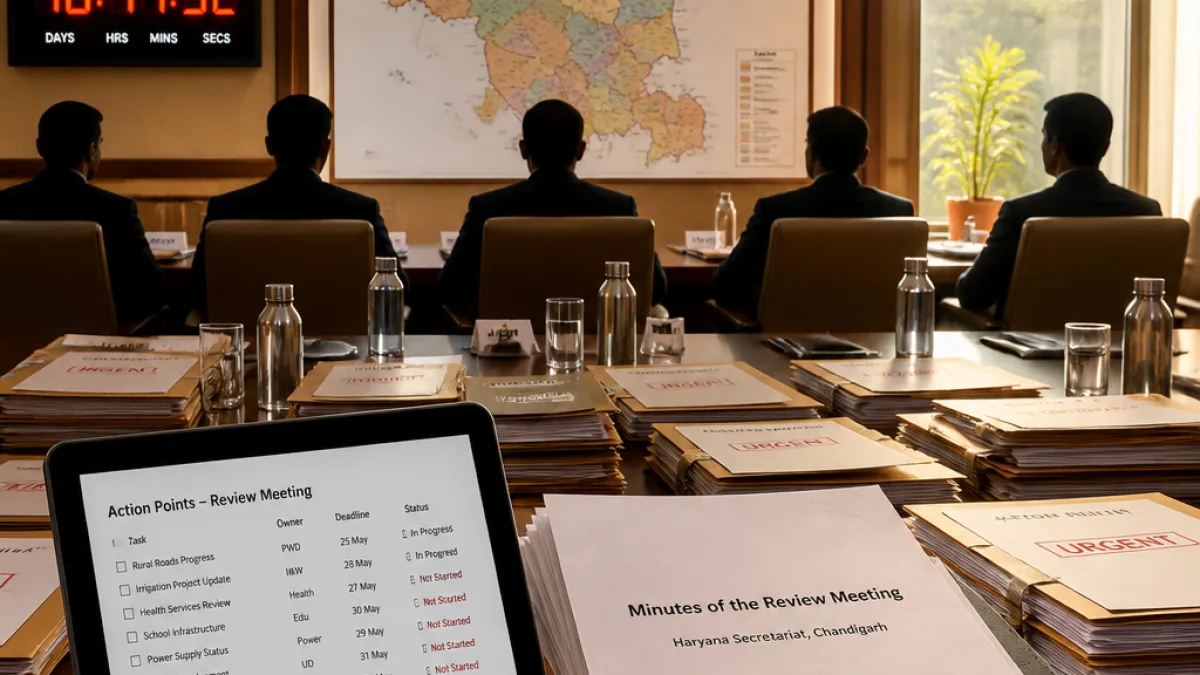
Under the SOP, issued by Chief Secretary Anurag Rastogi, every decision recorded in a Chief Minister's meeting must be converted into a distinct action point. Each action point is to specify what will be done, who will execute it, by when, what outcome is expected and what will constitute proof of completion. The instructions are applicable immediately and have been circulated to administrative secretaries, heads of departments, managing directors and chief administrators of boards, corporations and PSUs, as well as deputy commissioners, sub-divisional officers and university registrars.
The SOP emphasises that vague compliance remarks such as "action is being taken" or "look into it" are unacceptable. Instead, replies to the Chief Minister's office and other competent authorities should be specific, measurable and supported by documentary evidence where appropriate.
Minutes, corrections and circulation
The new process requires draft Minutes of Meeting to be prepared within three working days following the conclusion of a meeting. Once the minutes are approved at the competent level, they will be circulated to the concerned departments and officers. The SOP prohibits oral changes to an approved minute; any factual correction or amendment will need to be issued through a formal corrigendum or amendment authorised by the competent authority.
| Requirement | Timeline / Detail |
|---|---|
| Draft Minutes | Within three working days of meeting |
| Action point contents | Must answer five specified questions and include proof of completion |
Departments told to prepare background notes
For meetings, departments are to supply a background or briefing note outlining the current position, earlier decisions and actions taken, progress achieved, major bottlenecks, approvals required and proposed timelines and targets. This is intended to provide the Chief Minister and participants with a concise situational brief so that decided actions are measurable and trackable.
- Convert decisions into separate, actionable points.
- Specify implementer, deadline, outcome and proof for each action.
- Avoid vague compliance language; provide documentary evidence.
- Draft Minutes to be circulated only after approval; oral alterations disallowed.
Officials will now be expected to frame replies in an outcome-oriented manner and to attach relevant evidence where required. The SOP covers administrative, developmental, welfare, law and order, infrastructure and other significant matters discussed in the Chief Minister's meetings.
By instituting these norms, the state administration aims to reduce ambiguity in follow-up actions and speed up implementation of government decisions. The move brings a focus on accountability by linking decisions to named officers and explicit deliverables.
Implementation of the SOP is immediate, the statement said, and the directions have been sent to secretaries, department heads and subordinate functionaries across the state machinery. The government expects departments to align their internal reporting and monitoring mechanisms to meet the new requirements.
Observers within the administration said the change is likely to tighten oversight of project delivery and public service measures, while also making it easier to identify bottlenecks and escalation points when targets are not met.