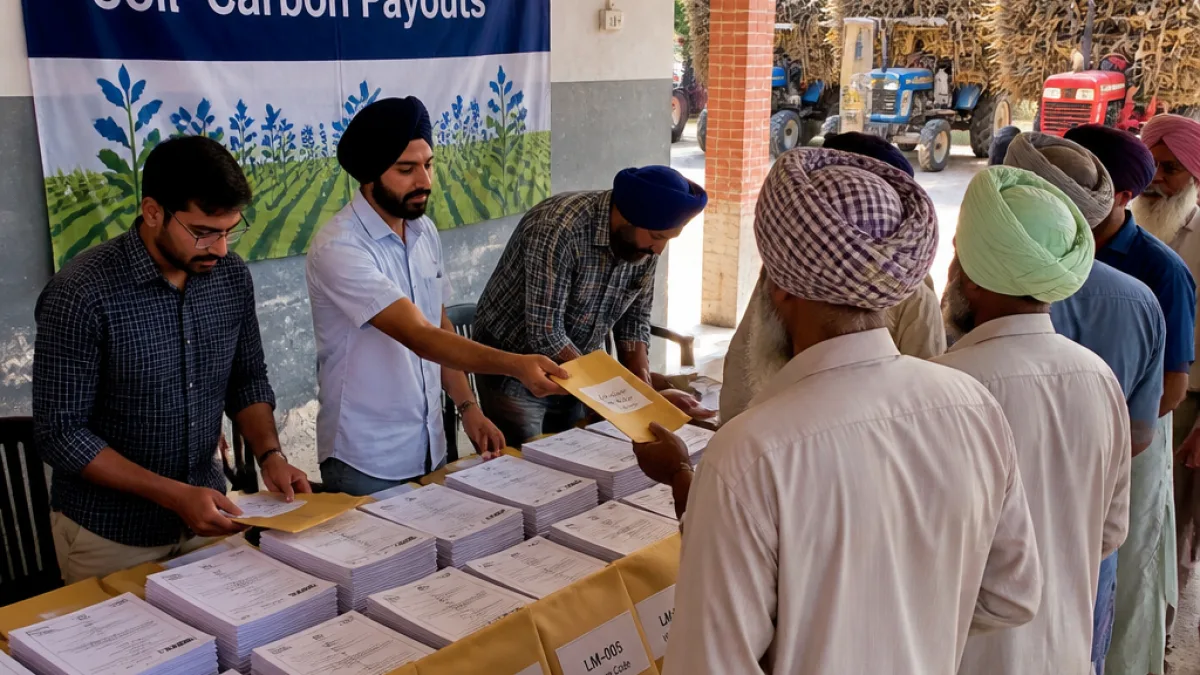
More than 2,550 farmers in Punjab and Haryana have received the first direct payments under an agricultural carbon programme, with over ₹2.9 crore transferred for regenerative farming practices executed between 2019 and 2022, officials said.
Payments disbursed at PAU, Ludhiana; ICAR role in verification
The initial tranche of payouts was released at the Punjab Agricultural University (PAU), Ludhiana, where M L Jat, Director General of the Indian Council of Agricultural Research (ICAR), flagged off direct benefit transfers to the beneficiary farmers, according to an official of the Ministry of Agriculture.
The payments form part of Aadi, a farmer‑carbon programme launched by Grow Indigo in 2019 with technical guidance from ICAR. Participating cultivators were credited for adopting practices such as direct‑seeded rice (DSR), reduced tillage and crop‑residue management during the 2019–22 period. Greenhouse gas reductions and soil‑carbon increases from these practices were measured and independently verified before issuance of carbon credits, the official said.
“Farmers were paid according to their share of carbon credits generated from their fields. The first issuance covered around 30,000 acres and more than 50,000 carbon credits, with participating farmers receiving approximately ₹3,000 to ₹15,000,” said Usha Barwale Zehr, Executive Director, Grow Indigo.
Scale, savings and emissions avoided
The Aadi programme is being presented as the first flagship farmer‑carbon effort in India to issue agricultural carbon credits under the Verra VM0042 methodology. Grow Indigo says the wider programme now covers over 2 million acres and more than one lakh farmers across seven states, though the initial issuance covered a substantially smaller area.
Officials highlighted co‑benefits beyond carbon. Fields participating in the 2019–22 cycle reportedly saved an estimated 45 billion litres of water and kept over 2 lakh tonnes of crop residue out of fires, thereby avoiding roughly 1,000 tonnes of PM2.5 emissions, the Ministry source said.
What farmers received and when others will be paid
According to the organisers, payments to individual farmers in this first round ranged from about ₹3,000 to ₹15,000, depending on the quantum of carbon credits generated from each field.
Farmers who joined Aadi after 2022 will be paid in later monitoring cycles as their emissions reductions and soil‑carbon increments are independently verified and credits are issued.
- Beneficiaries in first tranche: over 2,550 farmers (Punjab and Haryana)
- Total disbursed: over ₹2.9 crore
- Area in first issuance: ~30,000 acres; credits issued: >50,000
- Payment per farmer: ~₹3,000–₹15,000
Why the payments matter for the region
The Punjab‑Haryana region has been under pressure to reduce stubble burning — a major contributor to seasonal air pollution in northern India — and to ease groundwater depletion caused by intensive paddy cultivation. By compensating farmers for practices that cut residue burning and save irrigation water, carbon payments aim to create an economic incentive aligned with environmental goals.
For participating cultivators, the payouts represent an additional income stream tied to verified environmental outcomes rather than commodity prices. However, the size of the payments in the current issuance is modest relative to overall farming incomes, and wider uptake will depend on simplifying monitoring and verification and ensuring timely transfers.
Data snapshot
| Metric | First issuance | Programme total (reported) |
|---|---|---|
| Farmers paid | ~2,550+ | >100,000 (across 7 states) |
| Area covered | ~30,000 acres | >2,000,000 acres |
| Credits issued | >50,000 | — |
| Total disbursed | ₹2.9 crore+ | — |
Implementation challenges and next steps
Officials said further payments will follow as additional monitoring cycles conclude and credits are issued to fields enrolled after 2022. Key implementation challenges include accurate field‑level measurement, robust independent verification and the administrative task of mapping credits to individual beneficiaries for direct transfers.
For farmers, the immediate questions will be the predictability of future payments and whether transaction costs or contractual terms limit participation. Policymakers and market intermediaries will need to demonstrate that such incentive mechanisms can be scaled without excessive overheads while guarding against double‑counting of outcomes.
The initial disbursement marks a practical shift from policy debate to cash transfers on the ground for carbon‑linked agricultural practices in the region, offering a possible template for linking environmental services to farmer incomes in northern India.