Delegation inspects door-to-door collection, composting units and sanitary operations
A team from the M.S. Swaminathan Research Foundation (MSSRF), Chennai, carried out a two-day field study of sanitation management in Greater Warangal on Tuesday, focusing on waste collection, segregation, processing and frontline execution of municipal sanitation services, according to local officials.
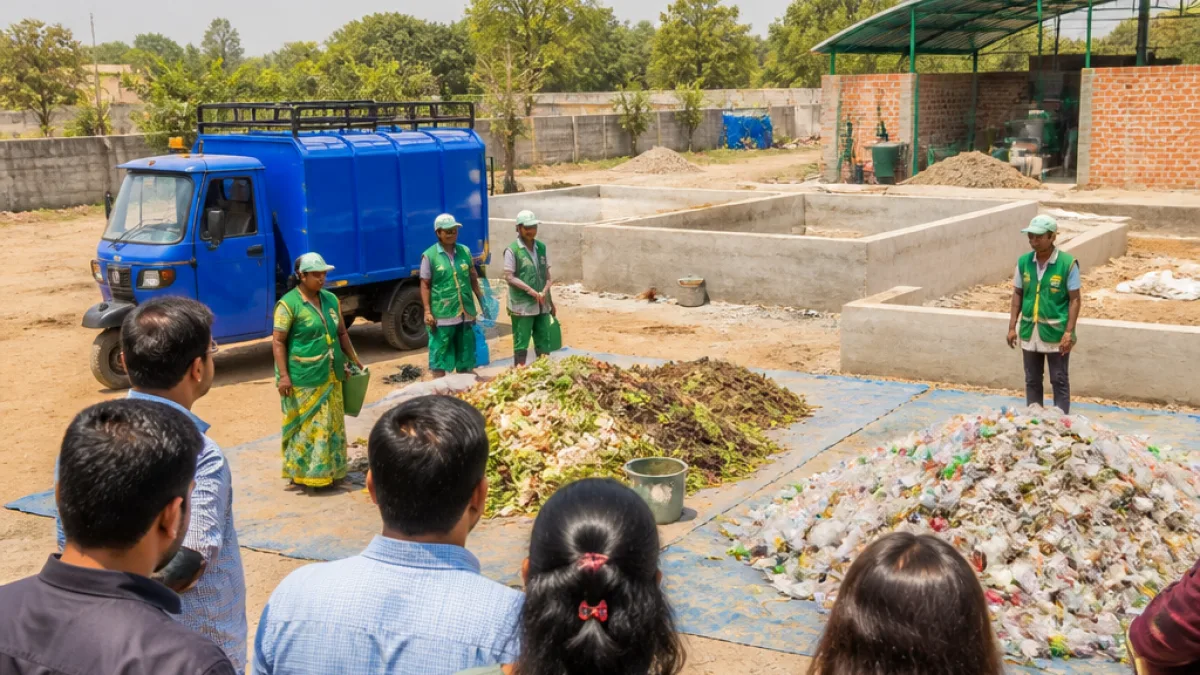
The delegation visited several wards within the Greater Warangal Municipal Corporation (GWMC), beginning with meetings at the Baldia office and a field inspection at the Dry Resource Centre (DRC) in Nakkalagutta. The visitors reviewed door-to-door collection systems, separate collection of wet and dry waste, and operations of the city’s Swachh auto service used for household pick-up, GWMC sources said.
Officials and staff at multiple levels — from sanitary jawans and Swachh auto drivers to supervisory officers — were interviewed to understand on-the-ground challenges and the degree of public participation in source segregation.
- Meetings with Baldia Commissioner T. Venkanna and senior civic officers reviewed existing sanitation arrangements.
- Field interactions were held with sanitary supervisors, inspectors and sanitary jawans to map division-wise practices and problems.
- Visits to composting and biomethanation units assessed organic-waste processing and facility maintenance.
Officials who participated in the discussions included Chief Health Officer Dr. Rajareddy, Superintending Engineer Rajkumar, MHO Dr. Rajesh, Executive Engineer Mahender, Superintendent Baka Santosh and Deputy Engineer Spandana, the civic administration reported.
| Activity | Location | Focus |
|---|---|---|
| Administrative meeting | Baldia office | Sanitation strategy, staffing, Swachh auto operations |
| Field inspection | Nakkalagutta DRC | Dry waste processing, logistics |
| Unit visits | Composting & biomethanation sites | Organic waste management, maintenance |
Operational gaps and frontline feedback under review
During division-wise reviews, MSSRF members sought granular information on operational matters such as daily Swachh auto routes, duties assigned to sanitation staff, and obstacles encountered while collecting segregated waste. Field teams spoke with Swachh auto drivers in Balasamudram to map route management and household-level separation of wet and dry fractions.
The delegation also spoke directly with sanitary jawans to document routine task execution, gaps in equipment or manpower, and the level of cooperation received from residents during door-to-door collection, the report said. At composting and biomethanation units, unit staff outlined organic-waste handling, composting cycles and upkeep challenges.
The MSSRF team spent its first day gathering ground-level observations and recording suggestions from officials and workers. The study will continue with further field-level assessments across other Baldia limits on the second day, the civic administration said.
Why this matters for Warangal residents
Effective source segregation and timely processing of organic waste are central to reducing landfill pressure and improving public health in a fast-growing district hub like Warangal. Insights from an external research body such as MSSRF may inform refinements to collection schedules, mechanisation of transfer points and technical interventions at composting or biomethanation plants.
Greater Warangal is expanding rapidly as an economic and educational centre in Telangana. Better municipal waste governance can support urban living standards, protect peri-urban water bodies from contamination and lessen the workload on sanitation staff.
Municipal officials indicated the study’s findings will be compiled and examined for practical measures that GWMC can implement to improve waste management and frontline working conditions, especially where route optimisation or increased citizen awareness can raise segregation rates.
Further details on recommendations or an action plan were not released at the time of the visit. The MSSRF delegation’s work in Greater Warangal follows a pattern of collaborative field studies by research organisations to benchmark urban sanitation practices in Telangana and elsewhere.