
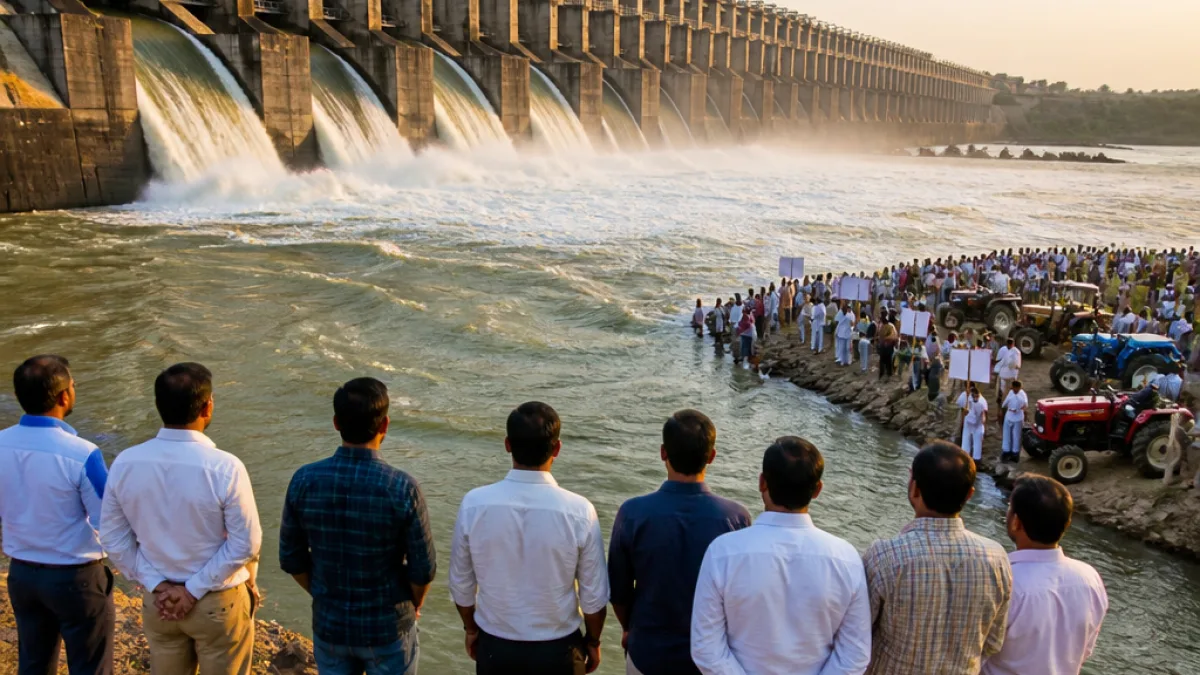
HYDERABAD/BENGALURU: Karnataka has agreed to release water from the Narayanpur dam into Telangana’s Jurala reservoir, the two states’ governments reported on Wednesday, after a delegation led by Telangana ministers met Karnataka Chief Minister D. K. Shivakumar in Bengaluru.
Phased release to protect standing crops
According to reports, Karnataka will release three thousand million cubic feet (three TMC) of water in phases from the Narayanpur dam across the Krishna River into the Jurala project. The decision follows a request from the Telangana government seeking water to protect standing crops in the erstwhile Mahabubnagar district and adjoining command areas.
Telangana had sought continuous releases of 5,000 cusecs per day for 30 days to protect crops across about 5.5 lakh acres under the Jurala, Bhima, Nettempadu and Koilsagar irrigation projects, the delegation told Karnataka authorities.
"This is a great example of bonhomie between two different states and showcases the love and brotherhood of people of India," Telangana Chief Minister A. Revanth Reddy said in a post on X acknowledging Karnataka's decision.
The delegation from Telangana included ministers Jupalli Krishna Rao and Vakati Srihari, along with local public representatives and irrigation officials. They outlined the difficulties faced by farmers in the jurisdiction of the Jurala project and urged immediate assistance to avert crop losses.
Immediate action in Telangana
Following the assurance from Karnataka, Minister Vakati Srihari ordered irrigation officials in Telangana to commence releases from the Jurala project to meet the irrigation needs of farmers. Officials lifted the gates and started discharging water into canals on Wednesday morning, state sources reported.
Farmers in the erstwhile Mahabubnagar district had been staging protests in recent days, demanding release of water to save standing crops. Opposition parties — Bharat Rashtra Samithi (BRS) and Bharatiya Janata Party (BJP) — also organised demonstrations near irrigation projects in Jogulamba Gadwal district in solidarity with the agitating cultivators, according to reports.
Key facts at a glance
- Requested by Telangana: 5,000 cusecs per day for 30 days
- Area to be protected: About 5.5 lakh acres under Jurala, Bhima, Nettempadu and Koilsagar
- Karnataka decision: Release of three TMCs from Narayanpur to Jurala in phases
- Delegation: Ministers Jupalli Krishna Rao and Vakati Srihari met CM D. K. Shivakumar
| Parameter | Telangana request | Karnataka response |
|---|---|---|
| Daily flow | 5,000 cusecs/day (for 30 days) | Phased release totalling 3 TMC |
| Area targeted | ~5.5 lakh acres across four projects | Water to be routed into Jurala project canals |
Officials said the phased dispatch aims to supplement releases already being managed at Jurala and to stabilise irrigation supplies for critical crop stages. The exact schedule and daily discharge rates from Narayanpur were not published in the initial communiqués.
Political and local impact
The agreement comes amid heightened public pressure and visible unrest among farmers who feared crop loss due to inadequate irrigation releases. The swift high‑level engagement between the two states underscored the political sensitivity of inter‑state water transactions, especially during the kharif season when crop survival depends on timely irrigation.
Telangana Chief Minister A. Revanth Reddy publicly thanked his Karnataka counterpart for the gesture, casting the outcome as an example of cooperative federal relations. The Karnataka chief minister reportedly also appealed for peace and harmony during the Ganesh Chaturthi festival period, when large public gatherings and processions are under way.
Local irrigation departments will now be expected to monitor deliveries closely and update farmers on canal supply schedules. Administrations in affected mandals are likely to coordinate with revenue and agriculture officials to prioritise the most vulnerable stretches of command area.
Further technical details on gate lifts and daily cusec figures are awaited from the irrigation departments of both states. Officials in Jurala's command area have been asked to assess field conditions and advise on any supplementary interventions needed to protect standing crops.
This development marks a temporary respite for farmers in the erstwhile Mahabubnagar area, but officials and cultivators alike will be watching the pace and predictability of flows in the coming days to determine the measure’s effectiveness in averting crop losses.