Hyderabad: The Telangana government has set up a dedicated bureau to consolidate traffic operations, enforcement, crash investigation and highway patrolling under a single statewide framework, officials said on Thursday. The new body — Telangana Traffic Management, Road and Rail Safety Bureau (TG‑TMARS) — will be headquartered in Hyderabad and cover national highways, expressways, state highways, district roads and urban and rural thoroughfares.
Structure and control
TG‑TMARS will be led by an officer of ADGP/IGP rank and will operate under the supervision of the State Road Safety Council, which is chaired by the Chief Minister, while administrative and disciplinary authority will remain with the Director General of Police, the government said. The move responds to the challenge of coordinating traffic work across a state with more than 32,000 km of roads and over 1.8 crore registered vehicles.
Two wings, defined functions
The bureau is organised into two main wings: a Traffic wing and a Road & Rail Safety wing. The Traffic wing will be responsible for management of traffic flows, signals, road markings and signage, as well as planning for special-event traffic and coordinating with road-owning agencies and local bodies.
The Road & Rail Safety wing will focus on electronic enforcement and allied functions: e‑challans, monitoring through control rooms and targeted action against violations such as drunk driving, speeding, wrong‑side driving, helmet and seatbelt non‑compliance and overloading. This wing will also oversee highway patrol operations.
Crash response and data-led safety
Every police station will nominate a road crash response officer to provide round‑the‑clock assistance at accident sites, secure scenes, help shift the injured within the golden hour and record incident details in iRAD/eDAR systems. Fatal and grievous crashes will be subject to review by multi‑departmental committees.
Crash information will be analysed to identify high‑risk corridors, black spots and repeat offenders — a data‑driven approach officials said is intended to prioritise interventions and resource allocation.
- Statewide coverage across national, state, district and urban/rural roads
- Dual oversight model: State Road Safety Council supervision; DGP retains administrative control
- Electronic enforcement and highway patrols to be standardised
Highway patrol units and equipment
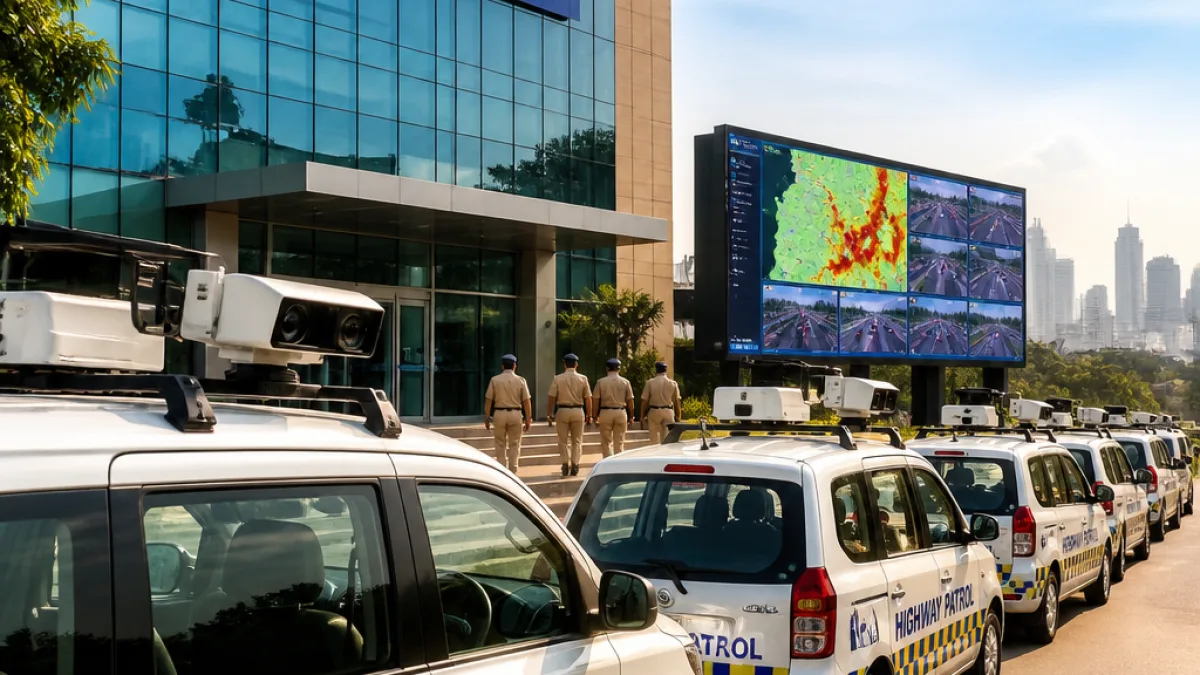
The government has directed the creation of highway patrol units attached to police stations with significant traffic responsibilities or those that cover more than 50 km of national or state highways. Each unit will include a head constable, a constable and a vehicle. Patrol vehicles will be fitted with dashboard cameras, automatic number‑plate recognition (ANPR) and speed‑detection systems, enabling on‑the‑spot evidence collection and quicker enforcement.
| Component | Details |
|---|---|
| Unit personnel | Head constable + constable |
| Equipment | Vehicle with dashcam, ANPR, speed detection |
| Coverage trigger | Stations covering >50 km of national/state highways or with traffic/safety issues |
Training and standards
A State Traffic Training Academy will be established to upskill personnel in traffic systems, electronic enforcement and crash investigation techniques. The bureau will also standardise operating procedures, training curricula and enforcement analytics, addressing a historical lack of a common command structure across the state's traffic wings, the announcement said.
Officials said these measures aim to create uniform standards for technology adoption, training and review, enabling better coordination between local police units and agencies that own or maintain roads.
By centralising oversight while retaining local operational control through police stations and highway patrol units, the government hopes to reduce response times, improve evidence gathering at crash scenes and apply enforcement more consistently across Telangana.
Implementation timelines, budgets and staffing numbers for TG‑TMARS were not disclosed in the government note.
Reporting from Hyderabad.