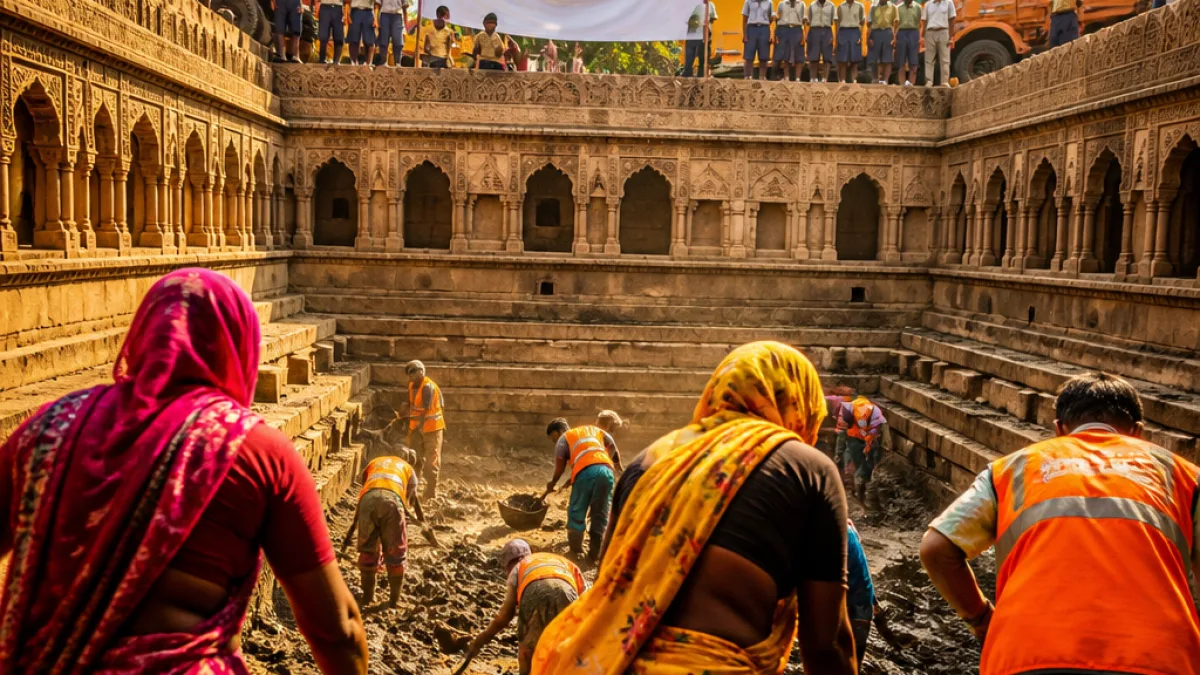
District administration moves to reclaim centuries‑old water heritage
Kotputli‑Behror district has kicked off a district‑wide campaign to restore and maintain its traditional water infrastructure — stepwells (bawdis), ponds and wells — in a drive led by District Collector Aparna Gupta, a 2018‑batch IAS officer. The initiative aims to use local community participation to bolster water security while preserving cultural heritage.
The operation began with a major cleanliness and public awareness event at the historic Shiv Mandir Talab Bawdi (Ganga Sagar Talab), organised jointly by the District Administration Kotputli‑Behror and the Kotputli Municipal Council with support from UNICEF and the local group Bawdi Baisa. The event, officials said, attracted students, youth organisations, social groups and local residents who participated in cleaning and voluntary labour.
“Our historic stepwells (bawdis), ponds and wells are not merely ancient structures, they are living proof of centuries old scientific water management systems. When restored through active community participation, they can play a decisive role in mitigating future water crises.”
The campaign has a dual objective: immediate cleanliness and long‑term, participatory conservation. District officials told reporters that a phased plan is being prepared to clean, restore and maintain historic water bodies across the district. Regular shramdaan (voluntary labour) drives will be organised to ensure sustained community involvement.
Beyond physical restoration, the programme emphasises behavioural change among residents. Officials listed practical measures to be promoted alongside restoration work, including the adoption of rainwater harvesting, judicious water use and proactive prevention of pollution and plastic waste from entering local water sources.
Community action tied to policy recognition
The initiative has attracted attention at the state level. Rajasthan Chief Secretary V. Srinivas described the campaign as an inspiring example of water conservation and public participation, saying the model should be emulated elsewhere in the state.
District authorities emphasise that the campaign is not limited to one‑off events. Instead, they want to develop a permanent and participatory system for water conservation across Kotputli‑Behror, where restored bawdis and ponds would be maintained by local communities in collaboration with municipal bodies and NGOs.
What the campaign will focus on
- Cleanliness drives at historic water bodies to remove silt, debris and waste.
- Sustained shramdaan involving youth, students, NGOs and residents for ongoing upkeep.
- Public awareness campaigns to promote rainwater harvesting and reduce pollution.
- Phased restoration plans to structurally repair and preserve bawdis and ponds.
| Activity | Primary purpose |
|---|---|
| Cleanliness drives | Immediate removal of waste and debris to restore water holding capacity |
| Shramdaan (voluntary labour) | Community ownership and ongoing maintenance |
| Awareness programmes | Behavioural change: rainwater harvesting, pollution prevention |
Local residents and activists who joined the initial event said the approach links cultural pride with practical water management. District officials indicated that partnerships with organisations such as UNICEF will provide technical and outreach support where needed.
Restoration of traditional water structures has gained renewed interest across several parts of Rajasthan as policymakers and communities seek low‑cost, locally appropriate methods to enhance groundwater recharge and manage increasingly variable monsoon patterns. Kotputli‑Behror’s model seeks to combine conservation with community stewardship so that restored structures remain functional and cared for over the long term.
Officials said the next steps will include mapping priority water bodies, scheduling phased restoration work and institutionalising regular Shramdaan drives involving gram sabhas, schools, youth groups and local NGOs. The district administration also plans to monitor the impacts on water availability and public engagement as restoration progresses.
As Rajasthan faces recurring pressure on water resources, initiatives that fuse heritage conservation with practical water management are being treated as important complements to infrastructure and policy measures. Kotputli‑Behror’s campaign, backed by the district administration and civil society, aims to translate that idea into tangible local action.
Reporter: Meera Rathore, Rajasthan correspondent.