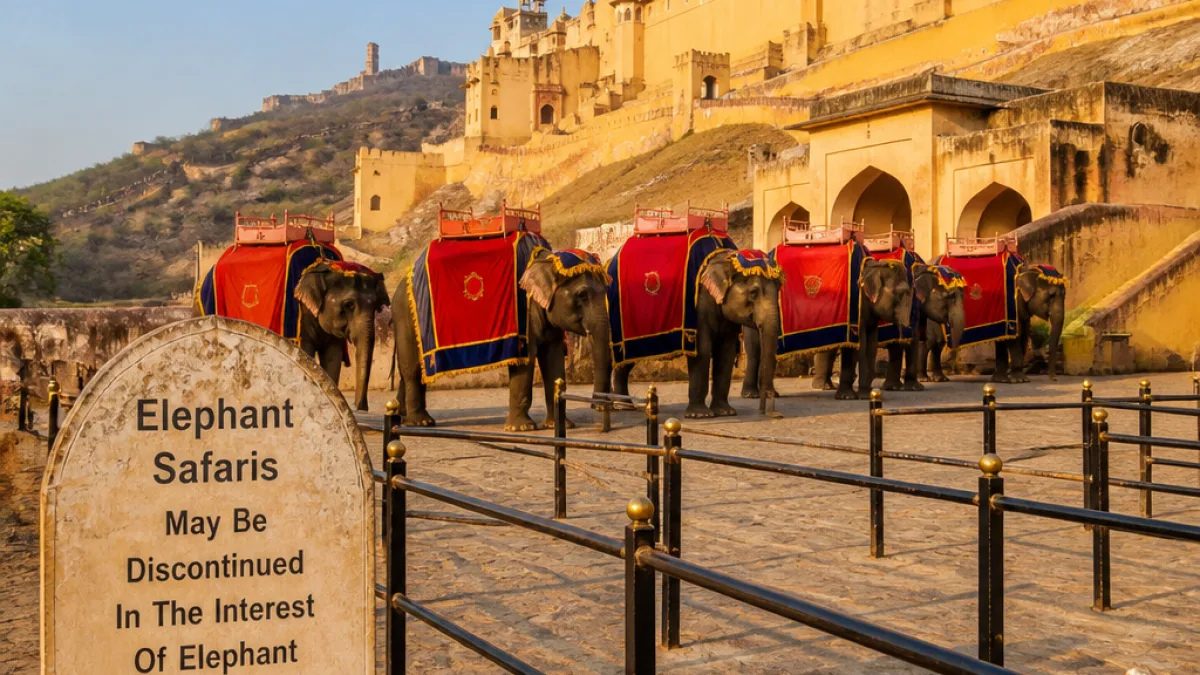
Sharp decline in elephant safaris at Amer Fort raises economic and welfare questions
Jaipur: The number of tourists taking elephant safaris at the historic Amer Fort has plunged by about 70 per cent in seven years, official records show, prompting concern among operators who say the fall is affecting livelihoods tied to the centuries-old attraction.
Data from the fort administration indicate that 1,64,608 tourists availed elephant rides in 2018-19, while the figure dropped to 48,474 in 2025-26. Numbers fluctuated in the intervening years: 1,08,378 in 2019-20, a steep fall to 2,922 in 2020-21 during the COVID-19 pandemic, followed by recovery phases — 9,560 (2021-22), 54,514 (2022-23), 79,090 (2023-24) and 67,018 (2024-25) — before the recent decline.
| Year | Elephant safari visitors |
|---|---|
| 2018-19 | 1,64,608 |
| 2019-20 | 1,08,378 |
| 2020-21 | 2,922 |
| 2021-22 | 9,560 |
| 2022-23 | 54,514 |
| 2023-24 | 79,090 |
| 2024-25 | 67,018 |
| 2025-26 | 48,474 |
The figures assume prominence ahead of World Elephant Day, observed on 12 August to highlight elephant conservation and welfare. Local tourism stakeholders and experts traced the recent downward trend to multiple factors — a sustained fall in foreign tourist arrivals, shifts in visitor preferences away from animal-based attractions, and growing international and domestic attention to animal welfare standards.
- Reduced foreign tourist footfall and package changes by international tour operators.
- Greater awareness of animal-welfare campaigns leading visitors to prefer alternatives such as jeep safaris.
- Competition from other wildlife and experience-based destinations nationally.
"Many international tour operators and travel companies have removed elephant rides from their tour packages as part of their animal welfare policies. This has particularly affected demand among foreign tourists," said tourism expert Mahesh Sharma.
Another industry observer, Ashok Chaudhary, noted that global campaigns on animal welfare have prompted several foreign tourists to avoid elephant rides and that many tour operators now de-emphasise elephant safaris in their itineraries.
For Jaipur, where heritage tourism is a key livelihood for guides, transporters, artisans and hospitality workers, the change in demand has practical consequences. Operators linked to the elephant safaris have warned of reduced incomes for mahouts, support staff and ancillary service providers when visitor numbers decline. The fall from over 1.6 lakh visits in 2018-19 to under 50,000 in 2025-26 signifies a structural shift rather than a temporary dip, they say.
Officials at Amber Fort have not publicly attributed the full set of reasons for the recent drop beyond the raw attendance figures provided to the administration. However, industry sources point to the reconfiguration of tour packages and the growth of alternative experiences — such as sound-and-light shows, heritage walks, artisan trails and jeep safaris — which have become more attractive, especially to environmentally conscious travellers.
The debate around elephant safaris also intersects with animal welfare and regulatory concerns. While the practice has long been a part of Amer Fort's tourist offering, observers say authorities may need to consider enhanced welfare standards, transparent oversight and diversification of livelihoods for those dependent on the elephant economy.
Measures suggested by stakeholders include:
- Developing non-animal experiences at Amer Fort to absorb displaced demand.
- Providing alternative skill and livelihood training to mahouts and support workers.
- Introducing clearer welfare and monitoring protocols if rides continue, to meet evolving tourist expectations.
As Jaipur prepares for another tourist season, the city faces the dual challenge of preserving a historic visitor draw while responding to shifting ethical standards and market realities. How heritage managers, tourism authorities and local communities adapt will shape both the visitor experience and the welfare of animals linked to one of Rajasthan's most iconic forts.