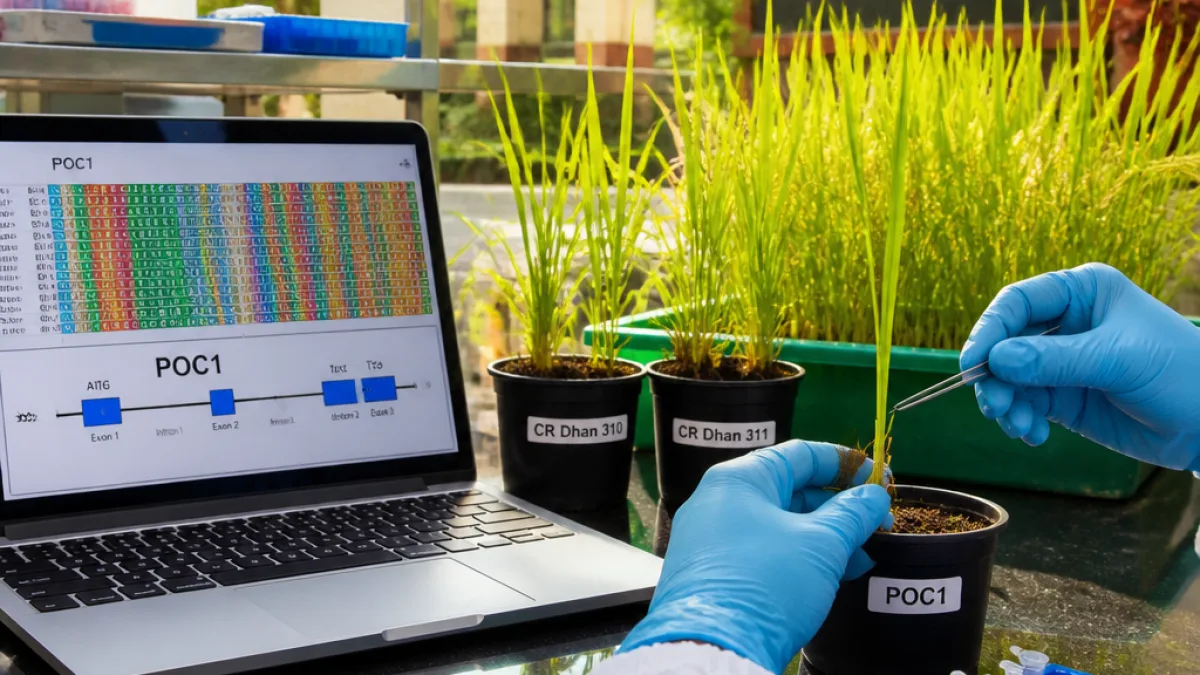
CUTTACK: Scientists at the ICAR‑Central Rice Research Institute (CRRI), based in Cuttack, have developed and experimentally validated a suite of AI‑designed genome‑editing tools for plants, the institute reported. The work centres on a novel editing platform dubbed Plant OpenCRISPR‑1 (POC1), derived from an artificial intelligence‑generated nuclease called OpenCRISPR‑1 (OC1).
New platform demonstrates multiple editing functions in rice
According to the CRRI report and the study accepted in the international plant science journal New Phytologist, the POC1 platform was adapted to produce tools for gene knockout, base editing and prime editing in plants. Experimental results in rice — used as the model crop in the study — showed that POC1 performed gene disruption with efficiencies described as comparable to the widely used SpCas9 system.
The CRRI research team further demonstrated that POC1‑based base editors and prime editors could precisely alter single DNA letters, indicating functionality for targeted crop improvement without permanently introducing foreign genes.
- POC1 capabilities: gene knockout, precise base editing, prime editing in rice.
- Performance: editing efficiencies reported as comparable to SpCas9 across several rice genes.
- Significance: first demonstration, according to CRRI, that an AI‑designed nuclease functions robustly inside plant cells.
Genome editing functions like a molecular scissor that enables precise alterations in plant DNA, and the CRRI researchers noted that until now, commonly used plant genome‑editing tools have relied on proteins derived from bacteria and other naturally occurring microbes. The POC1 work therefore represents a shift towards synthetically designed enzymes for plant biotechnology, the institute said.
| Feature | POC1 (ICAR‑CRRI) | SpCas9 (common comparator) |
|---|---|---|
| Gene knockout | Demonstrated in rice; comparable efficiency | Widely used benchmark |
| Base editing | POC1‑based base editors showed robust activity | Established technology |
| Prime editing | POC1‑based prime editors demonstrated targeted single‑letter changes | Established in some plant systems |
CRRI highlighted that AI‑designed enzymes can, in principle, serve as versatile components for next‑generation crop improvement. Potential applications mentioned in the study include fine‑tuning traits such as grain quality, stress tolerance, nutritional content and resistance to pathogens — traits of keen interest to rice breeders and farmers in Odisha and across India.
While the study establishes proof of concept in rice plants, the institute emphasised the technological advance as part of India’s expanding capabilities in agricultural biotechnology. The research demonstrates that a computationally generated nuclease can operate effectively within plant cells — a capability not previously reported in plant systems, according to the published paper.
Local scientific capacity in Cuttack may benefit from such developments, as CRRI is a national centre for rice research and variety development. Plant breeders, molecular biologists and policy planners in Odisha will be watching further steps closely, including detailed field evaluations and any regulatory pathways required before novel genome‑edited products could be deployed to farmers.
Practical implications for growers depend on subsequent work to translate laboratory and controlled environment results into stable, field‑level outcomes. The CRRI study establishes technical feasibility; the pace and nature of adoption will hinge on further testing, regulatory clearances and seed‑system pathways.
What Cuttack residents and farmers should note:
- POC1 represents a new class of AI‑designed editing enzymes — not a commercial product yet; the work is at the experimental and validation stage.
- Benefits such as improved stress tolerance or grain quality will require additional research, multi‑location trials and assessments before any seeds reach farmers.
- Farmers and local extension services should stay informed through ICAR‑CRRI announcements and state agriculture departments about future trials or readiness programmes.
The study is accepted in New Phytologist, marking a notable step for plant biotechnology research emerging from CRRI in Cuttack and contributing to the broader national effort in next‑generation crop improvement technologies.