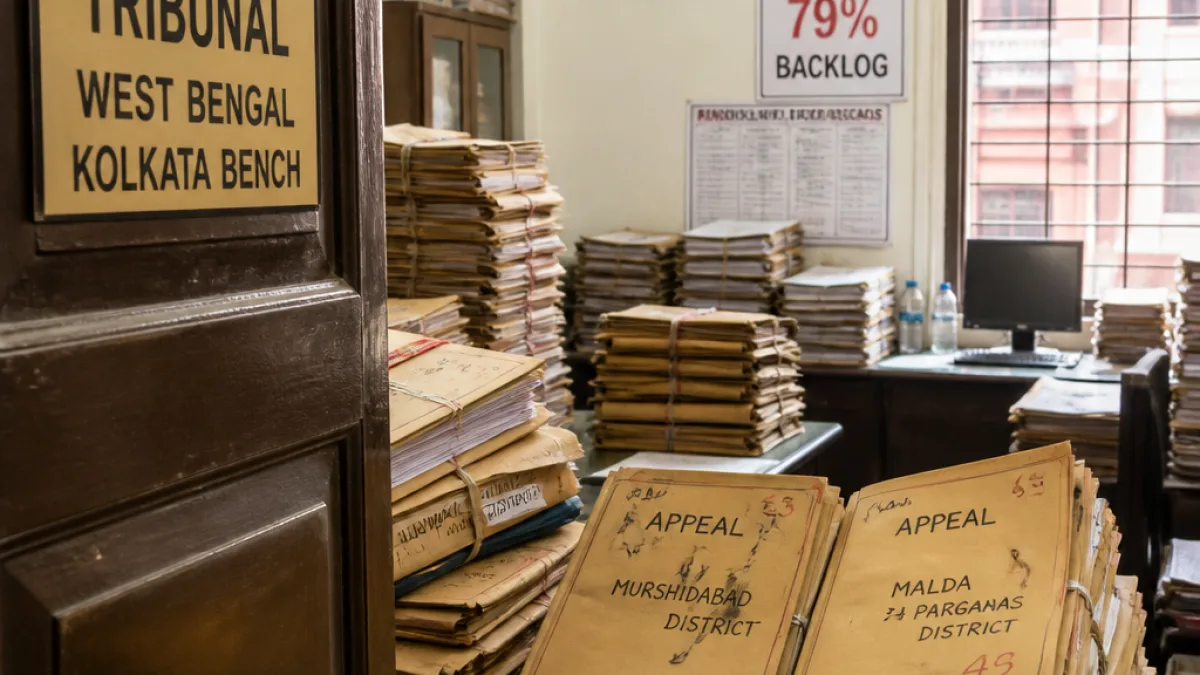
The Election Commission (EC) has informed the Supreme Court that Appellate Tribunals set up to hear objections during the West Bengal Special Summary Revision (SIR) have disposed of less than 3% of the total appeals received, leaving more than 97% undecided, according to an affidavit filed on September 16.
Statewide backlog runs into lakhs
In the affidavit, the EC said a cumulative 38,20,683 appeals were submitted before Appellate Tribunals across West Bengal during the SIR exercise. Of these, only 1,02,231 appeals — approximately 2.68% — have been disposed of, while 37,18,452 remain pending. The Commission did not provide a breakdown distinguishing appeals lodged by those seeking inclusion versus appeals filed by third parties against inclusions.
The affidavit was placed before a three-judge bench of the Supreme Court comprising Chief Justice of India Surya Kant, Justice Joymalya Bagchi and Justice V. Mohana, which is hearing litigation connected to the West Bengal SIR process.
District data shows uneven disposal rates
District-wise returns supplied in the EC affidavit indicate stark disparities in the rate of disposal by tribunals. Some districts recorded extremely low numbers of resolved matters compared with appeals filed, while a few showed higher disposal counts.
- Highest caseloads: Murshidabad (7,47,921 appeals), Malda (5,31,345) and North 24 Parganas (3,59,375) recorded some of the largest numbers of appeals submitted.
- Low disposal ratios: Several districts have disposed only a few hundred or a few thousand appeals despite substantive filings.
- Exceptions: Some districts such as South 24 Parganas and Hooghly show comparatively higher numbers of disposed matters, though pending figures remain substantial.
| District | Total Appeals Submitted | Total Appeals Disposed | Total Appeals Pending |
|---|---|---|---|
| Murshidabad | 7,47,921 | 514 | 7,47,407 |
| Malda | 5,31,345 | 1,514 | 5,29,831 |
| North 24 Parganas | 3,59,375 | 301 | 3,59,074 |
| Paschim Bardhaman | 64,829 | 934 | 63,895 |
| Total (State) | 38,20,683 | 1,02,231 | 37,18,452 |
Petitioners' earlier assertions not bifurcated by EC
At an earlier hearing, petitioners had relied on Right to Information (RTI) data to assert that a majority of appeals — over 80% — were filed by third parties challenging inclusions in the voters' lists, while appeals by those asserting wrongful exclusion constituted roughly 20%. The EC's affidavit to the court, however, did not supply segregated numbers showing how many appeals were lodged opposing inclusions and how many sought restoration of names.
The absence of a bifurcated breakdown prevents the court and litigants from assessing whether the pendency disproportionately affects one category of appellants, a point central to arguments about potential disenfranchisement and the efficacy of remedial mechanisms.
Practical implications ahead of elections
The large unresolved caseload has direct implications for voters and election management in West Bengal. Pending appeals in Appellate Tribunals typically relate to disputed entries or omissions from electoral rolls — matters that determine who is eligible to vote in a constituency. Prolonged delays in adjudication can leave prospective voters uncertain about their enrolment status and limit the correction of errors well before polling.
The Supreme Court had previously issued directions to the Election Commission relating to the SIR process. The current affidavit adds urgency to ongoing judicial scrutiny by illuminating the scale of arrears before tribunals, and the Commission may be expected to answer on steps to accelerate adjudication and ensure that final rolls are reliable for future elections.
The bench continues to hear petitions challenging various aspects of the SIR exercise and will take up the matter with the new data on the next dates of hearing.