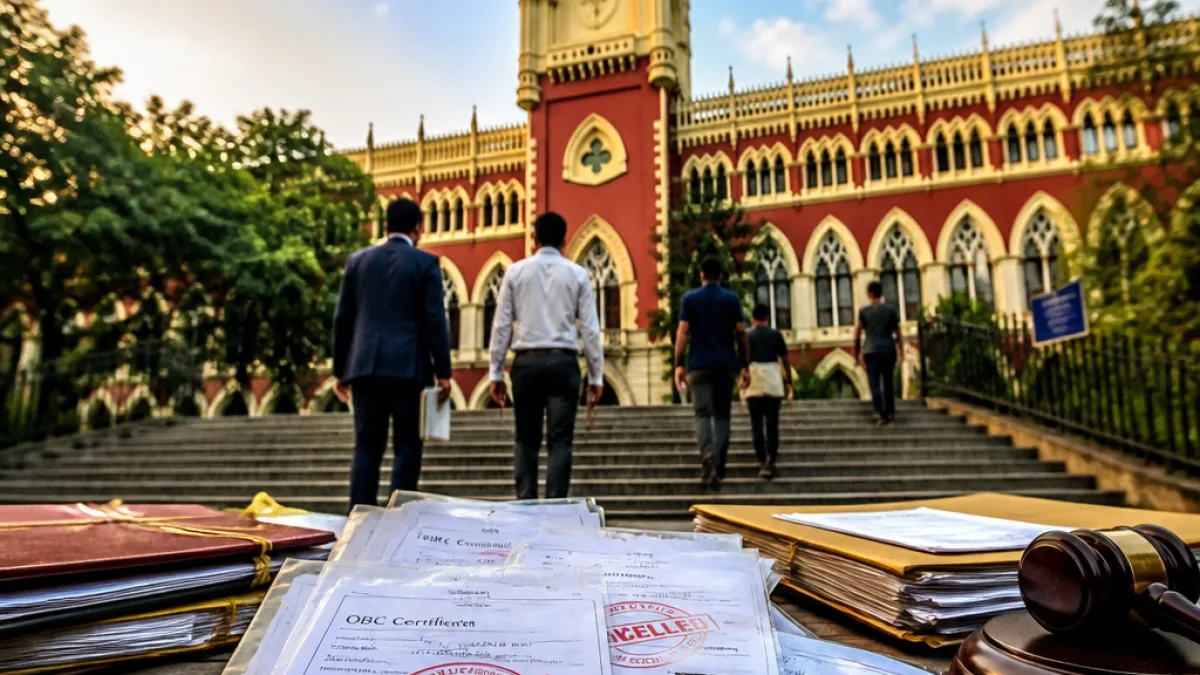
Kolkata: The Calcutta High Court on Wednesday directed cancellation of all Other Backward Classes (OBC) certificates issued under the revised rules notified by the previous Trinamool Congress government in 2025 that introduced the categories OBC-A and OBC-B. The division bench of Justices Rajasekhar Mantha and Anuj Singh observed that the classification has ceased to exist after it was abolished by the present state administration, and that certificate-holders under those categories must now be treated as general category.
Order arose from a JEE-Mains candidate’s petition
The bench’s remarks came while hearing a writ petition filed by Shreyasi Dhang, a candidate who had applied for admission to nursing-paramedical courses through the Joint Entrance Examination (JEE Mains-UG). Dhang appeared in the JEE Mains earlier this year and when results were published on 27 July 2026, she found her name placed in the general category instead of OBC and sought judicial relief.
During the hearing on Wednesday the court said that all certificates issued in OBC-A and OBC-B categories since the 2025 notification would be regarded as cancelled. The division bench noted that, following the administrative change effected by the current government, the separate classification no longer subsists.
Administrative and practical consequences
The ruling has immediate implications for students, job applicants and others who secured benefits or submitted applications on the basis of the OBC-A/B classification. Those whose certificates were issued between 8 May and 12 June 2025 under the state notification now face altered status for reservation and merit-list purposes.
Education institutions, recruiting authorities and examination boards will need to decide how to treat cases where selection, allotment or reservation was determined using the OBC-A/B categorisation. Until affected authorities issue stand-alone directions or the state files a review or appeal, the High Court order will govern legal status.
Timeline
| Date / Period | Event |
|---|---|
| 8 May – 12 June 2025 | OBC certificates issued in OBC-A and OBC-B categories under the 2025 notification |
| 27 July 2026 | JEE Mains-UG results published; petitioner's name shown in general category |
| 12 August 2026 (hearing) | Division bench ordered cancellation of certificates issued under OBC-A and OBC-B |
What authorities and affected persons should consider
- Students and applicants who received OBC-A/B certificates should check the status of their applications and merit lists with respective examination boards and institutions.
- Recruitment and admission authorities may have to re-examine lists and allocations where reservation was applied based on the abolished classification.
- The state government could choose to challenge the order or issue clarificatory instructions; affected persons may also seek individual reliefs in appropriate forums.
The court’s decision is an interpretation of the legal effect of administrative changes made after the 2025 notification. It hinges on the fact that the separate OBC-A and OBC-B categories were subsequently abolished by the incumbent administration, rendering certificates issued under that split classification inconsistent with the current statutory or administrative framework, the bench indicated.
Political and social sensitivity
Caste certification and reservation are politically sensitive issues in West Bengal, shaping educational and employment access for many communities. The 2025 move to create OBC-A and OBC-B was a significant administrative shift when introduced, and its subsequent reversal has produced immediate legal and practical fallout now being addressed in the High Court.
How the state implements the court’s direction — whether it announces transitional arrangements, reinstates a uniform OBC certificate, or seeks to defend the earlier classification in higher courts — will determine the scale and duration of disruption for applicants and beneficiaries.
For now, institutions processing admissions and recruitment are advised to await formal communication from the court registry or the state before taking unilateral steps that could affect candidates’ entitlements.
The case highlights the overlap of administrative policy changes and judicial review in a state where reservation policy frequently shapes public discourse. The Calcutta High Court has set the immediate legal position; further developments will depend on actions by the state government and any further judicial proceedings.