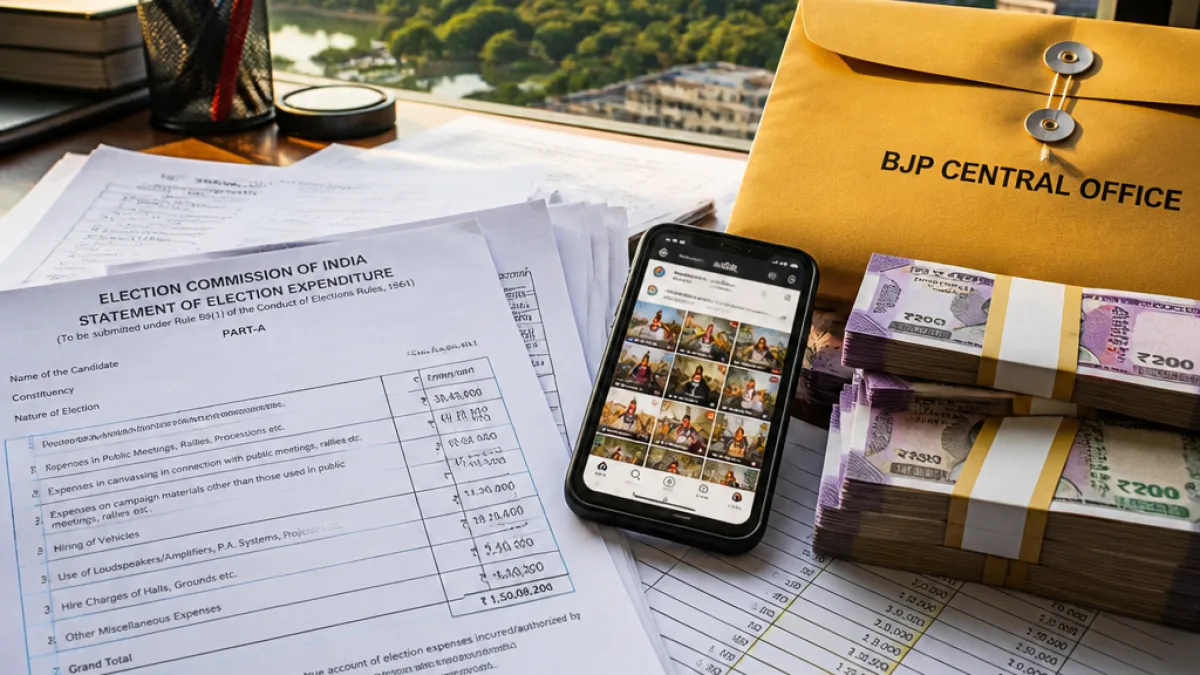
Kolkata: Financial statements submitted to the Election Commission reveal that the Bharatiya Janata Party’s central office paid a total of ₹55.76 crore to 36 social media personalities as part of its campaign activity during the recent West Bengal Assembly polls, the filings show. The disclosures form part of a larger return that puts the party’s total expenditure in the state at ₹286.99 crore.
Details from Election filings
The payments to influencers were recorded in the party’s expenditure statements filed with the Election Commission, covering the period of intensive campaigning for the Assembly elections. According to the filings, the payments to these digital content creators were made by the BJP’s central unit in New Delhi between 15 March and 6 May.
The returns list a range of amounts paid to individual creators. Among the names disclosed, actor and YouTuber Sayak Chakraborty was paid ₹2.5 lakh. Sayak, who became the centre of media attention after an altercation at a Park Street restaurant on 30 January, has said he made content for the BJP because the party had supported him after the incident.
“The incident at the restaurant was on January 30 and was an instant reaction. There was no politics. Many parties approached me to make content after the incident, but I only agreed to BJP as they supported me during the incident,” he said in a social media post, as reported in the filings.
Another disclosed payee, vlogger Shamik Adhikary (known online as @Nonsane), received ₹13 lakh, according to the documents. The filings describe the recipients as social media personalities who produced content used in the party’s communications in the run-up to polling.
Context and implications
Election spending by political parties on advertising and promotional activity, including payments to media and influencers, must be reported under the Model Code and the Representation of the People Act. The BJP’s returns show substantial outlays on digital outreach across West Bengal, reflecting the growing role of social platforms in electoral mobilisation.
Critics have questioned whether paid content by prominent online personalities can blur the line between journalism, opinion and political advertising. The Trinamool Congress has alleged that some narratives—citing the Park Street episode in Kolkata as an example—were orchestrated to stoke communal tensions and that payments were an inducement to manufacture such narratives; the party has pointed to the Election Commission disclosures in making the charge.
Payments and timeline at a glance
- Total paid to influencers: ₹55.76 crore
- Number of personalities listed: 36
- BJP’s total reported expenditure in WB: ₹286.99 crore
- Period of disclosed payments: 15 March–6 May
| Payee | Amount (₹) | Notes |
|---|---|---|
| Sayak Chakraborty | 2,50,000 | Actor, YouTuber; linked to Park Street incident (30 Jan) |
| Shamik Adhikary (@Nonsane) | 13,00,000 | Popular vlogger; active on YouTube |
Election returns examined for this report provide the figures above; other named recipients and amounts are detailed in the full disclosures lodged with the Election Commission, which are now in the public domain.
Reactions and what follows
Political parties and observers will closely scrutinise the detailed return to assess compliance with election expenditure rules and the nature of the content produced under these arrangements. The disclosures are likely to prompt questions about transparency in the funding of digital campaigns, and whether paid material was adequately identified as political advertising under election law.
In West Bengal’s charged political environment—where social media narratives have frequently intersected with street-level incidents and communal flashpoints—the new details add a financial dimension to debates about accountability and the ethics of paid influencer campaigns during elections.
Further inquiries into the contractual terms, scope of content and whether such pieces were clearly labelled as paid political material would typically involve the Election Commission and, where required, local enforcement agencies. The filings themselves do not contain the full text of contracts or the editorial control exercised in creating the material; they record payment entries as part of the party’s declared poll expenditure.
As the state moves on from polling, the disclosures are likely to feature in political arguments and could spur broader calls for clearer rules on digital political advertising and stricter disclosure norms.