Students say refusal could affect internal marks; principal cites state order
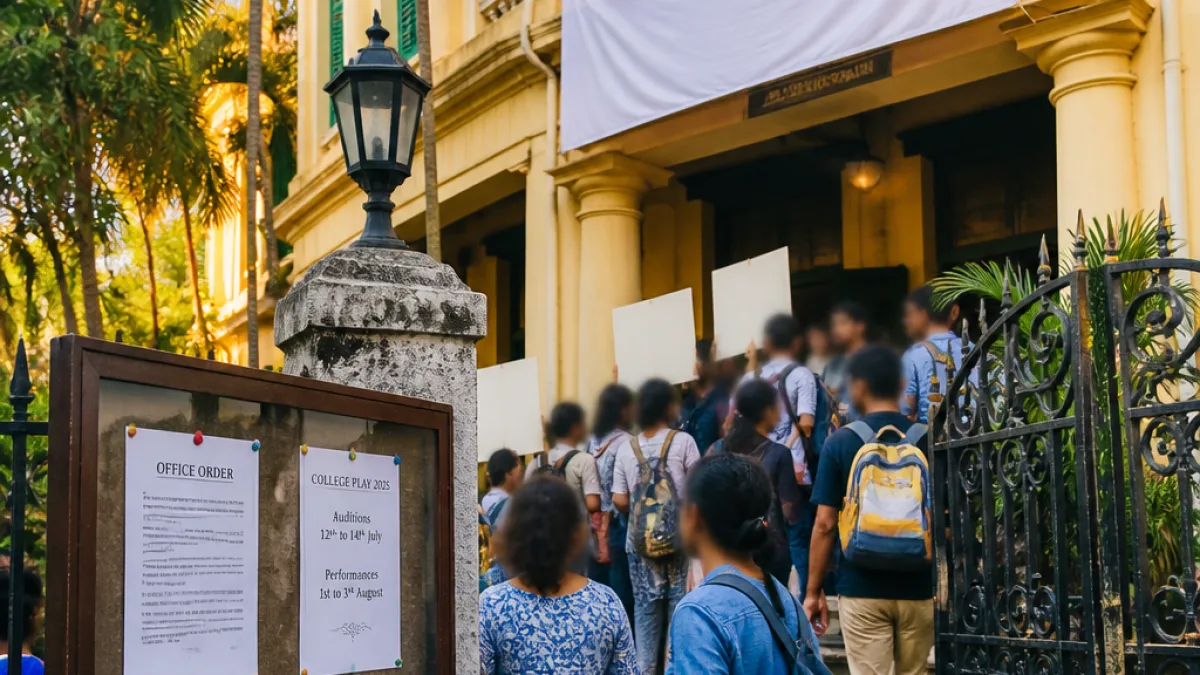
A section of students at Scottish Church College in Kolkata on Saturday alleged that they were threatened with adverse consequences if they did not take part in a play titled "Namo Seva — Untold Stories", which the college plans to stage during a month of programmes marking the Prime Minister's birthday.
Students associated with the college drama club told reporters that they were repeatedly urged to participate in the production, which they said contains political references and appeals to the audience to raise the slogan "Jai Shri Ram". One student alleged that internal examination marks and project assessments could be affected if they declined to join the play.
Principal Madhumanjari Mandal denied the coercion charge, telling PTI on Saturday that participation was voluntary. She said the college was following directions issued by the State Higher Education Department to commemorate Prime Minister Narendra Modi's birthday and his years in public service.
"We had to follow the order of the Higher Education Department to commemorate the birthday of the Prime Minister and his years of public service," the principal said, according to PTI.
The planned activities form part of the State government's Seva Sankalp Abhiyan, scheduled between September 17 and October 10, during which state-run higher educational institutions have been asked to stage the play and organise drawing and elocution competitions for students. The Scottish Church production is listed to be staged at the college auditorium on September 29, the students said.
Political reactions and policing
The issue drew wider attention when Vishwa Hindu Parishad (VHP) national spokesperson Vinod Bansal posted a news clipping on X, asking whether the slogan "Jai Shri Ram" was being banned in Kolkata colleges and tagging the Kolkata Police and the West Bengal Chief Minister. The post sought official attention to the students' allegations.
There has been no public statement from the Kolkata Police cited in the reports and the college administration reiterated that the institutional calendar had listed a series of programmes between September 17 and October 6 to mark the Prime Minister's birthday month in line with departmental instructions.
Context and implications for campus autonomy
The dispute highlights tensions between institutional autonomy and state directions to government-run colleges. While the principal framed the events as compliance with a State Higher Education Department order, students raised concerns about the voluntariness of participation and potential academic consequences for dissent.
Student concerns about curricular and co‑curricular imposition can have lasting effects on campus climate, especially when events intersect with partisan slogans and religiously charged expressions. The controversy comes ahead of the scheduled staging at a historic Kolkata college that has a long tradition of cultural and political engagement.
- Event: Play titled "Namo Seva — Untold Stories"
- College: Scottish Church College, Kolkata
- Allegation: Students say they were warned their marks and assessments could be affected
- Principal's stance: Participation voluntary; following State Higher Education Department directions
- Scheduled date: 29 September
| Item | Detail |
|---|---|
| Seva Sankalp Abhiyan window | 17 September – 10 October |
| College programme dates (as stated) | 17 September – 6 October |
| Play scheduled at college | 29 September |
The principal's remarks were carried by PTI; students' accounts were reported in media coverage of the episode. No independent corroboration of the alleged threats to marks and project assessments was provided in initial reports, and the college has not released a formal written statement beyond the principal's comments to PTI.
As the controversy develops, the key questions for Kolkata's academic community centre on how state directives are implemented in campuses and the safeguards in place to ensure that participation in government‑encouraged programmes remains genuinely voluntary and non‑punitive.