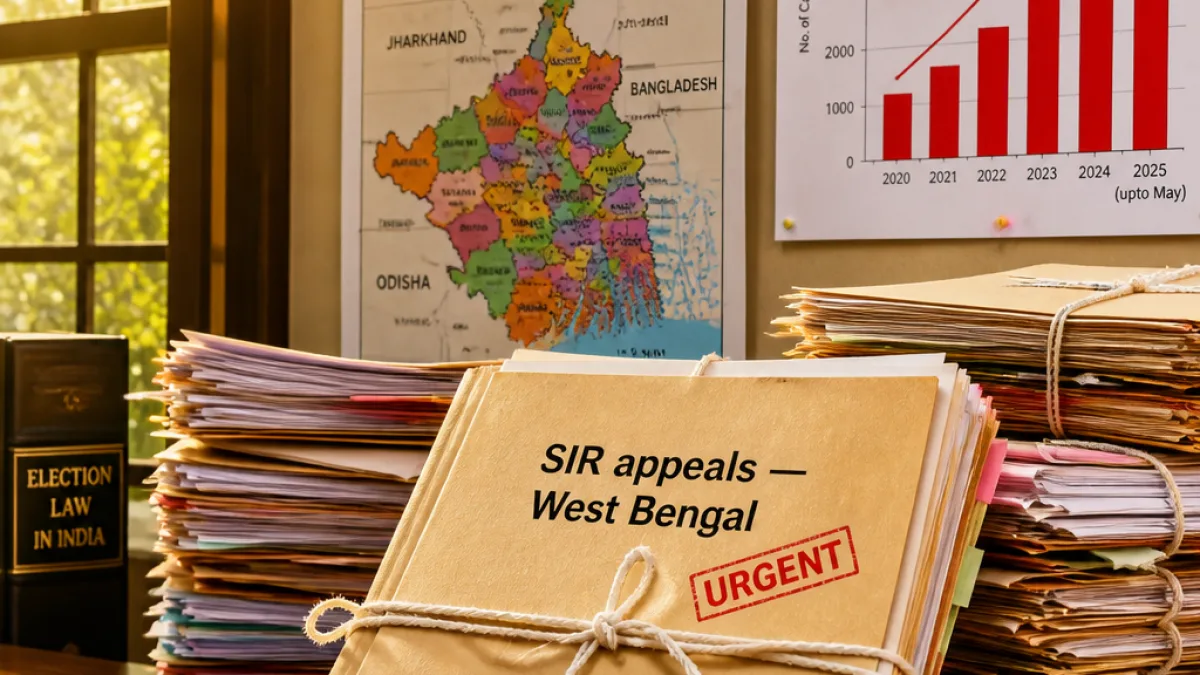
New Delhi/Kolkata: The Supreme Court on Tuesday directed the Election Commission (EC) to furnish comprehensive data on the pendency and disposal of appeals filed before appellate tribunals contesting inclusion or exclusion from electoral rolls after the Special Intensive Revision (SIR) conducted in West Bengal.
Bench seeks segregation of appeals and tribunal capacity details
A three-judge bench comprising Chief Justice Surya Kant and Justices Joymalya Bagchi and V Mohana asked the poll body to state, in a detailed affidavit, how many appeals are pending, how many have been decided and how many of the filings relate to the original applicants whose names were deleted or added as against cross appeals, according to a PTI report.
The court also directed the EC to explain what steps it is taking to streamline the appellate mechanism and to spell out whether additional tribunals need to be constituted to deal with the backlog.
Senior counsel Kalyan Banerjee, representing petitioners, told the bench that reliable data on the number and disposal of appeals is not available in the public domain and conveyed figures from 31 Assembly constituencies. The court said it would not limit the exercise to those seats and that its concern extends to all constituencies in the State.
“Let the Election Commission file a reply specifying how many appeals are pending before Tribunals. The pending appeals be segregated, and it may be disclosed as to how many appeals at the instance of voters who were excluded/included or their cross appeals,” the bench said.
Petitioners point to lack of transparency and looming local polls
Petitioners argued that the absence of clear, accessible statistics has practical implications: people whose names were removed in the SIR will be unable to vote in imminent municipal and panchayat elections unless their cases are resolved. Another counsel, Gopal Sankaranarayanan, cited an RTI reply given to a Member of Parliament and described the information as "appalling," saying many appeals before SIR appellate tribunals may not even be from excluded voters.
Senior advocate D S Naidu, appearing for the Election Commission, informed the court that the poll panel has been coordinating with appellate tribunals to explore methods for improving the appeal-disposal process, but the hearing record in the available report trails off mid-sentence on the EC's submission.
What the court has asked the EC to provide
- Number of appeals pending before appellate tribunals arising from West Bengal SIR.
- Breakdown of appeals: filed by excluded/included voters and cross appeals.
- Number of appeals disposed and the time taken for adjudication.
- Assessment of additional tribunals needed and steps to expedite disposal.
The bench warned that if existing tribunals cannot clear the backlog in a time‑bound manner, the court may consider constituting more tribunals to ensure prompt adjudication.
Context and local impact
The SIR exercise in West Bengal — aimed at updating electoral rolls — has been contentious, with multiple petitions challenging deletions and inclusions. Timely adjudication of tribunal appeals is crucial because pending cases can disenfranchise voters in upcoming municipal and panchayat polls if their names remain deleted at the time of voting.
Legal experts say that appellate tribunals formed to hear SIR-related matters must balance speedy disposal with procedural fairness; delays risk both denial of franchise and administrative arbitrariness. The Supreme Court’s demand for granular data seeks to assess whether the current infrastructure is adequate to uphold voters’ rights within electoral timelines.
| Item | What SC asked the EC to disclose |
|---|---|
| Pending appeals | Number and segregation by applicant type |
| Disposals | How many decided and time taken |
| Tribunal capacity | Whether additional tribunals required |
Practically, petitioners and civil-society groups have been seeking transparency on the SIR process. The court’s direction, if implemented with detailed disclosures, could provide clarity to affected voters and political stakeholders across the State.
The matter returned to the Supreme Court amid representations that municipal and panchayat elections are approaching, increasing urgency. The bench emphasised that appeals must be decided within a timeframe so that electoral participation is not compromised.
The EC will now prepare and file the specified reply in the apex court, setting out the pendency, disposal metrics and any plan for constituting additional appellate tribunals if needed.
Reporting for West Bengal from New Delhi and Kolkata.